The Ultimate Range Hack: How a Simple Wheel Swap Unlocked 25% More Efficiency for the Tesla Model S Plaid
For all its mind-bending, 1,020-horsepower acceleration, the Tesla Model S Plaid has always harbored a dirty secret: its appetite for electrons. When ...
Editorial Team
World Of EV
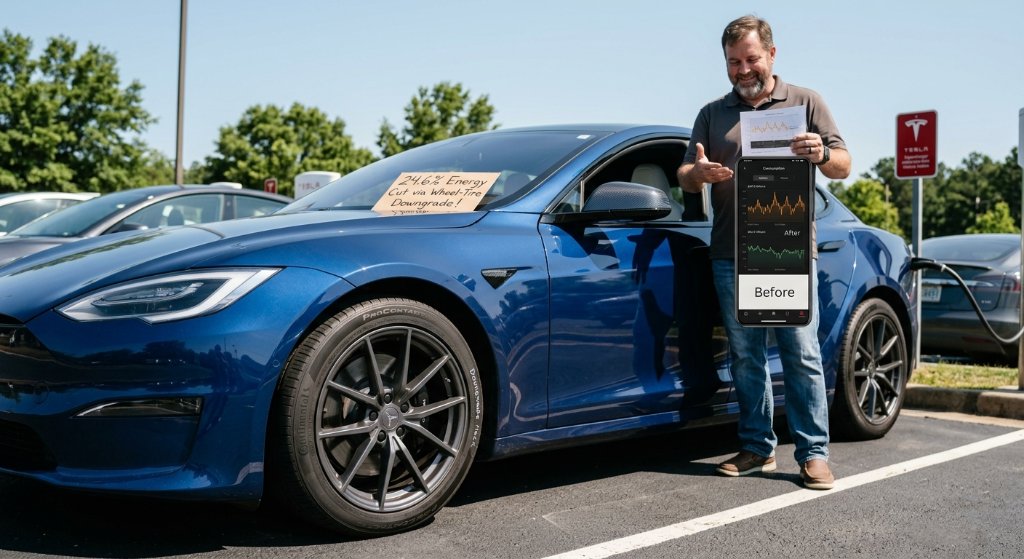
For all its mind-bending, 1,020-horsepower acceleration, the Tesla Model S Plaid has always harbored a dirty secret: its appetite for electrons. When equipped with massive, sticky performance wheels, the Plaid’s real-world highway range can take a devastating hit, leaving owners to choose between aesthetic muscle and road-trip endurance. However, an Alabama-based Plaid owner has just shattered the notion that you have to live with mediocre efficiency, proving that a calculated wheel and tire swap can yield jaw-dropping improvements.
By shedding excess rotational mass and optimizing aerodynamics, Reddit user u/bubbafrombama demonstrated how transitioning from heavy 20-inch wheels to a highly optimized 19-inch aftermarket setup fundamentally transformed the car's efficiency. This real-world test highlights a crucial and often overlooked reality in the EV era: wheel design and tire compound choices matter far more than they ever did in gas-powered cars.
The Math Behind the 25% Efficiency Jump
In the world of internal combustion engines, upgrading wheels is usually about style or shaving fractions of a second off a lap time. In an EV, it is a game of physical optimization. The Alabama-based owner swapped out their previous 20-inch wheel setup for 19-inch Atomic AWZZ wheels wrapped in Continental ProContact RX tires. The results were immediate and staggering:
- Energy Consumption Plunged: Energy usage dropped from a heavy 347.4 watt-hours per mile (Wh/mi) down to a highly efficient 262.0 Wh/mi—an approximate 24.6% increase in overall efficiency.
- Massive Range Extension: On a standard 100 kWh Tesla battery pack, this efficiency gain theoretically extends the vehicle's real-world driving range from roughly 288 miles to over 380 miles on a single charge.
- Financial Savings: The swap yields an estimated savings of $2.56 per 100 miles driven. Over a typical 15,000-mile driving year, that translates to $384 back in the owner's pocket.
- Enhanced Comfort: Beyond the raw numbers, the owner reported a significantly quieter cabin, thanks to the noise-dampening characteristics of the Continental ProContact RX tires and the thicker sidewalls of the 19-inch setup.
The Physics of the Downsize: Why Smaller is Smarter
To understand why this modification was so wildly successful, we must look at the historical compromises Tesla forces on its buyers. When purchasing a Model S, Tesla offers 19-inch Tempest wheels or optional 21-inch Arachnid wheels. The EPA range difference between the two is stark: choosing the 21-inch wheels instantly slashes the car's estimated range from 402 miles to 348 miles.
Larger wheels act as heavy flywheels. They require more energy to accelerate, have wider contact patches that increase rolling resistance, and feature open spoke designs that create aerodynamic turbulence. By stepping down to 19-inch Atomic AWZZ wheels—which are specifically engineered to slice through the air—and pairing them with a low-rolling-resistance touring tire like the Continental ProContact RX, the owner minimized both aerodynamic drag and rotational inertia.
Why This Matters:
This DIY efficiency breakthrough signals a profound shift in the EV aftermarket industry. For decades, car customization was defined by "performance tuning"—adding louder exhausts, wider tires, and stiffer suspensions. Today, we are witnessing the birth of "efficiency tuning."
The Winners: EV owners who prioritize long-distance grand touring over racetrack performance. By making a simple hardware swap, drivers can bypass factory compromises and tailor their vehicles for maximum range. Additionally, aftermarket wheel manufacturers like Atomic, who prioritize aerodynamic efficiency over purely aggressive styling, stand to capture a massive, highly lucrative market of range-anxious EV buyers.
The Losers: Traditional aftermarket wheel companies who rely on heavy, open-spoke legacy designs. If wheel manufacturers do not adapt to the aerodynamic demands of electric vehicles, they will quickly become obsolete.
The Crucial Trade-off: There is no free lunch in automotive engineering. While the owner unlocked incredible efficiency and cabin quietness, wrapping a 1,020-horsepower hyper-sedan in low-rolling-resistance touring tires will inevitably degrade lateral grip and hard braking performance. If you intend to launch your Plaid from 0-60 mph in under two seconds on a regular basis, these tires will struggle to find traction. However, for 95% of daily driving and highway cruising, this is a compromise most drivers would make in a heartbeat.
Conclusion
As electric vehicles continue to dominate the market, the definition of automotive optimization is being rewritten. This Model S Plaid owner has successfully demonstrated that the aftermarket can beat factory efficiency ratings without sacrificing the premium nature of the vehicle. For prospective EV buyers and current owners alike, the lesson is clear: if you want to unlock your vehicle's true range potential, look past the battery pack and start looking at what meets the road.