The Sovereign Microgrid: How Your EV is Key to Grid Independence
EVs are no longer just tools for decarbonizing transportation—they are becoming the centerpiece of a decentralized domestic energy revolution. For yea...
Editorial Team
World Of EV
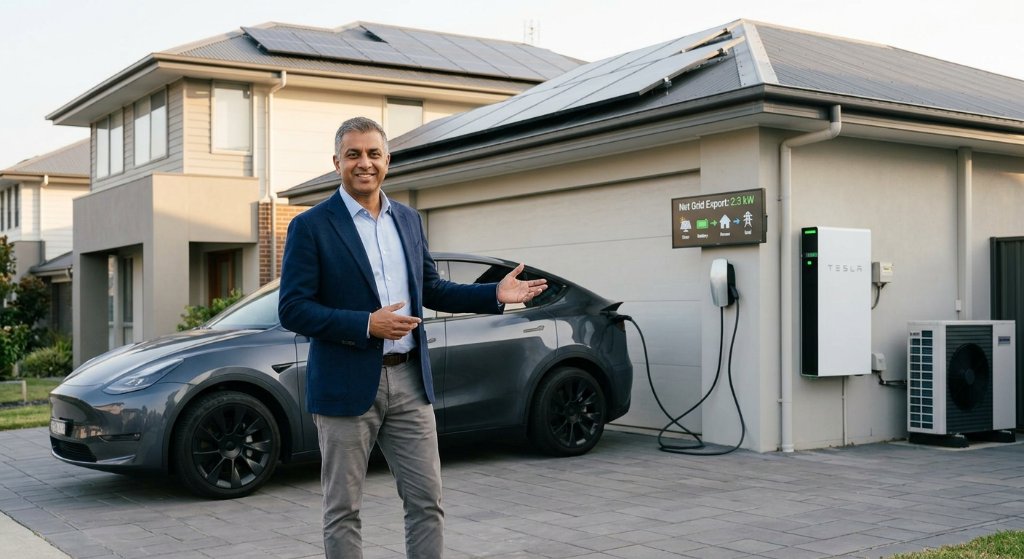
EVs are no longer just tools for decarbonizing transportation—they are becoming the centerpiece of a decentralized domestic energy revolution. For years, utility skeptics argued that electric cars would overload local power grids. Instead, pioneering owners are proving the exact opposite: when integrated correctly, EVs act as powerful mobile batteries capable of stabilizing, and even powering, the grid itself.
Take Abyd Karmali, Managing Director and Environmental Business Advisory at Bank of America. Since purchasing his first EV in 2015—a time when public charging was a gamble and vehicle-to-grid (V2G) was a distant dream—Karmali has transformed his personal infrastructure. By linking his EV with home solar, battery storage, and an air-source heat pump, he has bypassed traditional utility dependency to become a net exporter of clean power. His journey offers a masterclass in how EV ownership is evolving from a transport choice into a comprehensive lifestyle ecosystem.
Building the Ultimate Home Microgrid
Karmali’s setup illustrates how the synergy of multiple clean-energy technologies creates a system far greater than the sum of its parts. Rather than viewing the electric vehicle as a passive energy drain, this holistic approach positions the vehicle as a key flexible load and storage asset.
The core pillars of this modern, self-sustaining home microgrid include:
- Solar PV Generation: Harvesting free, zero-emission electricity directly from the roof to charge the vehicle and power the home.
- Stationary Battery Storage: Capturing excess daytime solar generation, ensuring that the household remains self-sufficient during evening peak-demand hours.
- Air-Source Heat Pumps: Replacing inefficient fossil-fuel heating systems with highly efficient electrified climate control, further lowering the home's overall carbon footprint.
- Smart Energy Arbitrage: Utilizing the EV's substantial battery capacity to shift energy consumption away from high-tariff grid times, and occasionally exporting excess power back to local utilities for profit.
The Shift from Transport to Grid Asset
When Karmali began his EV journey in 2015, early adopters faced bare-bones charging networks and vehicles with modest battery capacities. Fast forward to today, and the conversation has completely shifted. The modern EV is essentially a rolling grid asset. With the average battery pack size now hovering around 70-100 kWh, a single EV contains enough energy to power an average, efficient household for several days.
Automakers are rapidly capitalizing on this reality. We are seeing a massive push into native Vehicle-to-Home (V2H) and Vehicle-to-Load (V2L) capabilities from brands like Hyundai (with its E-GMP platform) and GM (via its GM Energy division). This technological leap turns the vehicle into an active participant in home energy management, protecting consumers against rising utility rates and grid instability.
Why This Matters:
- The Power Shift to Automotive OEMs: Automakers are transitioning from simple manufacturing companies into fully integrated energy providers. By selling home chargers, solar panels, and stationary storage alongside vehicles (similar to Tesla’s ecosystem or GM Energy), OEMs are unlocking lucrative, recurring revenue streams that extend far beyond the initial vehicle sale.
- Virtual Power Plants (VPPs) Go Mainstream: As more owners adopt Karmali’s blueprint, utilities are losing their centralized monopoly. Instead, aggregators are linking thousands of decentralized home batteries and EVs to form Virtual Power Plants. These VPPs can feed energy back into the grid during peak strain, preventing blackouts and rendering dirty fossil-fuel 'peaker' plants obsolete.
- The Ultimate Consumer Win: The financial incentive is shifting from merely 'saving on gas' to achieving complete domestic energy sovereignty. By acting as a net exporter of energy, the modern EV owner is turning what was once a depreciating mobility asset into an active revenue generator.
Conclusion
Karmali’s decade-long experience demonstrates that the 'sustainability life hacks' of early adopters are quickly becoming the standard blueprint for the modern homeowner. As global electrical grids face unprecedented strain from extreme weather and increased demand, the integration of EVs, solar, and residential storage is no longer just an environmental statement. It is a highly rational, economically advantageous strategy for energy independence. The future of motoring isn't just about driving past the gas station—it's about powering the grid.