The Ignorance Chasm: How a New Tesla Model 3 Performance Owner Exposed the Ultimate EV Education Gap
While electric vehicles dominate modern automotive headlines, a massive chasm of misinformation still separates real-world owners from legacy internal...
Editorial Team
World Of EV
While electric vehicles dominate modern automotive headlines, a massive chasm of misinformation still separates real-world owners from legacy internal combustion engine (ICE) loyalists. This cultural divide was recently laid bare by a new Tesla Model 3 Performance owner who transitioned directly from the traditional, enthusiast-driven "car guy" scene. Their conclusion? A pervasive "culture of self-perpetuating ignorance" dominates the anti-EV echo chamber, keeping prospective buyers locked out of a vastly superior driving and ownership experience.
To understand this shift, one must look at the rapid evolution of the EV market. Early adopters had to tolerate serious compromises—much like buyers of Mazda's ill-fated, low-range MX-30. But just as battery technology has leaped from sluggish early chemistries to structural 4680 cells and ultra-dense BYD Blade batteries, vehicle manufacturing has matured dramatically. The refreshed "Highland" Model 3 Performance, boasting 510 horsepower and a 2.9-second 0-60 mph time, stands as a prime testament to this manufacturing maturation, yet traditional enthusiast circles remain trapped in a time capsule of outdated talking points.
Dismantling the Legacy ICE Myths
Writing to the EV community, the owner detailed how hands-on experience shattered the myths they had ingested from online enthusiast forums. The gap between keyboard-warrior rhetoric and real-world engineering is wider than ever. Here is how the most common anti-EV tropes stacked up against actual ownership:
- The "Flimsy" Build Quality Myth: While early Tesla models suffered from production growing pains, the updated Model 3 Performance features heavily bolstered sports seats, acoustic glass, and a tightly screwed-together interior that rivals established European luxury brands.
- The "Hours at the Charger" Myth: Skeptics routinely claim that charging an EV paralyzes your day. In reality, modern Superchargers replenish hundreds of miles of range in the time it takes to grab a coffee, while the vast majority of charging happens passively.
- The "Instant Battery Drain" Myth: Critics often assert that using the car's performance capability immediately drains the battery. The owner noted the absurdity of this claim, pointing out that high-displacement V8s are never held to the same ridiculous standard of fuel efficiency during spirited driving.
The Ultimate Ownership Life Hack: Charging At Home
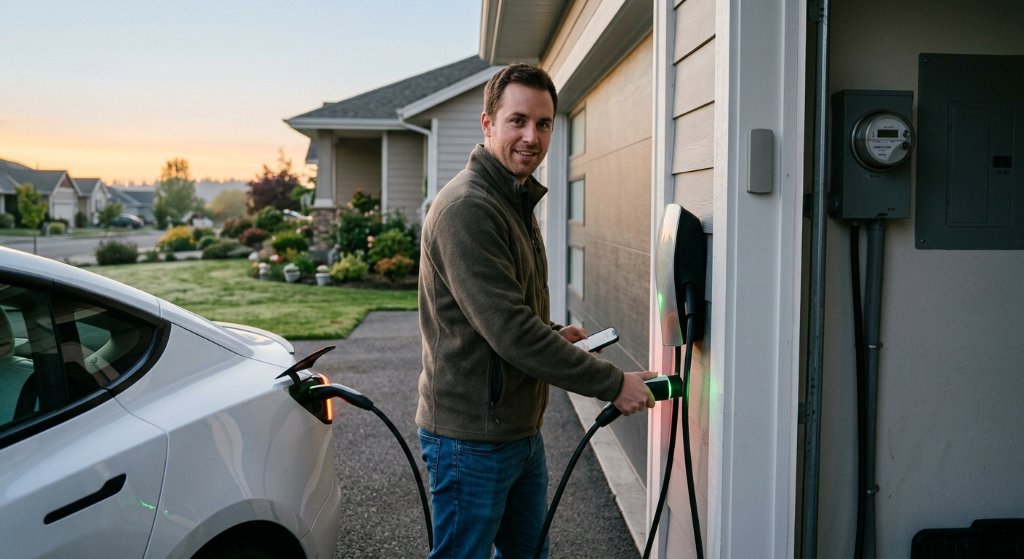
For those transitioning from gas-powered vehicles, the fundamental shift in "refueling" behavior remains the hardest concept to grasp. Legacy drivers are conditioned to drive until empty, then seek out a public station. The new Model 3 owner highlighted their primary ownership life hack: simply plugging the vehicle into a home charger overnight.
By treating the EV like a smartphone—plugging it in at night and waking up to a fully charged battery—the owner completely bypassed the gas station experience. Even better, this simple shift slashed their fuel costs to roughly one-sixth of what they previously spent on gasoline. This transition highlights a key truth: the convenience of an EV doesn't come from public infrastructure, but from eliminating the errand of fueling altogether.
Why This Matters:
This clash of perspectives signals a critical bottleneck for the entire automotive industry. The barrier to mass EV adoption is no longer a failure of engineering or battery chemistry; it is a failure of education.
- Who Wins: Tesla and other vertically integrated EV manufacturers (like Rivian and Hyundai) who can bypass traditional dealership networks. Dealerships often struggle or actively resist selling EVs due to lower service revenues, further starving the public of accurate information.
- Who Loses: Legacy automakers who rely on dealership-driven education and traditional marketing. If legacy brands cannot break through this "ignorance gap," their multi-billion-dollar EV transitions will stall on dealer lots, regardless of how good their engineering is.
- The Strategic Shift: This owner's experience proves that the industry must stop marketing EVs solely as "green" alternatives. Instead, manufacturers must focus on the absolute convenience and economic dominance of home charging to win over the masses.
Conclusion
Ultimately, the transition from gas to electric is less about the car itself and more about a mental shift. As more traditional car enthusiasts cross the aisle and experience the reality of modern EVs like the Model 3 Performance, the wall of self-perpetuating ignorance will inevitably crumble. The future belongs to those who plug in, wake up fully charged, and leave the gas station in their rearview mirror.