The Hardware Divide Widens: Tesla's Major 2026 Summer Update Pushes AI4 Forward, Relegating HW3 to 'Lite' Status
The widespread rollout of Tesla's massive 2026 Summer Software Update (version 2026.26.6.5) marks a pivotal moment for the electric vehicle pioneer, b...
Editorial Team
World Of EV
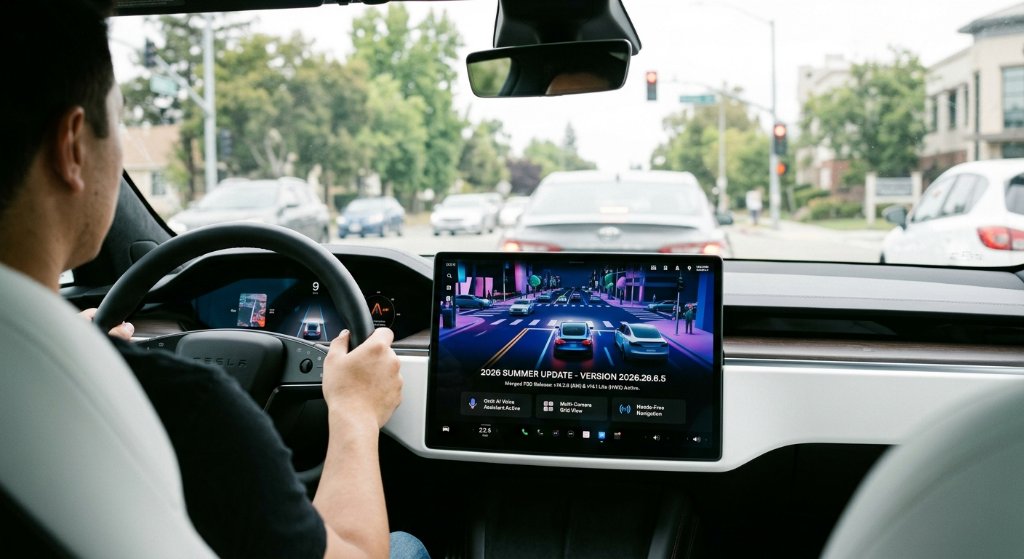
The widespread rollout of Tesla's massive 2026 Summer Software Update (version 2026.26.6.5) marks a pivotal moment for the electric vehicle pioneer, but it comes with a sobering reality check. By merging its latest lifestyle-focused Summer features with the heavy-hitting Full Self-Driving (FSD) v14 suite, Tesla is demonstrating the sheer power of its over-the-air ecosystem. However, the update also exposes a widening and uncomfortable technical gap within the fleet, drawing a sharp line between newer and older vehicles.
For years, Tesla and Elon Musk assured buyers that Hardware 3 (HW3)—introduced back in 2019—would be fully capable of achieving unsupervised Level 5 autonomy. But this summer, that narrative faces a reckoning. While vehicles equipped with Tesla's newer AI4 computing suite are treated to the highly capable FSD v14.3.8, older HW3 vehicles are receiving a severely constrained version dubbed FSD v14.1 "Lite". This bifurcated rollout reveals that the technical debt of legacy hardware is starting to catch up with the EV leader.
A Tale of Two Autopilot Brains: FSD v14.3.8 vs. v14.1 Lite
The distinction between the two FSD branches in this update is far more than just semantic branding. AI4 (formerly referred to as Hardware 4) boasts a much larger neural network capability, allowing it to easily process the massive computational overhead of FSD v14.3.8. HW3, on the other hand, is running out of headroom. To prevent older processors from choking on the complex data, Tesla had to trim the fat, creating a "Lite" version.
The differences in execution and capability are stark:
- AI4 and FSD v14.3.8: This version features an entirely rebuilt AI compiler and runtime using MLIR, delivering a 20% faster reaction time. It upgrades the neural network vision encoder, which significantly improves 3D geometry and traffic sign understanding in low-visibility situations. Early test drives show a drastic reduction in skittishness around pedestrians, better complex roundabout negotiation, and an increased max speed for Actually Smart Summon to 8 mph.
- HW3 and FSD v14.1 Lite: Operating under strict computational constraints, the "Lite" model relies on compressed neural networks. While still a step up from older FSD v12 builds, early real-world tests indicate that v14.1 Lite is prone to critical highway errors, such as missing exits in construction zones and occasionally displaying hesitation during complex maneuvers that the AI4 processor handles seamlessly.
Grok AI and Cabin Tech: The Processor Wall
The performance divide isn't limited to the vehicle's autonomous driving systems; it extends straight into the cabin's infotainment unit. The 2026 Summer Update introduces a highly anticipated, supercharged Grok AI voice assistant designed to replace traditional, clunky voice commands with seamless, natural-language controls. Yet, once again, older owners are being locked out.
This update’s feature set delivers massive convenience improvements, provided your vehicle has the hardware to back it up:
- Supercharged Grok AI Assistant: Drivers can control climate systems, navigation routing, and vehicle settings hands-free through conversational prompts, alongside setting location-based reminders. However, this advanced voice processing requires the AMD Ryzen infotainment chip; legacy vehicles running Intel Atom processors are completely excluded.
- In-Car Browser Video Calling: The central touchscreen now supports video calling directly through the browser, facilitating remote meetings and virtual check-ins on the go.
- Persistent Visualization Zoom: Drivers can now set and lock their preferred FSD screen zoom level, eliminating the annoyance of the visualization snapping back to a default view.
- Active Multi-Camera Grid View: Provides a real-time, customizable camera grid while driving, massively upgrading rearward and blind-spot visibility.
Why This Matters:
This update represents a critical turning point for Tesla, shifting from a philosophy of absolute backward compatibility to one of pragmatic triage.
- The Winners: Owners of newer AI4-equipped, Ryzen-powered Teslas. These drivers get a masterclass in modern EV software engineering, enjoying incredibly responsive, human-like autonomy alongside a conversational AI cabin assistant that rivals the best in the consumer tech space.
- The Losers: Early adopters holding HW3 and Intel Atom-equipped models. For years, these owners believed they bought "depreciating assets that would turn into appreciating robotaxis." This update is a soft admission from Tesla that legacy hardware simply cannot support the cutting-edge, end-to-end neural networks required for full autonomy. The "Lite" moniker is a warning sign that HW3 is reaching the end of its functional development cycle.
- The Market Implications: By prioritizing AI4 and leaving a scaled-down experience for HW3, Tesla is preparing its software ecosystem for its upcoming dedicated Robotaxi fleet. However, this strategy carries severe legal and reputational risks. Millions of older Teslas are on the road with paid-for FSD packages. If Tesla cannot deliver true unsupervised autonomy on HW3, they will likely face immense pressure to offer hardware retrofits—a logistical and financial nightmare—or risk a wave of customer backlash and class-action lawsuits.
Conclusion
The 2026 Summer Update is a brilliant display of Tesla’s software supremacy, showing a level of agility that traditional OEMs still struggle to match. Features like Grok-powered voice controls and video calling push the boundaries of what a car's cabin can be. Yet, the update's split delivery serves as a wake-up call to the industry: in the age of software-defined vehicles, legacy hardware is the ultimate bottleneck. For Tesla, the future is arriving fast, but it is leaving its oldest supporters behind.