The EV Remorse Myth is Dead: Why 94% of Electric Vehicle Owners Are Never Going Back to Gas
For years, detractors of the electric vehicle transition have eagerly capitalized on the narrative of "early adopter remorse," pointing to any driver ...
Editorial Team
World Of EV
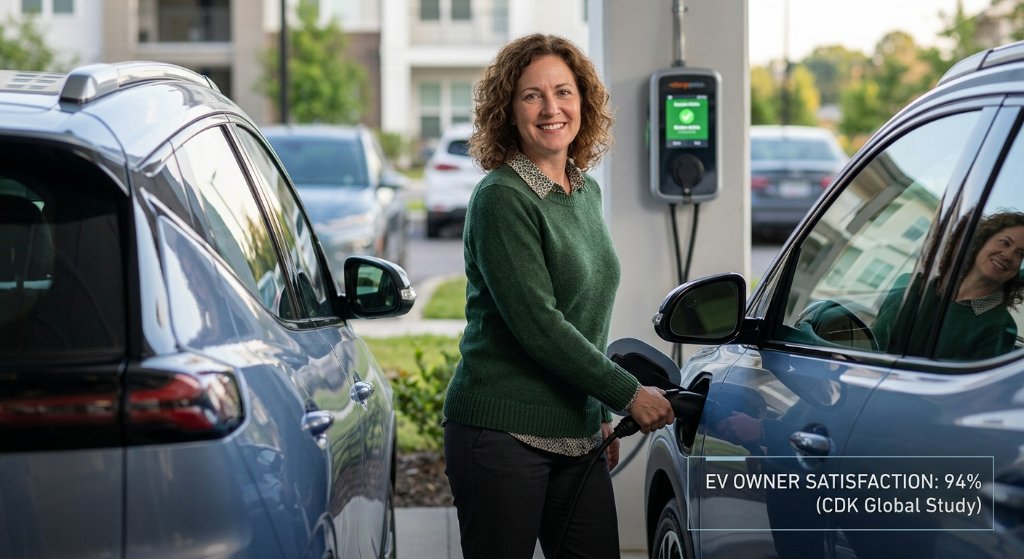
For years, detractors of the electric vehicle transition have eagerly capitalized on the narrative of "early adopter remorse," pointing to any driver who traded their battery-powered car back for an internal combustion engine (ICE). But as electric vehicles firmly plant themselves in the mainstream market, that skeptic-fueled theory has completely dissolved. The newly released 2026 CDK Global EV Ownership Study reveals a massive, undeniable shift in driver sentiment: a staggering 94% of U.S. EV owners report being happy with their purchase, up from a more modest 73% in 2025.
Even more devastating for legacy automakers hoping to stall their electric transitions is the complete collapse in buyer remorse. Only 1% of current EV households report that they are likely to switch back to traditional, gasoline-only vehicles—a dramatic plunge from the 21% of owners who were contemplating a return to gas just a year ago. Living with an EV, it turns out, is a one-way ticket to brand loyalty.
The Cold, Hard Math of Electric Loyalty
While early EV adopters were often motivated by environmentalism or tech novelty, the driver of today’s high satisfaction rates is much more practical: the pocketbook. As owners live with their vehicles beyond the first year, the long-term operational advantages become undeniable.
- Slashing Maintenance Costs: According to the study, EV owners average a whopping 39% reduction in maintenance costs compared to gasoline vehicles. Removing oil changes, spark plugs, and complex gearboxes delivers direct, recurring savings that drivers feel immediately.
- The Referral Engine: This financial upside has turned ordinary drivers into powerful brand advocates. An incredible 92% of respondents say they have actively recommended an EV to friends or family, establishing a grassroots referral network that dealership marketing budgets simply cannot buy.
- High Emotional Return: The daily driving experience is also winning over consumers. Over 85% of surveyed owners call their EV the best car they have ever owned, showing that electric powertrains are outperforming gas rivals on pure vehicle merit, not just efficiency.
The Final Frontier: The Road Trip Friction Point
Despite the near-universal acclaim for daily commuting, the EV transition still faces one glaring bottleneck: public infrastructure. The CDK study highlights that public charging network reliability remains a prominent friction point when planning long-distance travel.
- The Infrastructure Divide: While home charging provides a seamless daily experience for the majority of owners, embarking on a road trip still forces drivers to confront a highly fragmented public charging grid.
- The Non-Tesla Headache: While Tesla’s Supercharger network continues to open up to other manufacturers via the NACS (North American Charging Standard) transition, third-party DC fast chargers still suffer from broken hardware, payment lag, and frustratingly inconsistent speeds.
- Planning Over Spontaneity: Taking an EV on a road trip still requires a level of calculation and patience that ICE vehicles do not demand. This friction limits the vehicle's versatility, even if it does not ultimately convince drivers to abandon the technology.
Why This Matters:
This data signals a massive paradigm shift for the automotive industry. It completely dismantles the narrative of an "EV slowdown" and proves that once a consumer crosses the ownership threshold, they do not return.
- Who Wins: Pure-play EV manufacturers like Tesla, Rivian, and aggressive legacy OEMs (like Hyundai-Kia) that have invested heavily in dedicated EV platforms. They are building a lifetime customer base that will continuously cycle through their ecosystems.
- Who Loses: Traditional dealership service departments. Dealership business models have historically relied on service bays for up to 50% of their gross profits. A permanent 39% drop in maintenance costs means dealerships must completely rethink how they generate long-term revenue.
- The Market Signal: The microscopic 1% reversion rate proves that the barrier to EV adoption is not the product itself—it is the buying process and the charging infrastructure. For legacy brands dragging their feet on electrification, playing the waiting game is no longer a viable strategy. The customer base is converting, and they are not looking back.
Conclusion
The 2026 CDK Global study makes it clear that the EV transition is a one-way street. Despite lingering public charging headaches, the sheer economic savings and superior driving dynamics of electric vehicles have permanently won over the American driver. If charging operators and governments can resolve the road-trip charging bottleneck, the remaining ICE market will collapse far faster than critics care to admit.