The EV Reality Check: ACSI Study Reveals Deepening Satisfaction Gap as Hybrids Take the Crown
For years, the electric vehicle revolution was sold to us as a frictionless, low-maintenance upgrade to the old-world combustion engine. Early adopter...
Editorial Team
World Of EV
For years, the electric vehicle revolution was sold to us as a frictionless, low-maintenance upgrade to the old-world combustion engine. Early adopters raved about instant torque and never visiting a gas station again. But as EVs move from a tech-bro novelty into the mainstream market, the honeymoon is officially over. The newly released American Customer Satisfaction Index (ACSI) Automobile Study reveals a harsh reality: EV customer satisfaction has plummeted to an abysmal score of 72 out of 100—lagging far behind hybrids, which crowned the list at a dominant 80.
This satisfaction chasm comes at a time of unprecedented financial pressure for consumers, with average monthly car payments hovering near an eye-watering $767. As buyers commit to longer loans, their tolerance for expensive tech glitches and mediocre dealership support has evaporated. The result is a historic shift: for the first time in recent history, luxury brands (which heavily pushed expensive, tech-laden EVs) have lost their satisfaction edge entirely, dropping 3% to tie with mass-market brands at a score of 78.
The Powertrain Paradox: Why Hybrids Are Winning the Value War
While battery-electric vehicles (BEVs) dominate headlines and regulatory targets, everyday consumers are voting with their satisfaction scores, and they are choosing the middle ground. Hybrids maintained their flawless lead at 80, proving that drivers value the flexibility of gas combined with the efficiency of electric assist, without any of the range anxiety. In stark contrast, EVs dragged the bottom of the fuel-type charts. Let's look at how the powertrains stacked up in the ACSI study:
- Hybrids (Score: 80): Unchanged from previous years, hybrids remain the undisputed consumer favorite, offering a seamless bridge to electrification.
- Gasoline (Score: 78): Slipped as fuel costs and high maintenance bills wear on consumer wallets.
- Electric Vehicles (Score: 72): Slipped to a bottom-tier 72, indicating widespread frustration with the reality of full EV ownership.
The divergence becomes even clearer when examining the core metrics of utility. When asked to rate driving range, hybrid owners gave their vehicles a highly satisfied 76, whereas EV owners gave their vehicles a frustratingly low 64. A similar gap emerged in expected resale value, where hybrids scored 75 compared to a dismal 63 for EVs—reflecting growing consumer anxiety over rapid EV depreciation and battery lifespan.
Software Glitches and Dealer Woes: Inside the EV Pain Points
The ACSI study doesn't just show that consumers are unhappy; it tells us exactly why. The report highlights three fatal flaws dragging down the EV customer experience:
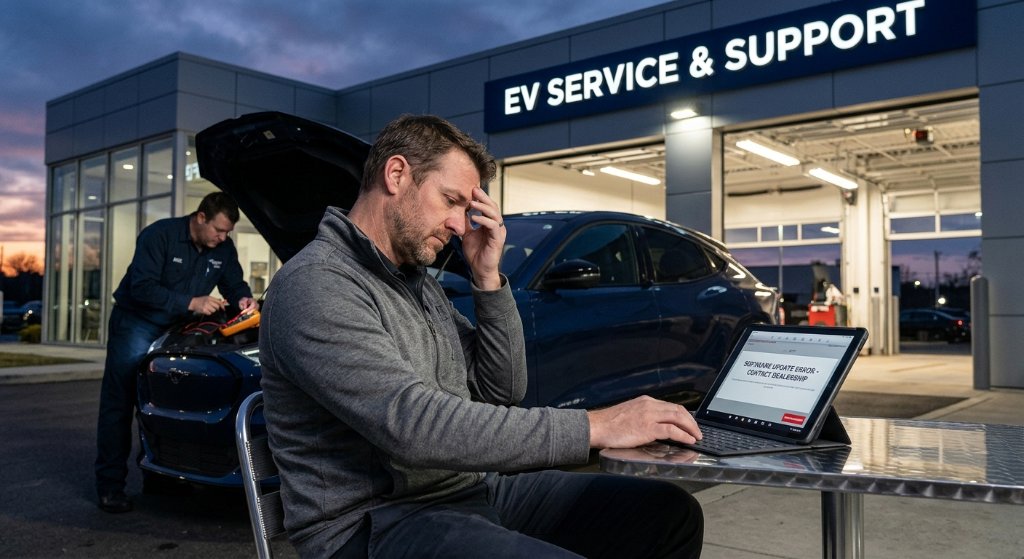
- Electrical, Battery, and Software Issues: Rushed to market on immature software architectures, many modern EVs are plagued by buggy infotainment systems, phantom battery drain, and over-the-air (OTA) update failures. This recalls General Motors' high-profile software struggles with the Chevrolet Blazer EV, which previously resulted in a stop-sale, highlighting the massive risks of rushing code to production.
- Engine and Powertrain Problems: While EVs have fewer moving parts, when things go wrong with high-voltage architectures, thermal management systems, or drive units, they are incredibly complex to diagnose and fix.
- Dealership Service and Support: Legacy dealership networks, historically reliant on easy, high-margin maintenance like oil changes, are catastrophically unprepared to service complex, software-defined electric vehicles. Technicians lack specialized high-voltage training, diagnostic tools are frequently outdated, and service bays are backed up for weeks waiting on proprietary parts.
This service deficit has had a devastating impact on premium brands. Lexus, a previous luxury darling with a spectacular score of 87, suffered a catastrophic 10% drop to 78 in the latest study. Meanwhile, Cadillac—which has bet heavily on a high-end EV transition with vehicles like the Lyriq—plummeted 15% to score a dead-last 69 in the luxury segment.
Why This Matters:
This ACSI study is a watershed moment for the automotive industry, signaling that the "honeymoon phase" for EVs has officially ended. The market has shifted from enthusiastic early adopters who tolerated bugs to mainstream, payment-weary buyers who demand flawless execution.
- Who Wins: Toyota. Long criticized by EV maximalists for "foot-dragging" on battery-electrics and stubbornly sticking to hybrids, Toyota's strategy has been completely vindicated. Toyota took the industry lead in mass-market satisfaction with an 83 (up 1%), riding the wave of hybrid enthusiasm and proven reliability.
- Who Loses: Legacy luxury brands rushing half-baked EV transitions. When a consumer is paying over $750 a month for a premium badge, finding out their local dealership cannot diagnose a battery software glitch is an instant brand-killer.
- The Market Signal: Legacy OEMs cannot rely on the "cool factor" of EVs anymore. They must immediately pivot from rushing new EV models to fixing the backend of the business.
This is a do-or-die moment for the dealership franchise model. If traditional dealers cannot retrain technicians and adapt to software-defined vehicle diagnostics, they risk driving buyers straight into the arms of direct-to-consumer rivals or back to dependable, worry-free hybrids.
The Path Forward
The transition to electric isn't failing because of the concept; it's failing because of execution. Automakers must realize that selling an EV is only 10% of the battle—supporting it for the next ten years with flawless OTA updates and competent dealership service is the other 90%. Until legacy brands bridge this service and software gap, hybrids will continue to wear the automotive crown.