The EV Premium Evaporates: Collision Repair Costs Plunge to Near-Parity With Gas Cars
For years, EV skeptics and worried prospective buyers shared a common, valid anxiety: get into a minor fender bender in an electric car, and the repai...
Editorial Team
World Of EV
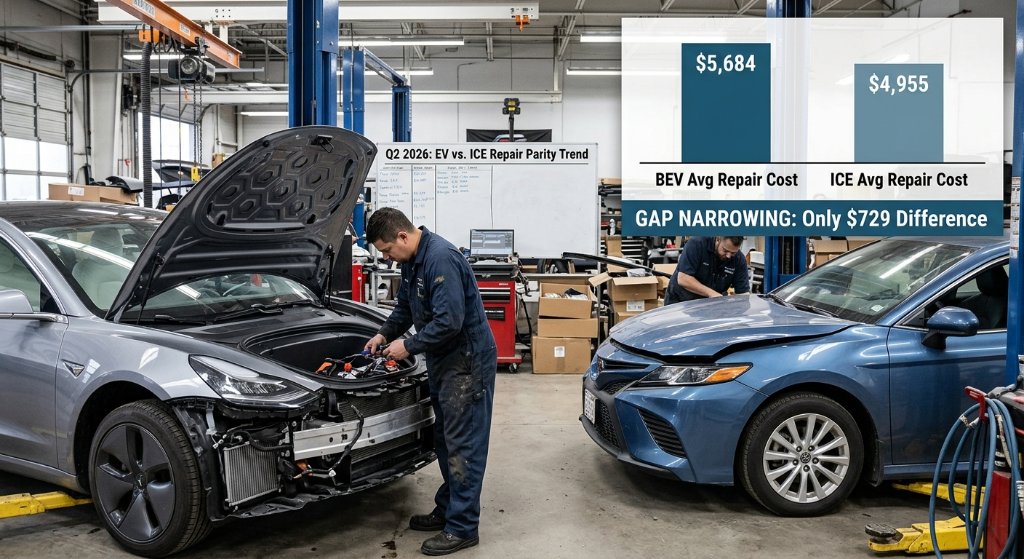
For years, EV skeptics and worried prospective buyers shared a common, valid anxiety: get into a minor fender bender in an electric car, and the repair bill could bankrupt you—or instantly write off the vehicle. Historically, battery electric vehicles (BEVs) faced massive repair premiums due to specialized labor, rare original equipment manufacturer (OEM) parts, and hyper-complex diagnostics. Fleet giants like Hertz famously began dumping their EV fleets in late 2023 and 2024, citing soaring collision costs and high insurance premiums as primary factors.
But according to the latest data, that narrative is rapidly crumbling. The newly released Q2 2026 'Plugged-In: EV Collision Insights' report by Mitchell reveals that the gap in average repair and maintenance costs following a collision between BEVs and internal combustion engine (ICE) vehicles has hit its lowest level on record. As the global EV fleet matures and the industry stabilizes, the long-dreaded "EV tax" on repairs is on the verge of complete extinction.
By the Numbers: The Gap Shrinks to Historic Lows
The narrowing cost gap represents a remarkable shift in automotive economics. In previous years, such as 2023, the average repairable severity for an EV in the U.S. hovered around $6,018, commanding nearly a 30% premium over equivalent gas cars. Mitchell's Q2 2026 data shows that this chasm is nearly closed:
- U.S. Collision Repair Severity: The average repairable cost for BEVs settled at $5,684 compared to $4,955 for traditional ICE vehicles—representing a historic low difference of just $729.
- The Canadian Market: A similar trend emerged in Canada, where the average BEV repair cost dropped to $6,645 CAD, narrowing the gap with ICE vehicles ($5,411 CAD) to $1,234 CAD.
- The Hybrid Factor: Plug-in hybrids (PHEVs) and mild hybrids (MHEVs) are bridging the difference, with average U.S. repair severities sitting at $5,022 and $5,033 respectively, proving that as gas vehicles adopt more electrical architecture, their repair costs climb to match EVs.
Why is the Repair Premium Collapsing?
The decline in EV repair premiums isn't happening by accident; it is the result of structural maturation in both the automotive and collision repair industries. Over the last three years, automakers have moved away from first-generation experimental EV platforms to more standardized layouts, allowing repair technicians to develop standardized procedures.
Key drivers pushing repair costs toward parity include:
- A Maturing EV Fleet: With millions more EVs now on the road, third-party collision centers have invested in specialized training and high-voltage safety tooling, breaking the monopoly of expensive, manufacturer-backed repair networks.
- The Rising Complexity of ICE Cars: The narrowing gap is a two-way street. Newer ICE vehicles are now packed with advanced driver assistance systems (ADAS), complex turbocharging, and hybrid battery systems, inflating traditional gas-car repair bills to meet the floor of EV repair costs.
- Standardized Diagnostics: Early EV repairs were bogged down by diagnostic uncertainties, but standardizing calibration procedures for cameras, radar, and lidar (now averaging 1.70 calibrations per estimate for BEVs) has streamlined shop workflows.
Why This Matters:
This record-low gap is a watershed moment for the electric vehicle industry, signaling a massive win for consumers, insurers, and fleet operators alike.
For the average consumer, this data directly addresses the "total cost of ownership" calculation. High repair costs have long translated into punishingly high insurance premiums for EVs. As collision costs normalize, insurance underwriters will have no choice but to adjust their risk models downward. This will eliminate one of the final psychological and financial hurdles for buyers on the fence about switching to electric.
For the auto industry, it’s a clear sign that the ecosystem is finally catching up with the technology. However, we aren't entirely out of the woods. The report warns that BEVs still heavily rely on OEM replacement parts—using OEM parts for roughly 85% of their repair dollars compared to just 62% for ICE cars. In an era of intense geopolitical tension, shifting trade policies, and new tariffs, this reliance on OEM supply chains leaves EVs uniquely vulnerable to sudden part-pricing spikes. Automakers who prioritize localized, aftermarket-friendly parts sourcing will dominate this next phase of the market.
Conclusion
The closing of the EV repair cost gap proves that electric vehicles are no longer a high-risk, experimental niche—they are mainstream automobiles subject to the same scaling economics as the gas cars they are replacing. While supply chain sensitivities remain, the rapid descent toward cost parity removes a massive barrier to mass adoption. For anyone waiting for the practical realities of owning an EV to match the environmental promise, the wait is officially over.