The EV Ownership Paradox: Why Massive Fuel Savings Can't Outrun Steep Depreciation
For years, the rallying cry of the electric vehicle movement has been simple: pay more upfront, but save a fortune on fuel. But AAA’s landmark 2026 "Y...
Editorial Team
World Of EV
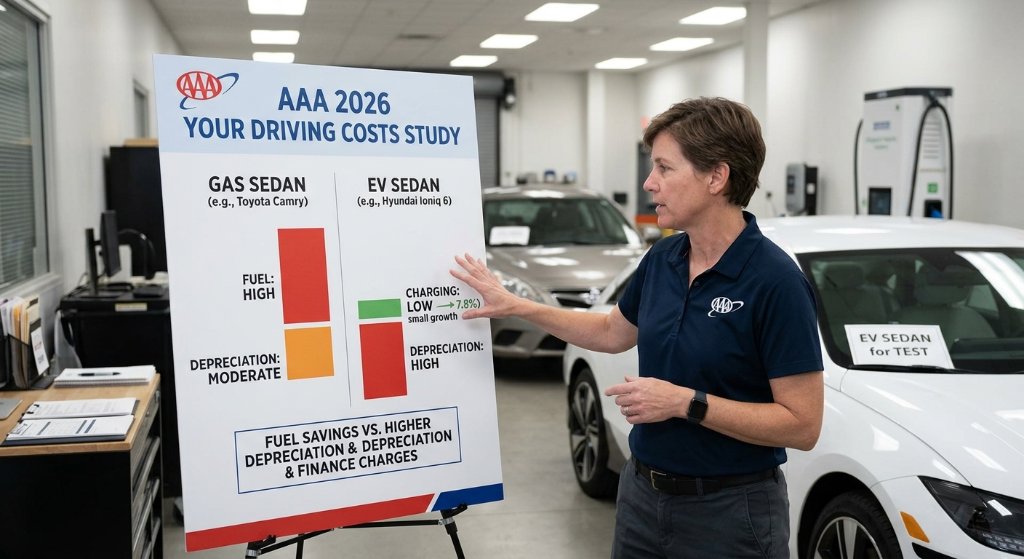
For years, the rallying cry of the electric vehicle movement has been simple: pay more upfront, but save a fortune on fuel. But AAA’s landmark 2026 "Your Driving Costs" (YDC) study has just delivered a sobering dose of reality, revealing that for many buyers, those highly publicized fuel savings are being completely swallowed up by brutal depreciation and high financing costs.
In a massive methodological shift, AAA has retired its standalone EV and hybrid categories, integrating them directly into traditional body-style categories like medium sedans and SUVs. This integration exposes a stark economic divide. While electricity prices remained remarkably stable, skyrocketing gas prices were still not enough to offset the rapid loss of value suffered by new electric vehicles. In fact, AAA's data shows that a medium EV sedan costs a whopping 29.1% more to own annually than its gas-powered equivalent.
EVs Enter the Mainstream Arena
For the past several years, mainstream EV adoption has struggled with a persistent "sticker shock" problem. To give consumers a more realistic picture of the market, AAA’s 2026 study evaluated 34 top-selling models across standard categories, allowing for a direct, head-to-head comparison of powertrains.
The results paint a complicated picture for the EV transition. While the average annual cost to own and operate a new vehicle has climbed to $12,863 (or $1,071.92 per month), the financial experience varies wildly depending on what is under the hood:
- Gas-Powered Vehicles: Still dominate on pure purchase-related costs, offering lower upfront MSRPs, reduced finance charges, and far more stable depreciation. A standard gas-powered medium sedan costs an average of $10,582 per year to run.
- Electric Vehicles: Despite delivering unparalleled fuel economy, higher purchase prices and devastating depreciation curves pushed the average annual cost of a medium EV sedan to $13,662—a punishing $3,080 premium over its gas counterpart.
- Hybrids: Emerged as the ultimate "sweet spot," blending the best of both worlds by pairing strong fuel savings with minimal depreciation penalties.
The Fuel Victory: Charging Still Beats the Pump
If there is a bright spot for EV advocates, it is the undeniable efficiency of the electric drivetrain. AAA's analysis highlights a massive divergence in energy markets that heavily favors electric power:
- Gas Price Spikes: Regular-grade gasoline jumped a staggering 31.8% compared to the previous year, averaging $4.152 per gallon.
- Electricity Stability: Home charging rates proved incredibly resilient, rising only 7.8% to average 18.0 cents per kilowatt-hour.
- The Bottom Line: This divergence means EV charging costs remain 66% to 70% lower than fueling a traditional internal combustion engine (ICE) vehicle. For drivers with access to cheap overnight home charging, the day-to-day operating costs of an EV remain unmatched.
The True Cost Killer: Twice the Depreciation
So, why aren't EV owners laughing all the way to the bank? The answer lies in the silent financial killer of car ownership: depreciation.
While a vehicle's fuel cost is highly visible at the pump every week, depreciation quietly erodes thousands of dollars of household wealth in the background. According to AAA, EV medium sedans experience roughly twice the depreciation rate of comparable gas-powered models.
This rapid loss of value is driven by several modern market forces. First, aggressive price wars initiated by market leaders like Tesla have tanked used EV values overnight; when a manufacturer slashes the price of a new model, the resale value of every existing model on the road plummets instantly. Second, rapid technological advancements in battery chemistry and software mean that a three-year-old EV can feel ancient compared to newer models, much like an older smartphone. Finally, consumer anxiety regarding out-of-warranty battery replacements—which can range from $7,000 to $25,000—creates a shallow pool of buyers in the secondary market, further depressing trade-in values.
Combined with higher interest rates on larger initial loan balances, these financing and depreciation charges simply overwhelm the savings gained at the charging station.
Why This Matters:
AAA's 2026 study marks a watershed moment that shifts the consumer conversation from "range anxiety" to "depreciation anxiety."
- The Winners: Used EV buyers are the ultimate victors here. The steep depreciation curve of new EVs means the secondary market is currently flooded with high-tech, low-maintenance vehicles at absolute bargain prices. Fleet operators who plan to run vehicles into the ground (minimizing the impact of resale value) also stand to benefit from the ultra-low charging and maintenance costs.
- The Losers: New EV buyers who plan to trade in their vehicles within three to five years are taking a massive financial hit. Likewise, leasing companies are being forced to adjust residual values downward, which will inevitably drive up monthly lease payments and make EVs less attractive to casual drivers.
- The Market Signal: This is a clear warning to legacy automakers. Pushing raw battery range is no longer enough to win over mainstream buyers. To combat this depreciation crisis, manufacturers must focus on battery health transparency, robust software updates that keep older models relevant, and standardized battery recycling or remanufacturing pipelines to ease consumer anxiety about long-term reliability. Until resale values stabilize, hybrids will continue to steal the mainstream spotlight as the pragmatic consumer's choice.
In Conclusion
The 2026 AAA Your Driving Costs study proves that greening your driveway requires looking far beyond the window sticker or the daily fuel savings. While the operational efficiency of electric vehicles is unmatched, the brutal realities of depreciation and high financing costs mean that, for now, many new EVs remain a luxury of passion rather than a triumph of pragmatism. As the market matures, the industry's next great battle won't be fought over charging speeds or horsepower, but over stabilizing the long-term residual value of the electric fleet.