The EV Loyalty Paradox: Why Disappointed Mass-Market Drivers Are Still Rejecting Gas
Mass-market electric vehicles have hit a baffling roadblock in the latest 2026 American Customer Satisfaction Index (ACSI) Automobile Study. Mainstrea...
Editorial Team
World Of EV
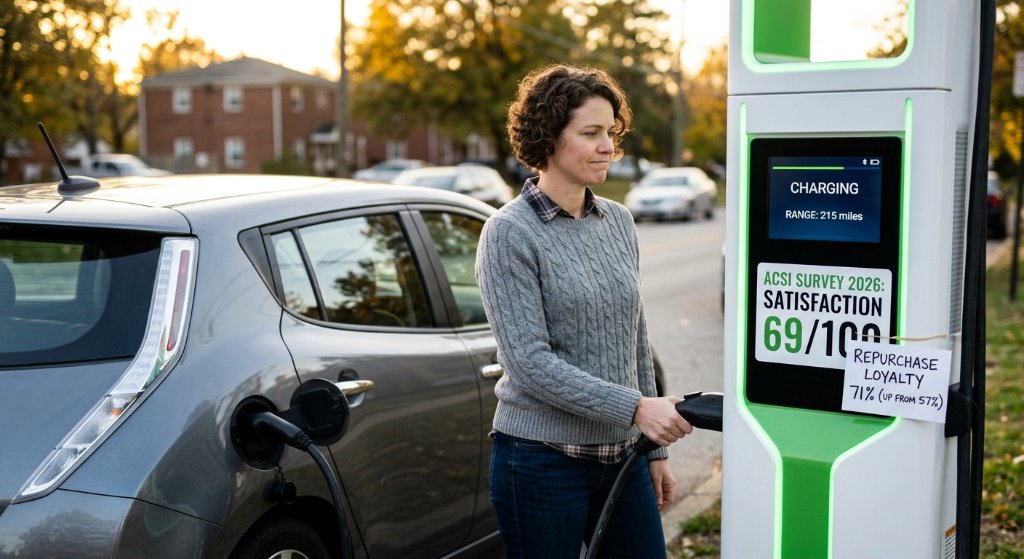
Mass-market electric vehicles have hit a baffling roadblock in the latest 2026 American Customer Satisfaction Index (ACSI) Automobile Study. Mainstream EVs registered a dismal satisfaction score of just 69 out of 100—the lowest of any powertrain in the industry. For legacy automakers trying to court mainstream buyers, this is a wake-up call; the combination of rapidly depreciating resale values, unpredictable public charging infrastructure, and nagging range anxiety has left first-wave buyers deeply frustrated.
Yet, in a bizarre twist of consumer psychology that we at World Of EV are calling the 'loyalty paradox,' these same frustrated drivers are doubling down on electric. Despite the lackluster satisfaction numbers, mass-market EV repurchase loyalty skyrocketed from 57% to an impressive 71% year-over-year. What looks on paper like a failing ownership experience is actually a fiercely loyal, highly sticky customer base that is utterly unwilling to return to internal combustion engines (ICE).
Unpacking the Numbers: Frustration Meets Commitment
To understand how a vehicle category can be both highly criticized and intensely coveted, we must look at where the friction lies. The 69-point satisfaction score for mass-market EVs is a stark contrast to hybrids, which lead the industry at a stellar 80, and standard gasoline-powered vehicles at 78. According to the ACSI data, the primary culprits driving down EV satisfaction are:
- The Resale Cliff: Brutal depreciation curves, driven by aggressive price wars and rapid technological obsolescence, have left many early mass-market EV buyers underwater on their car loans.
- Range and Charging Friction: While luxury EV buyers (who scored a more resilient 76) often enjoy home chargers or dedicated OEM charging agreements, mass-market buyers are more frequently subjected to the wilderness of broken public networks.
- Rising Price Sensitivities: With average new car payments hovering around $767 per month and average transaction prices exceeding $50,000, consumer patience with tech glitches—such as frozen infotainment systems or software bugs—has completely run out.
The Home-Charging Safe Haven
If the ownership experience is so fraught with irritation, why are 71% of these buyers committed to buying another EV? The answer lies in the establishment of stable charging routines. According to ACSI, as buyers transition from relying on erratic public infrastructure to installing Level 2 home-charging stations, their day-to-day relationship with the vehicle changes. Once a daily routine is locked in, the inherent benefits of EV driving—instant torque, zero tailpipe emissions, silent cabins, and never visiting a gas station again—completely overshadow the initial transition headaches.
Key shifts recorded in the 2026 ACSI study include:
- Repurchase Likelihood: Jumped by 13% to a score of 72.
- Likelihood to Recommend: Improved by 9% to 73.
- Customer Retention: Climbed 14 percentage points to 71%, proving that once consumers go electric, they rarely look back to fossil fuels.
Why This Matters:
This is a defining watershed moment for the global transition to electric mobility. The 'loyalty paradox' is a clear signal to legacy giants like Ford, General Motors, and Hyundai: the battle for the EV market isn't about convincing people that electric drivetrains are superior—drivers already believe that. Instead, the battle is entirely about fixing the post-purchase ownership ecosystem.
- The Winners: Automakers that have successfully integrated reliable charging ecosystems. Hyundai and Kia, which have rapidly adopted the NACS (Tesla Supercharger) standard while delivering stellar mass-market platforms like the Ioniq 5 and EV6, are poised to capture this hyper-loyal demographic as they trade in their early-generation EVs.
- The Losers: Brands failing to address software glitches and resale protection. If legacy OEMs do not step up with competitive battery-health guarantees, certified pre-owned (CPO) leasing programs, and flawless over-the-air (OTA) updates, they risk pushing their hard-won, loyal EV buyers directly into the hands of Tesla or more agile premium players.
- The Market Signal: This is a 'do-or-die' mandate for infrastructure investment. The high loyalty rates prove that the EV market isn't collapsing; it is consolidating around highly committed, tech-savvy users. For automakers, ignoring early ownership complaints under the assumption that loyalty guarantees future sales is a dangerous gamble. Buyers are staying electric, but they will quickly jump ship to whichever brand solves their charging and software headaches first.
Conclusion
The 2026 ACSI study exposes a market in a delicate, transitional state. Mass-market EVs are testing their owners' patience with early-stage infrastructure and financial pain points, yet the fundamental driving experience remains too good to give up. As loyalty surges to 71%, the message to Detroit, Seoul, and Tokyo is unmistakable: stop worrying about 'EV skepticism' and start building a seamless, worry-free ownership lifecycle. The buyers are ready; it is the vehicles and the infrastructure that need to catch up.