The Death of Range Anxiety: CAA’s 2026 EV Circuit Proves It's Time to Face Real Ownership Costs
For more than a decade, the spectral fear of 'range anxiety' has haunted the electric vehicle market, acting as the primary barrier for skeptical buye...
Editorial Team
World Of EV
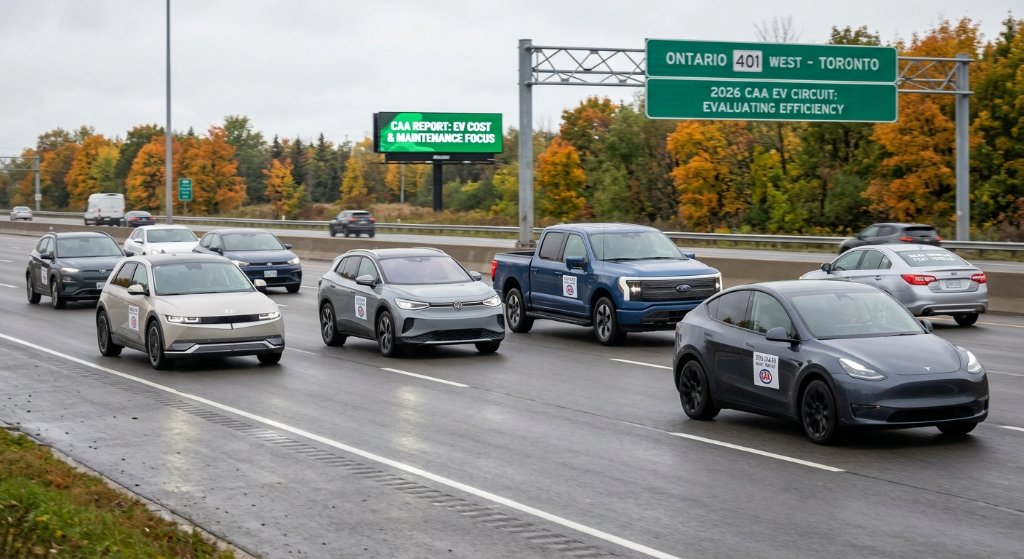
For more than a decade, the spectral fear of 'range anxiety' has haunted the electric vehicle market, acting as the primary barrier for skeptical buyers and forcing legacy automakers to design heavy, oversized battery packs. This paradigm was born in the early 2010s, when pioneering compliance cars like the first-generation Nissan Leaf struggled to clear 120 kilometers of real-world range. But the Canadian Automobile Association (CAA) just delivered a devastating blow to this lingering psychological barrier with its 2026 EV Circuit road test, proving that modern EVs have officially outgrown their developmental training wheels.
Blasting 230 kilometers from Blue Mountain to Vaughan, Ontario, a fleet of 22 current-generation electric vehicles completed the real-world route with zero stops to recharge. In fact, the vehicles barely broke a sweat—consuming an average of just 40% of their battery capacity, which means most could have completed the journey twice. The landmark test signals that the era of worrying about whether an EV can complete a road trip is dead. Instead, the consumer conversation must pivot to the metrics that actually impact ownership: efficiency, charging curves, and localized electricity costs.
The Numbers That Killed the Myth
The 2026 CAA EV Circuit put 22 distinct EV models—representing roughly three-quarters of the Canadian electric vehicle market—through a rigorous real-world test under optimal September conditions. The results speak volumes about how far battery engineering has advanced:
- The 230-km Sweeper: Every single participating vehicle, including those with the shortest advertised ranges on the market, completed the run from Blue Mountain to Vaughan without plugging in.
- Massive Power Reserves: On average, vehicles ended the run with 60% of their battery intact. The mammoth Chevrolet Silverado EV proved particularly frugal with its percentage, using a mere 20% of its massive pack, while even the least efficient vehicle in this category, the Lucid Gravity, finished with 45% of its battery remaining.
- Crushing Gasoline Efficiency: The test fleet posted an average energy consumption equivalent to just 2.0 liters of gasoline per 100 kilometers (L/100 km). Contrast that with the average Canadian internal combustion engine (ICE) passenger vehicle, which guzzles between 8.0 and 10.0 L/100 km.
The Efficiency War: Leaders and Laggards
While every vehicle made the trip, the test exposed massive engineering disparities in how these vehicles use power. Simply cramming a massive battery into an EV is a brute-force approach that degrades real-world efficiency. The CAA's findings highlighted a wide chasm in kilowatt-hour consumption per 100 kilometers (kWh/100 km):
- The Efficiency Elite: In a major upset, the Toyota bZ claimed the crown as the most energy-efficient vehicle tested, sipping just 11.43 kWh/100 km. It narrowly outperformed industry benchmarks like the Tesla Model Y (11.81 kWh/100 km) and the Tesla Model 3 (11.85 kWh/100 km), followed closely by the budget-friendly Kia EV4 (11.89 kWh/100 km).
- The Heavy Drinkers: At the opposite end of the spectrum, heavy-duty engineering took a massive toll. The ultra-luxurious Lucid Gravity devoured a whopping 28.91 kWh/100 km, while rugged beasts like the GMC Hummer EV SUV (23.55 kWh/100 km) and the Tesla Cybertruck (23.41 kWh/100 km) proved that moving heavy steel and blocky aerodynamics still requires a massive energy penalty.
Charging Speed: The True Bottleneck
With range effectively solved, the real differentiator for road-trippers is how fast a vehicle can recover driving range during a brief stop. The CAA tested this by subjecting the fleet to a standardized 15-minute public charging session. The variance was stark:
- Rapid Recovery: The Lucid Gravity redeemed its poor efficiency by adding an astonishing 178 kilometers of range in just 15 minutes, demonstrating the power of its high-voltage architecture. Close behind were the Hyundai Ioniq 5 (136 km gained) and the Mercedes-Benz CLA with EQ Technology (135 km gained), both utilizing advanced thermal management to maximize charging curves.
- The Slow Slayers: Conversely, the Lucid Air struggled mightily in this specific session, recouping a mere 58 kilometers of range—a stark reminder that theoretical peak charging speeds do not always translate to real-world public charging sessions.
Why This Matters:
This shifting paradigm redraws the competitive landscape for automakers and resets expectations for prospective EV buyers.
The Winners: Manufacturers like Hyundai, Kia, and Toyota are the massive winners here. By mastering aerodynamic efficiency and highly advanced 800V charging architectures, they prove that you do not need a heavy, expensive 100+ kWh battery to build a highly capable road-tripper. The Toyota bZ's surprise efficiency crown is a vindication for a brand that was heavily criticized for its slow start in the EV transition. Furthermore, the average consumer wins by realizing they do not need to pay a premium for a 'safety blanket' 600-kilometer range vehicle when a highly efficient, fast-charging 400-kilometer model easily satisfies their lifestyle at a fraction of the cost.
The Losers: Off-road and ultra-luxury giants that rely on 'brute-force' battery packaging are on notice. Vehicles like the GMC Hummer EV SUV and the Lucid Gravity are engineering marvels, but their atrocious efficiency means owners will pay more than double at public fast chargers compared to their more efficient peers. As public utility commissions increasingly transition to demand-based or tiered EV charging rates, these heavy haulers will become highly expensive to run.
The Market Signal: This is a 'do-or-die' moment for automaker marketing departments. For years, OEMs have taken the easy way out, engaging in a 'range arms race' to soothe uneducated buyers. Now, they must shift to educating consumers on efficiency metrics (kWh/100 km or miles/kWh) and real-world charging curves. Buyers will soon realize that a vehicle that charges from 10% to 80% in 18 minutes is vastly superior for road trips than one with an extra 100 kilometers of nominal range that charges at a snail's pace. Master the charging curve and aerodynamic efficiency, or prepare to be left behind on dealership lots.
Looking Ahead
The CAA's 2026 EV Circuit has officially closed the book on the first era of EV adoption. With range anxiety dismantled, the path to mass market integration relies heavily on building denser, more reliable public charging networks and lowering vehicle charging times. As consumers begin to scrutinize vehicle efficiency and localized energy tariffs rather than nominal range limits, the electric vehicle transition will finally mature from a speculative tech trend into a practical, math-driven economic choice.