The Cold Hard Math: Why Repair Costs and Battery Fear Are Freezing the Next Wave of American EV Buyers
For years, the electric vehicle narrative has been dominated by a simple promise: buy an EV, bypass the gas pump, and enjoy virtually maintenance-free...
Editorial Team
World Of EV
For years, the electric vehicle narrative has been dominated by a simple promise: buy an EV, bypass the gas pump, and enjoy virtually maintenance-free driving. But as the industry desperately tries to transition from tech-forward early adopters to pragmatists, that narrative is hitting a brick wall. Mainstream American buyers aren't just skeptical; they are actively running the numbers—and they do not like what they see.
A new survey report published by YouGov CategoryView exposes the deep-seated anxieties keeping non-EV buyers firmly in the internal combustion engine (ICE) camp. Despite volatile gasoline prices that historically pushed buyers toward electrification, the economic calculus has shifted. The fear of what happens after you drive off the lot is now the single greatest barrier to widespread adoption.
The Paradox of Painless Maintenance: The 43% Repair Bottleneck
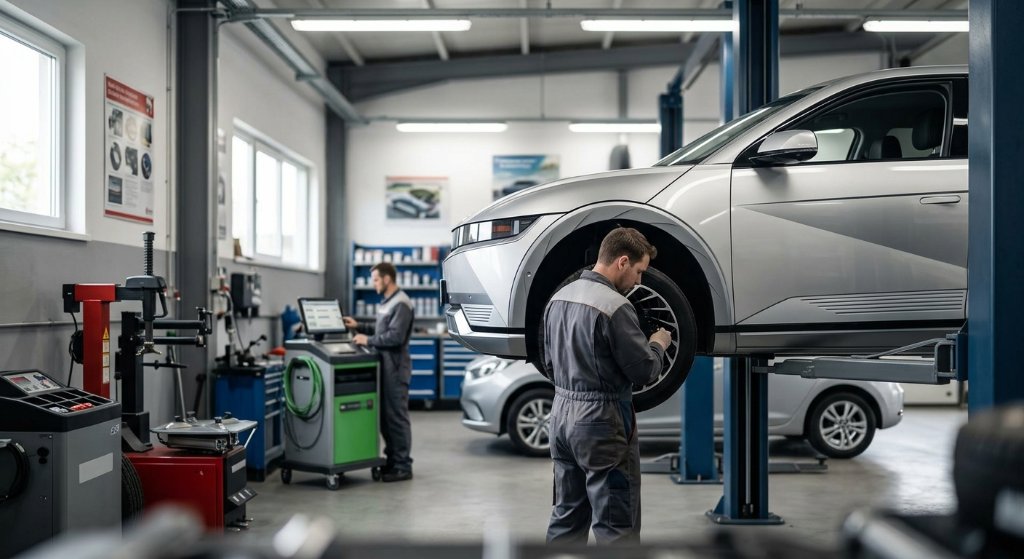
For years, EV manufacturers have bragged about the simplicity of their drivetrains. With no oil to change, no spark plugs to replace, and regenerative braking extending brake life, EVs should theoretically be a financial win. Yet, YouGov's data reveals that 43% of prospective U.S. car buyers who are not considering an EV cite high repair and maintenance costs as a major deterrent.
This isn't just an irrational fear; it's a reflection of a brutal reality that fleet operators like Hertz learned the hard way. Hertz's disastrous experiment with buying 100,000 Teslas ended in a massive fire sale of 30,000 vehicles and a multi-billion-dollar hit to its bottom line, largely due to astronomical collision repair costs and specialized labor. Mainstream buyers are paying attention. They realize that while routine maintenance is cheap, a fender-bender in a highly integrated, sensor-laden EV can write off the entire vehicle or result in repair bills that dwarf those of a traditional gas car.
- Specialized Repair Monopolies: A lack of independent mechanics certified to work on high-voltage systems forces buyers back to expensive dealership networks.
- Insurance Premium Hikes: Because minor battery pack casing damage often leads insurers to declare the vehicle a total loss, EV insurance premiums remain significantly higher than their ICE counterparts.
The Battery Boogeyman: Safety and Longevity Worries (46%)
The single largest hurdle identified in the YouGov report is battery safety and longevity, hovering at 46%. To the average consumer, the battery pack isn't just a fuel tank—it is a ticking financial time bomb.
While manufacturers offer federally mandated 8-year/100,000-mile battery warranties, the anxiety of what happens in year nine remains a major roadblock. The prospect of a $10,000 to $20,000 out-of-warranty battery replacement bill is enough to scare away middle-income buyers. Furthermore, highly publicized EV battery fires, though statistically less common than ICE fires, dominate the news cycle and fuel deep safety concerns among the uninitiated.
Charging Deserts: The 43% Infrastructure Gap
Even if buyers can stomach the potential repair bills, they still have to charge. The YouGov survey highlights that 43% of non-EV considerers are held back by the proximity and availability of charging stations.
This infrastructure gap persists despite federal funding through programs like the National Electric Vehicle Infrastructure (NEVI) formula program, which has been notoriously slow to deploy. Furthermore, the industry-wide transition to Tesla’s North American Charging Standard (NACS) has created a confusing "in-between" era for consumers, who are unsure whether the vehicle they buy today will require clumsy adapters to plug in tomorrow.
Why This Matters:
This data signals a critical, "do-or-die" pivot point for the automotive industry. The "hype phase" of the EV transition is officially over, and we have entered the "show me the utility" phase.
- Who Wins? Toyota and the Hybrid Defenders. Toyota's conservative, hybrid-first strategy looks more brilliant by the day. By offering the fuel efficiency of electrification without the high repair risks, battery anxiety, or charging dependence of pure BEVs, hybrids are the clear beneficiaries of this consumer hesitation.
- Who Loses? Pure-Play EV Startups and Legacy 'All-In' OEMs. Startups like Rivian and Lucid, along with legacy giants like Ford and GM that promised rapid, all-EV lineups, are facing a reality check. They cannot scale to profitability if 43% to 46% of the mass market is fundamentally locked out by structural anxieties.
- The Ultimate Takeaway: To unlock the next wave of buyers, automakers must stop selling "the future" and start solving the boring, practical realities of ownership. The industry must aggressively expand independent repair networks, demystify battery degradation through transparent diagnostic tools, and standardize the charging experience.
Conclusion
The YouGov CategoryView survey is a stark reminder that the battle for EV dominance won't be won on the drag strip or through zero-to-sixty times. It will be won in the service bay and at the local insurance agency. Until automakers can convince the average American that an EV is as cheap to fix as a Honda Civic and as reliable over fifteen years as a Toyota Camry, the electric revolution will remain stalled in the driveway of the wealthy.