The £5 Full Charge: How One UK EV Veteran is Saving £2,500 a Year with the Disruptive Kia PV5
For years, legacy automakers tried to convince buyers that retrofitting heavy, compromised internal combustion engine platforms with electric motors w...
Editorial Team
World Of EV
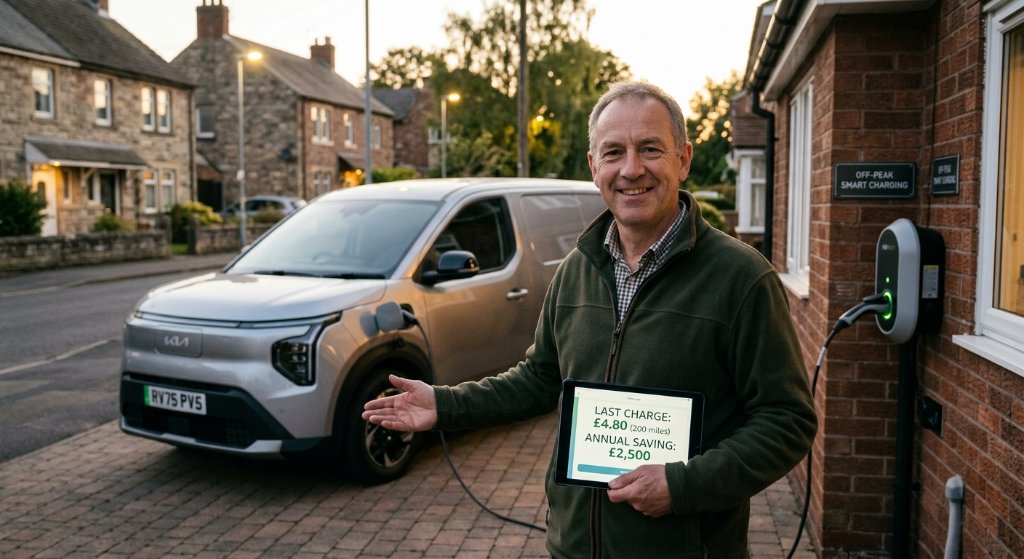
For years, legacy automakers tried to convince buyers that retrofitting heavy, compromised internal combustion engine platforms with electric motors was "good enough." But the market is quickly realizing that purpose-built EV architecture is where the real revolution lies. Nowhere is this clearer than in the UK, where early adopters are demonstrating the massive financial and practical advantages of switching to highly efficient, ground-up electric designs like the Kia PV5.
Take Dr. Waller of Carlisle, UK, an EV veteran who made the transition to electric vehicles back in December 2018. Today, he drives Kia's newly launched PV5—a vehicle that is shaking up both the electric multi-purpose and commercial segments. By moving away from fossil fuels, Dr. Waller reports saving a staggering £2,500 annually in fuel costs alone.
The Under-£5 Charging Cheat Code
The secret to maximizing EV ownership isn’t just about the vehicle itself; it is about how you fuel it. Dr. Waller’s primary daily "life hack" is remarkably simple yet highly lucrative: pairing off-street home parking with a smart utility tariff.
By taking advantage of overnight off-peak rates, he routinely secures a 200-mile charge in his PV5 for less than £5.
- The Smart Tariff Edge: Utilizing UK smart tariffs, which typically drop during overnight hours, EV drivers can schedule charging when grid demand is at its lowest.
- The Math: Recharging the PV5's battery to cover 200 miles requires roughly 50 to 60 kWh of energy. At off-peak rates, this costs between £3.50 and £4.50.
- Unmatched Convenience: This strategy eliminates the need for premium public rapid-chargers, delivering a full battery every morning for the price of a cup of coffee.
Inside the Kia PV5: A Masterclass in Purpose-Built Utility
To understand why Dr. Waller’s savings are so significant, you have to look at what he is driving. The Kia PV5 is not a retrofitted diesel van; it is built on Kia’s dedicated E-GMP.S "skateboard" architecture. Starting at an aggressive £31,495 OTR in the UK, the PV5 completely undercuts legacy rivals like the Volkswagen ID. Buzz, which demands a massive premium of nearly £30,000 more.
Dr. Waller highlights several features that make the PV5 a joy to live with daily:
- One-Pedal Driving: Thanks to Kia's highly adjustable regenerative braking system, drivers can navigate heavy city traffic almost entirely without touching the brake pedal. This not only eases fatigue but recaptures kinetic energy to feed back into the battery.
- Class-Leading Packaging: Because there is no bulky engine bay, the PV5 offers an ultra-spacious cabin and cargo hold that defies its physical footprint, mimicking a mobile lounge or workspace.
- Optimized Battery Efficiency: Available with standard (52 kWh) and long-range (71.2 kWh) battery packs, the PV5 provides up to 258 miles of WLTP range, ensuring plenty of headroom for daily duties.
Why This Matters:
This testimonial is a critical indicator of where the mass EV market is heading. For years, the EV transition was dominated by luxury sedans and high-end SUVs. The success of the Kia PV5 and the astronomical savings realized by owners like Dr. Waller signal a shift toward utilitarian, high-value electric vehicles that solve everyday transport needs.
The Winners:
- Kia: By delivering a purpose-built, modular EV platform (PBV) at a price point that undercuts traditional MPVs and electric vans, Kia is eating legacy automakers’ lunch. They have managed to bridge the gap between commercial utility and family comfort.
- Savvy Consumers: Homeowners with off-street parking who adopt smart charging are effectively insulated from volatile fuel prices, enjoying running costs that combustion engines simply cannot match.
The Losers:
- Legacy Conversions: Automakers still trying to sell converted internal combustion engine (ICE) vans and MPVs will find themselves completely outclassed on space, efficiency, and price.
- The Volkswagen ID. Buzz: While a design triumph, the ID. Buzz's premium pricing makes it a luxury lifestyle statement. The PV5, by contrast, is a democratized tool for the masses.
Ultimately, Dr. Waller's experience proves that the financial argument for EVs is no longer theoretical. When paired with smart energy habits, a ground-up EV isn't just an environmental choice—it’s an unbeatable financial strategy.