Tesla's Unsupervised Robotaxi Invasion Hits Miami: The Model Y Takes on Waymo and Zoox in the Ultimate Autonomy Battle
Tesla has officially crossed the Rubicon in South Florida. The EV giant has expanded its unsupervised, fully autonomous Robotaxi service to a portion ...
Editorial Team
World Of EV
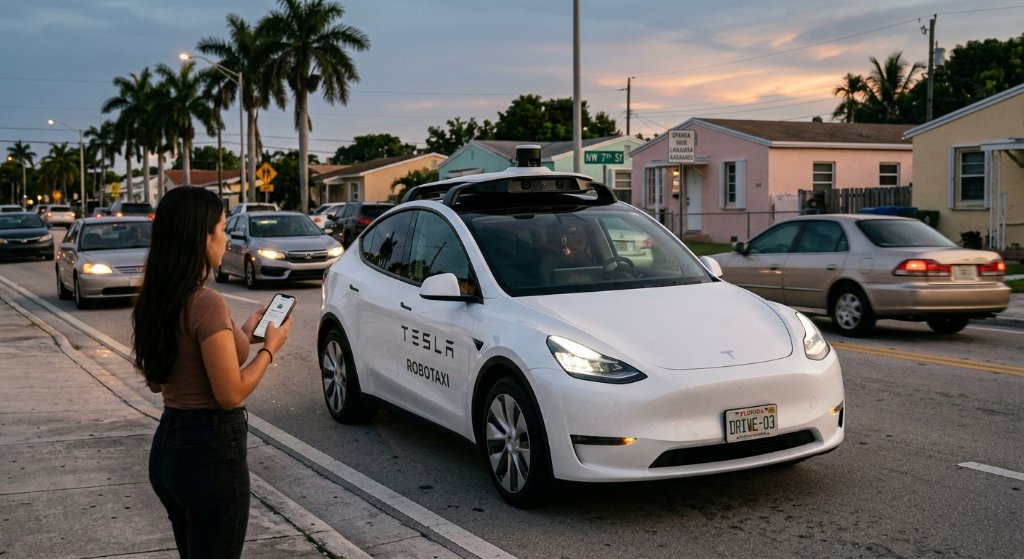
Tesla has officially crossed the Rubicon in South Florida. The EV giant has expanded its unsupervised, fully autonomous Robotaxi service to a portion of West Miami, unleashing a fleet of driverless Model Y vehicles onto some of the most chaotic streets in America. Hailed directly through the Tesla mobile application, these vehicles operate entirely without a human safety monitor behind the wheel.
This expansion is not an isolated experiment. West Miami marks the fourth major metropolitan battleground for Tesla’s autonomous ride-hailing network, building on previous rollouts in Austin, Dallas, and Houston. For years, skeptics dismissed Elon Musk's promises of a driverless future as vaporware—especially given the company's missed autonomy timelines dating back to 2016. However, by deploying fully driverless Model Ys in Miami, Tesla is drawing a line in the sand, positioning itself to go head-to-head with established autonomous heavyweights like Alphabet's Waymo and Amazon's Zoox.
The Battleground Shifts to South Florida
Miami is notorious for its aggressive drivers, unpredictable pedestrian traffic, and sudden tropical downpours—making it the ultimate stress test for any autonomous system. Tesla's approach in West Miami is lean and aggressive, utilizing its mass-market passenger vehicle rather than custom, low-volume shuttles:
- The Fleet: Unsupervised Tesla Model Ys operating purely on the company's vision-only Full Self-Driving (FSD) neural network architecture.
- The Experience: Local residents in the designated West Miami zone can hail a driverless ride seamlessly using the standard Tesla mobile application.
- The Footprint: This rollout joins existing service zones in Austin, Dallas, and Houston, showcasing Tesla's ability to rapidly scale to new urban environments.
Unlike its competitors, who rely on specialized, custom-built hardware or heavily modified luxury SUVs, Tesla is leveraging its existing consumer vehicle platforms. This allows the company to scale its ride-hailing operations at a fraction of the cost of its rivals.
Vision-Only vs. The Sensor-Heavy Establishment
The West Miami rollout sets up a fascinating technological showdown. While Waymo and Zoox navigate Miami’s streets using a suite of expensive Lidar, radar, and highly detailed, pre-mapped 3D environments, Tesla relies entirely on cameras and end-to-end AI.
This "vision-only" approach has been heavily criticized by industry purists who argue that Lidar is essential for safety, especially in adverse weather. If Tesla's Model Ys can successfully navigate Miami's torrential rains and erratic traffic patterns without Lidar, it will vindicate Musk’s contrarian hardware strategy and prove that heavy, expensive sensor suites are an evolutionary dead-end.
Why This Matters:
This is a pivotal moment for both Tesla and the broader transportation industry. By proving it can operate without a human safety driver in multiple major US cities, Tesla is actively transitioning from a traditional automotive manufacturer into a high-margin robotics and software powerhouse.
- Who Wins: Tesla and its investors. If this rollout succeeds, Tesla proves its hardware-light approach is commercially viable, giving it an insurmountable cost-per-mile advantage over Waymo and Zoox. Consumers also win as increased competition will inevitably drive down the cost of autonomous rides.
- Who Loses: Traditional ride-hailing platforms like Uber and Lyft, which remain tethered to the rising costs of human drivers. Additionally, competitors relying on expensive Lidar setups will face intense pressure to justify their hardware costs to investors.
- The Industry Signal: This rollout signals that the autonomous vehicle (AV) race is no longer in the "development" phase—it is in the "market capture" phase. Tesla's ability to rapidly deploy its consumer-grade Model Ys into new markets highlights the terrifying scalability of its manufacturing footprint.
Ultimately, Tesla's push into West Miami is a high-stakes gamble. If the vision-only system stumbles under the weight of Miami's unique driving conditions, it will fuel the arguments of regulators demanding stricter oversight. But if it succeeds, it marks the beginning of the end for the traditional ride-sharing model as we know it, paving the way for a cheaper, safer, and entirely driverless future.