Tesla’s Unified 2026.21.6 Update Heals the Fleet Rift, Bringing FSD v14 to Legacy and Next-Gen Cars Alike
Tesla has officially begun rolling out its highly anticipated unified software update, version 2026.21.6. In doing so, the EV pioneer is tackling one ...
Editorial Team
World Of EV
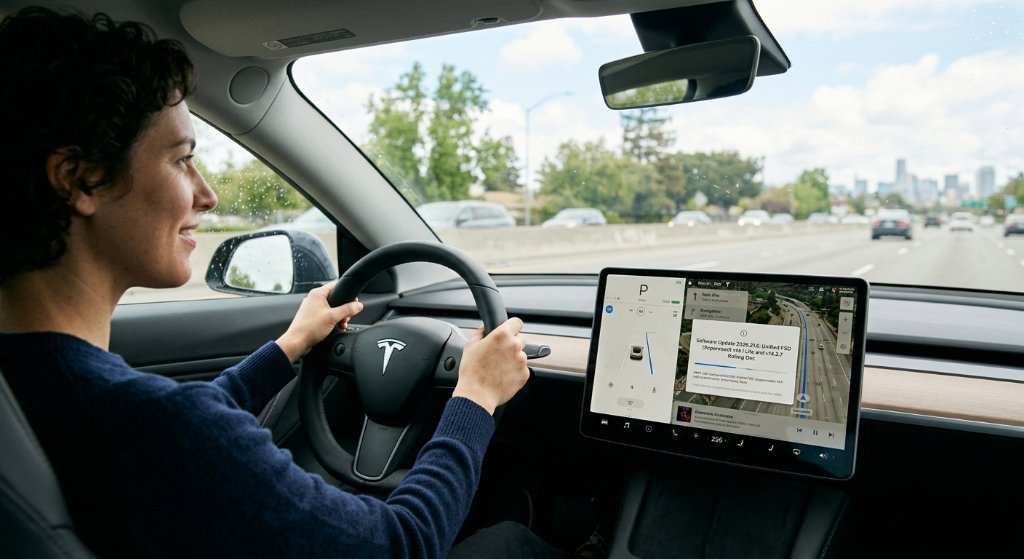
Tesla has officially begun rolling out its highly anticipated unified software update, version 2026.21.6. In doing so, the EV pioneer is tackling one of the most polarizing issues in its modern ecosystem: the widening performance and feature chasm between Hardware 3 (AI3) and Hardware 4 (AI4) vehicles.
For years, Tesla owners who paid up to $15,000 for Full Self-Driving (FSD) on legacy HW3 platforms watched with growing frustration as newer, HW4-equipped models received more advanced, smoother software branches. With compute limitations threatening to leave the aging HW3 fleet stranded, critics questioned whether Tesla could ever deliver on its promise of autonomy for older cars without costly hardware retrofits. Update 2026.21.6 is Tesla's definitive answer, deploying optimized code concurrently to both hardware generations and proving that legacy silicon still has a vital role to play.
Bridging the Divide: HW3/AI3 Receives FSD v14.1 Lite
To accommodate the processing constraints of the legacy AI3 chip, Tesla’s engineers have distilled the intelligence of its advanced v14 neural networks into a highly optimized version dubbed FSD (Supervised) v14.1 Lite. Early real-world feedback from the Tesla community suggests this build is a massive leap forward, successfully ironing out some of the most persistent, frustrating bugs that have plagued HW3 drivers for years. Key improvements include:
- Elimination of Highway Accelerator Pulsing: Smooths out the annoying micro-surges in speed that made highway driving feel jerky and unrefined.
- Banishment of Unexpected Brake Tapping: Drastically reduces instances of hesitant braking or 'phantom' brake stabbing, significantly improving cabin comfort and safety.
- Confidence at Intersections: Enhances handling of unprotected left turns and red-light stops, accompanied by smoother merges and lane centering.
Unleashing Next-Gen Capabilities: HW4 Gets FSD v14.3.7
While legacy cars get a refined, hardware-optimized experience, Tesla is concurrently unleashing the raw processing power of Hardware 4 (AI4) with FSD v14.3.7. This update packs upgraded Reinforcement Learning (RL) training models. More importantly, it delivers several major, undocumented features that elevate the overall user experience:
- Actually Smart Summon (ASS): Dramatically improves the vehicle's ability to autonomously navigate complex parking lots to find you (now also available for Cybertruck owners).
- Park-to-Drive Autonomy: The car can now initiate FSD directly from a parked state, eliminating the need for an initial manual pull-away.
- Camera Preview & Speed Profiles: Offers clearer visual confirmation of the vehicle's cameras before driving, paired with more natural, human-like speed adjustments based on real-time traffic flow.
Why This Matters:
Tesla’s simultaneous, dual-track deployment of FSD v14 across HW3 and HW4 is a major engineering and strategic victory. It sends a powerful message to both the market and its customer base: Tesla has no intention of abandoning its older vehicles.
- Who Wins: Legacy Tesla owners are the clear winners here. By successfully packing a heavy end-to-end neural network into older, compute-constrained hardware (via the 'Lite' model), Tesla has protected the residual value of millions of older vehicles and preserved customer trust. Furthermore, Tesla’s engineering team wins by consolidating its fragmented software branches, reducing development overhead.
- Who Loses: Traditional legacy automakers and rival AV companies who were hoping Tesla’s older fleet would become obsolete. This update proves Tesla's over-the-air (OTA) architecture can continuously breathe new life into older assets, a feat legacy brands still struggle to replicate.
- The Strategic Signal: Squeezing maximum efficiency out of HW3 through model optimization and model pruning demonstrates Tesla's world-class AI compiler capabilities. It signals that Tesla’s upcoming Robotaxi platform—which will rely on high-volume fleet deployment—can operate reliably even on tight hardware budgets. This is a crucial proof of concept for Tesla’s scaling ambitions.
Conclusion
Update 2026.21.6 is more than a simple point release; it is a masterclass in fleet management and software optimization. By keeping older vehicles in the FSD loop while concurrently expanding the capabilities of HW4, Tesla is bridging the gap between its past promises and its autonomous future. As the company marches toward unsupervised autonomy, this unified release serves as a crucial milestone, proving that its software-first approach can scale across generations without leaving early adopters behind.