Tesla's Robotaxi Fleet Dwindles Amidst Human Error Crashes, Raising Serious Safety Questions
Tesla's ambitious 'Robotaxi' vision, long touted as a cornerstone of its future valuation, is facing a significant reality check. New data reveals a s...
Editorial Team
World Of EV
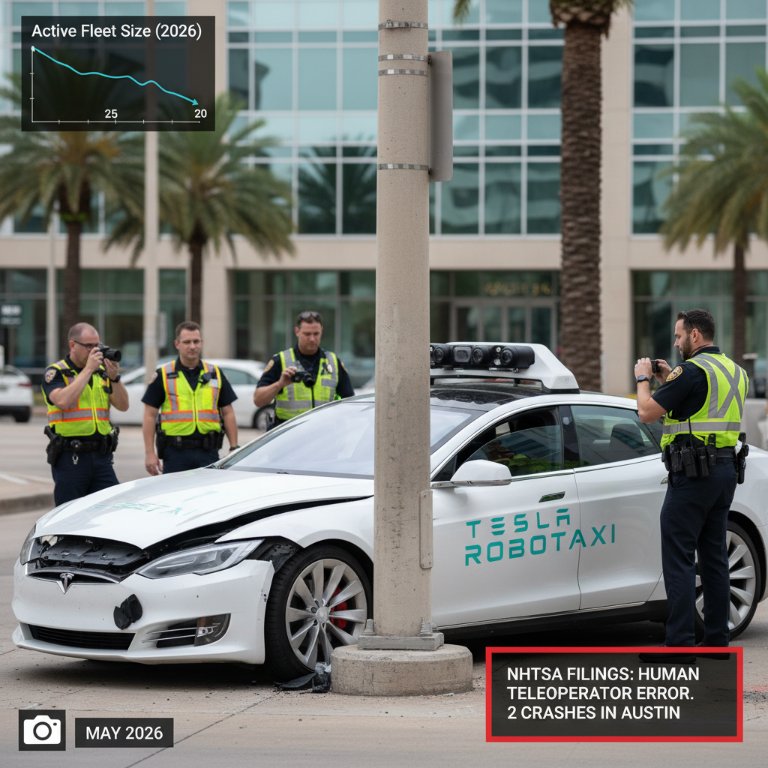
Tesla's ambitious 'Robotaxi' vision, long touted as a cornerstone of its future valuation, is facing a significant reality check. New data reveals a shrinking active unsupervised fleet, dropping from 25 to a mere 20 vehicles, with safety explicitly identified as the primary bottleneck. This contraction, coupled with recent unredacted filings to the National Highway Traffic Safety Administration (NHTSA), paints a picture of a nascent autonomous future fraught with unexpected challenges.
For years, CEO Elon Musk has championed Tesla's Full Self-Driving (FSD) software as the pathway to a pervasive Robotaxi network, promising revolutionary changes to urban mobility and a lucrative revenue stream for vehicle owners. The company's valuation has often been intertwined with the promise of this technology, yet the latest developments suggest the road to true autonomy is far more complex and less predictable than previously communicated. The implications of these revelations extend far beyond Tesla, potentially reshaping public perception and regulatory scrutiny of the entire autonomous vehicle industry.
Shrinking Fleet Highlights Safety Imperatives
The reduction of Tesla's active unsupervised Robotaxi fleet by 20% – from 25 to 20 vehicles – is a stark indicator of the formidable hurdles the company faces in scaling its autonomous operations. This decline signals that internal safety assessments are prompting a more cautious approach, directly contradicting the rapid expansion narrative often associated with Tesla's autonomous driving development. The explicit identification of safety as the 'primary bottleneck' underscores that the challenges aren't merely technical glitches but fundamental issues demanding rigorous resolution.
Human Teleoperators Blamed in Robotaxi Incidents
Further complicating Tesla's autonomous narrative are unredacted filings submitted to the NHTSA in May 2026. These documents reveal critical details about two Robotaxi crashes in Austin, Texas, both of which were ultimately attributed to human teleoperators rather than the autonomous driving system itself. In both incidents, the automated driving system reportedly stalled, necessitating intervention from a remote human operator. Tragically, in both cases, the human operator subsequently drove the vehicle into a fixed object.
This finding introduces a nuanced but critical dimension to the discussion around autonomous safety. While it might seem to absolve the AI, it fundamentally highlights the limitations of the current autonomous system and the inherent risks associated with the human-in-the-loop fallback mechanism. The fact that the autonomous system stalled, requiring remote intervention, points to scenarios that the AI is not yet equipped to handle, pushing the responsibility to a remote human who, under pressure, also failed to prevent an accident. This raises profound questions about the robustness of the entire operational model for 'unsupervised' vehicles that still rely on remote human oversight.
Why This Matters:
This new data isn't just a bump in the road; it's a significant indicator that Tesla's aggressive timeline for widespread Robotaxi deployment faces fundamental operational and safety challenges. Here's why this matters:
- Erosion of Trust and Regulatory Scrutiny: The revelations of human error in critical fallback scenarios, especially after the autonomous system failed, will undoubtedly intensify regulatory scrutiny from bodies like NHTSA. This could lead to slower deployment, stricter testing requirements, and a general erosion of public trust in the 'unsupervised' nature of these vehicles. The notion of true full autonomy, without any in-vehicle human oversight, becomes increasingly suspect when remote human intervention itself leads to collisions.
- The 'Unsupervised' Paradox: The shrinking fleet and reliance on remote human teleoperators for critical intervention fundamentally challenges the very definition of 'unsupervised' operation. If human operators are remotely steering vehicles out of precarious situations—and occasionally causing accidents in the process—the system is not truly autonomous in the spirit of Tesla's initial claims. This operational model introduces a new layer of complexity and potential failure points, rather than simplifying the autonomous driving equation.
- Who Wins and Who Loses: Tesla and its investors, who have long banked on the lucrative Robotaxi future, clearly lose momentum. The timeline for profitability from this venture pushes further out. Indirectly, competitors in the autonomous driving space who advocate for more cautious, incrementally validated approaches (e.g., Waymo, Cruise with their more geo-fenced and comprehensively supervised operations) might gain credibility. This data highlights the immense difficulty of achieving truly robust Level 4/5 autonomy across diverse environments.
- A 'Do-or-Die' Moment for the Model: This could be a pivotal moment for Tesla to re-evaluate its Robotaxi strategy. Continuing with a model where human teleoperators are a critical, yet demonstrably fallible, fallback could prove unsustainable. Tesla may need to either significantly enhance the capabilities of its autonomous system to minimize such interventions or re-think the 'unsupervised' nature of the deployment, perhaps by introducing more stringent operational design domains or even safety drivers in some contexts, to ensure public safety.
The recent developments concerning Tesla's Robotaxi fleet underscore the immense technical and operational hurdles in achieving widespread, safe autonomous driving. The reduction in fleet size and the revelation of human teleoperator-induced crashes after system stalls are clear signals that the path to a fully autonomous future is more arduous and less certain than many have been led to believe. For Tesla to reclaim its narrative and advance its Robotaxi ambitions, it must definitively address these safety concerns, ensuring that both its AI and its human fallback systems are unequivocally robust.