Tesla’s Regulatory Gamble Backfires: NHTSA Demands Sworn Proof That Steering-Wheel-Free Cybercab is Legal Under Threat of $139M Fine
Just weeks after Tesla triumphantly launched its commercial Cybercab robotaxi service on the streets of Austin, Texas, the federal government is deman...
Editorial Team
World Of EV
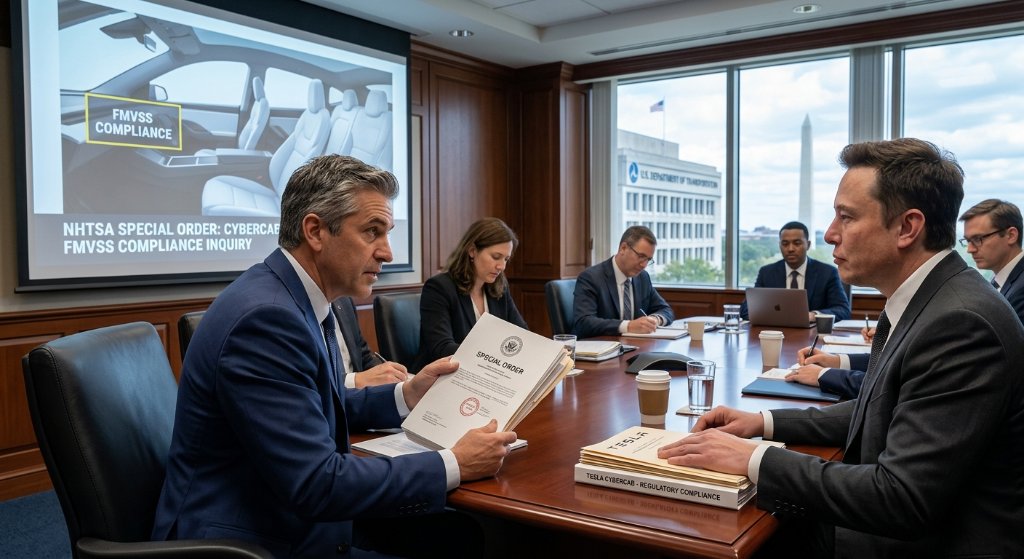
Just weeks after Tesla triumphantly launched its commercial Cybercab robotaxi service on the streets of Austin, Texas, the federal government is demanding answers under oath. The National Highway Traffic Safety Administration (NHTSA) has escalated its initial audit query into a formal, binding Special Order, pushing Tesla into a high-stakes regulatory corner. Tesla has until September 30, 2026, to prove how its steering-wheel-free, pedal-free, and mirror-less two-seater complies with Federal Motor Vehicle Safety Standards (FMVSS)—or face crushing civil penalties of up to $139 million.
This is a massive clash of philosophies. For years, autonomous vehicle pioneers like Alphabet's Waymo and Amazon's Zoox have meticulously sought federal exemptions to run driverless vehicles, playing within the strict rules of the road. Tesla, in typical Silicon Valley fashion, chose a different, much more aggressive path: self-certification. But with no manual steering wheel, foot pedals, or side-view mirrors on the Cybercab, federal regulators are fundamentally questioning whether Tesla’s self-certification is misleading—or outright false.
The Escalation: From Audit to Sworn Affidavit
The trouble began on September 3, 2026, when Tesla officially began accepting paying passengers for Cybercab rides in Austin. Within hours, NHTSA opened Audit Query AQ26002 to scrutinize the vehicle's design. But what started as an inquiry has rapidly turned hostile. Chief Counsel Peter Simshauser signed a formal Special Order, escalating the probe to a legal mandate that requires Tesla to provide detailed answers, under oath, to 21 comprehensive requests. Among the government’s inquiries is a highly pointed question: did Tesla temporarily install physical human driver controls to game the certification process?
The Core Battlegrounds: Why the Cybercab Violates Current Rules
Under current FMVSS guidelines, vehicles must feature specific physical safety overrides to protect occupants on public roads. The Cybercab completely reimagines the vehicle cabin, entirely omitting these components:
- No Steering Wheel: Traditional federal standards require a physical wheel connected to a steering column.
- No Pedal Assembly: FMVSS 135 strictly mandates a foot-activated service brake, whereas the Cybercab relies solely on redundant drive-by-wire and brake-by-wire computer systems.
- No Mirrors: Physical side and rearview mirrors are absent, replaced entirely by Tesla's camera-based vision system.
- Strict Operational Constraints: The current Cybercab fleet is restricted to a small footprint in Austin, prompting NHTSA to demand information regarding geofencing, speed limits, and operational safety domains.
If Tesla fails to provide convincing, legally binding evidence that the Cybercab meets the spirit and letter of safety regulations, NHTSA could compel a full recall of the fleet, effectively shutting down the Austin pilot before it can scale.
Why This Matters:
This is a defining "do-or-die" moment for Elon Musk’s autonomous ambitions. For years, Tesla has promised investors that fully autonomous driving would unlock trillions of dollars in value. But by bypassing the traditional FMVSS exemption route—which caps deployments at 2,500 vehicles per year per manufacturer—and trying to self-certify a vehicle with absolutely no backup driver controls, Tesla took an unprecedented legal gamble.
If NHTSA rejects Tesla's arguments, the losers are clear: Tesla and its investors. The Cybercab would be legally grounded, delaying Elon Musk’s autonomous timeline by years and potentially forcing a costly redesign to include removable or temporary physical controls. Furthermore, a negative ruling would signal to the entire automotive industry that there are no shortcuts to bypassing FMVSS; even the world’s most valuable EV maker must play by the rules.
On the flip side, the winners are rival AV operators like Waymo and Zoox, who have spent years navigating the regulatory bureaucracy. It validates their slower, safer, and legally compliant approach. Ultimately, this battle is about more than just one car; it is a referendum on whether the U.S. government will allow software-driven, custom-built robotaxis on public roads without physical human-override systems.
Conclusion
The clock is ticking loudly for Tesla. The September 30 deadline leaves Elon Musk’s legal and engineering teams with barely two weeks to compile an ironclad, sworn defense of a vehicle that defies decades of safety standards. If they fail, the Cybercab's revolutionary promise of cheap, driverless transport could be legally dead on arrival.