Tesla's Redacted Autonomous Crash Data Unveiled: Exposing Critical System Limits and Teleoperator Blunders
After years of operating under a veil of secrecy regarding its advanced driver-assistance systems, Tesla has finally lifted a corner, publicly reveali...
Editorial Team
World Of EV
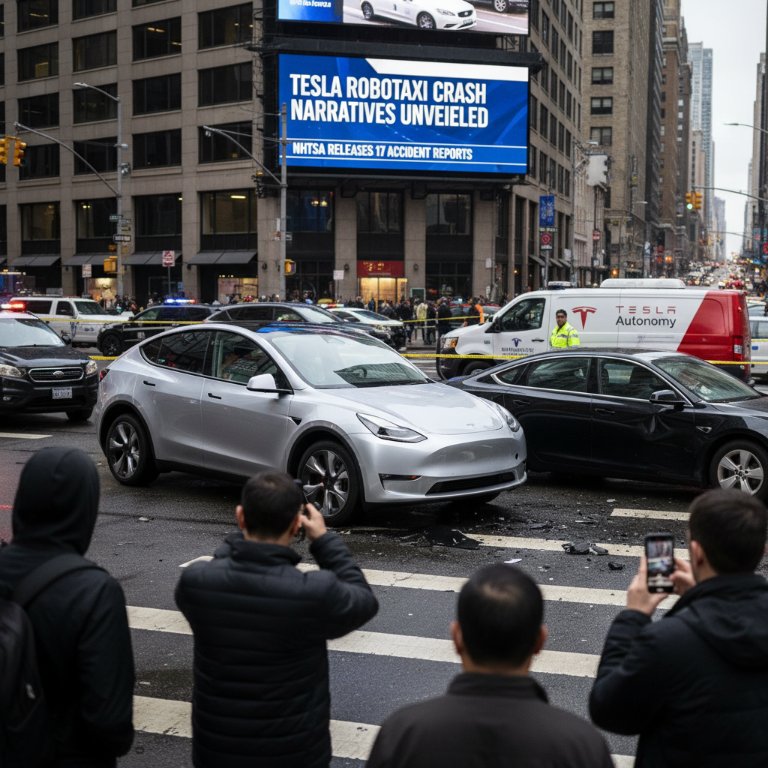
After years of operating under a veil of secrecy regarding its advanced driver-assistance systems, Tesla has finally lifted a corner, publicly revealing the details of 17 autonomous driving crash narratives filed with the National Highway Traffic Safety Administration (NHTSA). These incidents, previously fully redacted as 'confidential business information,' occurred between July 2025 and March 2026, predominantly involving 2026 Model Y vehicles operating with the Autonomous Driving System (ADS) engaged and a safety monitor present. The release offers a rare, unfiltered glimpse into the real-world challenges facing Tesla's autonomy ambitions, going beyond the marketing to the hard data.
Unpacking the Disclosed Incidents
The 17 crash narratives paint a complex picture of autonomous system performance. While a majority of the incidents were attributed to the actions of other drivers, reinforcing the chaotic reality of public roads, a significant portion highlighted critical limitations within Tesla's own autonomous driving system and its teleoperator backup. This public disclosure represents a crucial pivot, moving from an opaque system to one under increasing scrutiny. Tesla has long maintained a guarded stance on its FSD (Full Self-Driving) and ADS data, often citing proprietary concerns, making this release a notable shift in their data transparency strategy.
Key takeaways from the released data include:
- Timeline and Scope: Incidents spanned nine months (July 2025 to March 2026), focusing primarily on late-model 2026 Model Y vehicles, indicating these are not merely historical glitches but issues observed with more recent hardware and software iterations.
- ADS Engagement with Safety Monitor: All reported incidents occurred while the ADS was active and a human safety monitor was present, raising questions about the efficacy of current supervision protocols and the system's ability to handle edge cases.
- Beyond External Factors: While other drivers were often at fault, several narratives undeniably exposed shortcomings in Tesla’s ADS, challenging the narrative of seamless, omniscient autonomy.
- Teleoperator-Induced Crashes: Most concerning are the two distinct incidents where a remote teleoperator, intended as a safety net, directly caused crashes. This revelation points to a significant flaw in the human-in-the-loop strategy when that human is remote and potentially facing latency or incomplete situational awareness.
The Alarming Role of Remote Teleoperators
The most striking revelation from these narratives is the confirmed involvement of remote teleoperators in causing two crashes. Teleoperation is often touted as a critical safety feature for Level 4 and Level 5 autonomous systems, providing a human override or guidance in complex situations. However, these incidents suggest that introducing a remote human element can introduce its own set of vulnerabilities. Factors such as network latency, reduced situational awareness compared to an in-car driver, and potential interface complexities could all contribute to errors. This directly challenges the assumption that remote human intervention is an unmitigated safety enhancement, instead revealing a potential new vector for accidents within the autonomous driving ecosystem.
Why This Matters:
This unprecedented data release from Tesla is far more than just a regulatory filing; it's a pivotal moment for the autonomous driving industry, for regulators, and most importantly, for consumers. It forces a recalibration of expectations and highlights critical dilemmas.
- Transparency vs. Trust: Tesla's decision, or perhaps obligation, to release this previously redacted data is a double-edged sword. On one hand, greater transparency is vital for public trust and informed decision-making. On the other, the details, particularly the teleoperator-caused crashes, could erode confidence in the immediate safety and reliability of current ADS technology. For savvy EV enthusiasts and prospective buyers, this data moves the conversation from speculative capabilities to documented limitations.
- Regulatory Scrutiny Intensifies: This data will undoubtedly fuel further scrutiny from NHTSA and other global regulators. The agency now has concrete examples of system failures and human intervention gone wrong, which could lead to more stringent testing requirements, mandatory data sharing protocols, and potentially even limitations on the rollout of certain ADS features. This signals a maturation of the regulatory environment, pushing for accountability rather than simply allowing innovation to proceed unchecked.
- The 'Safety Monitor' Paradox: The fact that incidents occurred even with a safety monitor present underscores the inherent complexities of partial autonomy. It begs the question: how effective is a human monitor if they cannot always prevent or override system errors, or worse, if the remote monitor *causes* the error? This challenges the very foundation of current Level 2 and Level 3 autonomous system deployments.
- Industry Ripple Effect: While specific to Tesla, this data has implications for the entire autonomous driving industry. Competitors like Waymo and Cruise, who have generally adopted a more cautious deployment strategy and greater transparency regarding their incident data, might leverage this to highlight their own safety frameworks. For the broader industry, it's a stark reminder that robust safety cases and rigorous testing are paramount, and that the 'human-in-the-loop' solution is not a panacea.
This release forces a crucial reassessment of Tesla's autonomous driving systems. While progress in AV technology is undeniable, these narratives reveal that significant hurdles remain, not just in software and hardware, but in the intricate dance between machine and human intervention. It’s a moment that demands a critical look at how fast is too fast, and how much is too much, when it comes to entrusting our safety to machines and their remote human guardians. The long-term success of autonomous vehicles hinges not just on their capabilities, but on absolute, undeniable reliability, and transparent accountability.
The public unveiling of these crash narratives marks a crucial juncture for Tesla and the broader autonomous vehicle industry. It underscores the urgent need for a robust, transparent, and continuously refined approach to safety, particularly as these systems become more prevalent. The path to full autonomy is undoubtedly fraught with challenges, and this data serves as a stark reminder that both technological prowess and judicious oversight are indispensable for its safe realization.