Tesla’s Night Shift: FSD v15 to Unlock 24/7 Robotaxi Service and Upend the Autonomy Race
Just days after officially launching public Cybercab rides in Austin, Tesla is already preparing to throw its autonomous ride-hailing network into ove...
Editorial Team
World Of EV
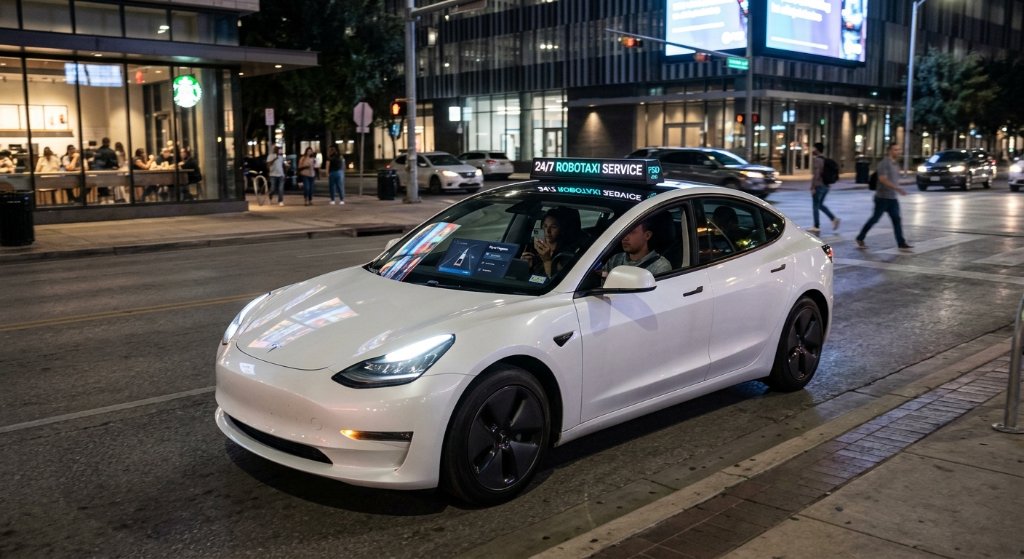
Just days after officially launching public Cybercab rides in Austin, Tesla is already preparing to throw its autonomous ride-hailing network into overdrive. Tesla’s AI lead, Ashok Elluswamy, confirmed that the company’s paid Robotaxi service will shed its daytime restrictions and transition to a round-the-clock, 24/7 schedule within the next month. This rapid expansion will be unlocked by a highly anticipated technical merge under Tesla’s next-generation Full Self-Driving (FSD) v15 architecture.
For years, critics laughed off Elon Musk's promises of a driverless future, pointing to the slow rollout of FSD and the shuttering of early safety-driver-bound pilot programs. But after quietly racking up unsupervised miles across states like Texas and Florida since mid-2025, Tesla’s autonomy roadmap has finally hit escape velocity. The move to a 24/7 service window is not just a scheduling tweak; it is a direct assault on established, lidar-reliant autonomous vehicle (AV) networks like Alphabet's Waymo.
Ditching the Curfew: The FSD v15 Paradigm Shift
Currently, Tesla's paid Robotaxi service operates under a strict 16-hour window (6:00 AM to 10:00 PM) across major hubs, including Austin, Dallas, Houston, Miami, Orlando, and Tampa. This limitation is largely due to the challenges of operating unsupervised cameras in low-light and high-glare environments. Elluswamy’s announcement that the service is ready for the night shift relies entirely on merging new technology tracks into FSD v15—an architecture Tesla describes as a 'step-change' update.
FSD v15 represents a massive architectural leap:
- Massive Scaling: The system possesses roughly ten times more parameters than previous builds.
- Parallel Optimization: It features seven parallel development tracks, of which only 40% have been integrated into early production fleets so far.
- Vision-Only Autonomy: It doubles down on Tesla's end-to-end neural network, rejecting the costly lidar sensors utilized by rivals in favor of pure camera-based processing.
The Economics of Extreme Vehicle Utilization
Unlocking the night shift is a massive win for the economics of autonomy. By expanding from 16 to 24 hours of operation, Tesla can dramatically increase vehicle utilization—the single most important metric for ride-hailing profitability. Overnight operations also perfectly align with Tesla's infrastructure playbook. The company is already utilizing public Superchargers during off-peak night hours when electricity rates are lowest and passenger demand on public stalls is minimal.
This software-driven scaling comes on the heels of the radical Cybercab hardware debut on September 3, 2026. Stripped of steering wheels and pedals, the Cybercab is a clean-sheet design engineered for maximum reliability and minimum operating cost:
- Powertrain & Range: Powered by a 48 kWh pack of 4680 battery cells, delivering 293 miles of range.
- Lightweight Efficiency: Weighing just 3,113 lbs and achieving an industry-leading 5.5 mi/kWh efficiency.
- Pioneering Tech: Utilizes a dry, hydraulic-free brake-by-wire system and inductive wireless charging, eliminating high-maintenance mechanical failure points.
Why This Matters:
This is the 'do-or-die' moment for Tesla's camera-only autonomous philosophy. By expanding to 24/7 service, Tesla is throwing down the gauntlet to Waymo and legacy ride-hailing platforms. If camera-based neural networks can flawlessly navigate pitch-black suburban streets, blinding headlight glare, and late-night highway construction zones without lidar, the cost argument for expensive sensor suites collapses. Waymo’s hardware stack costs tens of thousands of dollars per vehicle; Tesla's Cybercab aims for a sub-$30,000 retail price.
The Winners: Tesla is the clear winner here, proving it can scale a driverless network with a fraction of the capital expenditure of its competitors. Fleet owners and early adopters who plan to buy Cybercabs to rent them out on the network also win, as 24/7 uptime translates directly to faster ROI.
The Losers: Lidar manufacturers and traditional ride-hailing drivers are on notice. If Tesla can scale this rapidly across multiple states, the traditional economics of human-driven platforms like Uber and Lyft will look increasingly obsolete in urban centers.
Conclusion
Tesla's transition to a 24/7 driverless network marks the end of the experimental phase of vehicle autonomy and the beginning of a brutal commercial price war. Achieving 1 million unsupervised miles was a major milestone, but unlocking round-the-clock operations on FSD v15 will prove whether camera-only autonomy can truly handle the unpredictable nature of the real world at midnight. If next month's rollout goes smoothly, the entire automotive industry will have to rethink its self-driving timelines.