Tesla's Next-Gen Roadster Finally Lands Production Home at Giga Texas, Signalling a Hypercar Showdown
Austin, Texas – After years of anticipation, speculative timelines, and ambitious promises, Tesla executives have confirmed that the next-generation R...
Editorial Team
World Of EV
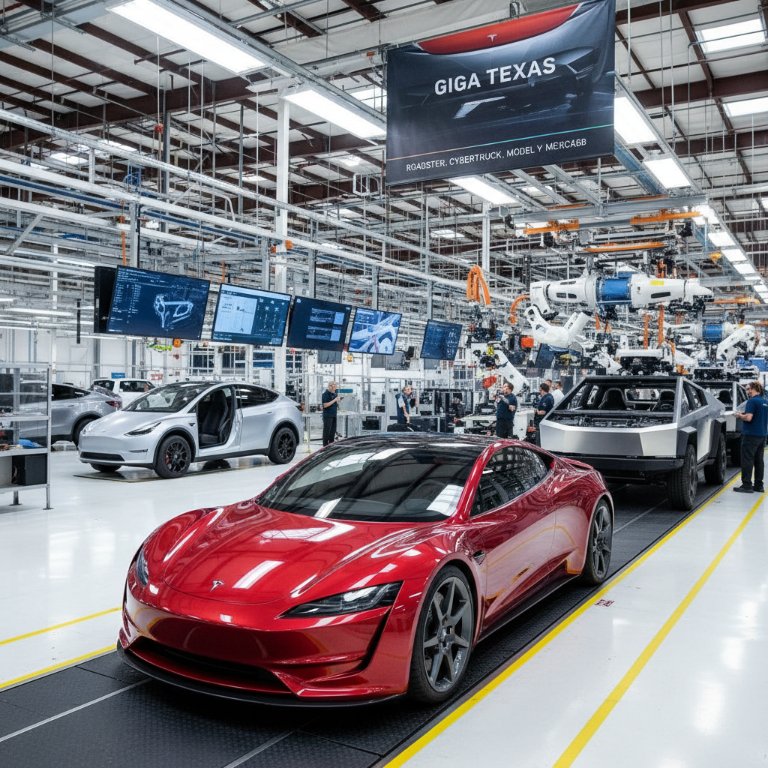
Austin, Texas – After years of anticipation, speculative timelines, and ambitious promises, Tesla executives have confirmed that the next-generation Roadster, positioned as a 250 mph electric supercar, will officially be produced at Gigafactory Texas. This strategic decision not only diversifies the output of Tesla's sprawling Austin facility but also firmly anchors the long-awaited halo car within the company's most advanced manufacturing ecosystem.
Unveiled in 2017 with mind-bending performance targets, the Roadster has existed largely as a concept, its release date shifting repeatedly through the years. Now, with Chief Designer Franz von Holzhausen and VP of Vehicle Engineering Lars Moravy confirming its Texas residency during a recent podcast appearance, the project gains its most concrete production milestone to date, sending a clear signal that Tesla is serious about delivering on its hypercar aspirations.
Giga Texas: The High-Performance Hub
Gigafactory Texas is rapidly evolving beyond a volume production center for the Model Y and Cybertruck. The addition of the Roadster positions it as a crucible for Tesla's most innovative and performance-oriented vehicles. The factory is already scaling up for future endeavors like the Cybercab robotaxi and the Optimus humanoid robot, making it a critical hub for Tesla's diverse technological ambitions.
- Diversified Production: The Roadster joins the high-volume Model Y and the recently launched Cybertruck, expanding Giga Texas's manufacturing portfolio into the ultra-luxury performance segment.
- 4680 Battery Integration: Production at Giga Texas allows for seamless integration with Tesla's advanced 4680 battery cells, crucial for achieving the Roadster's promised 620-mile range and lightweight performance ethos.
- SpaceX Synergy: The factory's proximity to SpaceX's Starbase facility in Boca Chica offers a unique advantage, potentially streamlining the engineering collaboration required for the rumored 'SpaceX Package' and its cold gas thrusters.
- New Test Track: Tesla is reportedly constructing a massive test track at Giga Texas, complete with a high-speed oval and chicanes, further underscoring the facility's role in developing and validating extreme performance vehicles.
The Roadster's Unprecedented Ambition
From its initial reveal, the second-generation Roadster set benchmarks that seemed almost fantastical. Tesla's stated performance targets remain audacious, even by today's rapidly advancing EV standards.
- Blistering Acceleration: A projected 0-60 mph sprint in just 1.9 seconds, with a quarter-mile time of 8.8 seconds.
- Record Top Speed: A top speed exceeding 250 mph.
- Exceptional Range: An estimated 620 miles on a single charge from its 200 kWh battery pack.
- Innovative Powertrain: Confirmation of a four-motor powertrain, allowing for unprecedented control and torque vectoring, with a staggering 10,000 Nm of wheel torque.
- 'SpaceX Package': The optional thruster system, hinted at by Elon Musk, promises to push performance envelopes even further, potentially enabling revolutionary capabilities in acceleration, braking, and cornering.
A Decade in the Making: The Road to Production
The original Tesla Roadster, a Lotus Elise-based EV that put Tesla on the map, ended production in 2012. The subsequent reveal of the second-generation Roadster in 2017 ignited immense excitement, but its journey to production has been fraught with delays. Initial delivery targets of 2020 and 2023 were missed, and even a more recent hint of an April 2026 re-unveil did not materialize. Despite the extended gestation period and growing skepticism among some enthusiasts, the recent confirmation by executives that alpha prototypes are actively undergoing testing and that production layout planning is underway offers tangible proof of progress.
Why This Matters:
The decision to build the Roadster at Gigafactory Texas holds significant implications for Tesla, the broader EV market, and the future of hypercar performance. For Tesla, it's a critical moment to solidify its reputation not just as a mass-market EV leader, but as an engineering powerhouse capable of delivering on its most ambitious promises. The company has increasingly focused on autonomous vehicles, robotics, and artificial intelligence, with fewer significant updates to its core vehicle lineup like the Model 3 and Model Y. The Roadster's production at Giga Texas, therefore, serves as a powerful reminder of Tesla's performance DNA and its commitment to pushing automotive boundaries. This isn't just about selling another car; it's about validating Tesla's technological prowess against a backdrop of increasing competition in the electric hypercar space from established players like Rimac with its Nevera, which has already shattered numerous performance records. The Roadster's arrival will ignite a new era of direct competition, forcing rivals to push even harder. For consumers and industry professionals, it signals a renewed focus on extreme performance and innovation from Tesla, confirming that Giga Texas is not merely a manufacturing facility, but a development hub for the company's most cutting-edge projects.
Conclusion
The long-awaited confirmation of the Tesla Roadster's production at Gigafactory Texas marks a pivotal moment for the electric supercar and for Tesla's strategic direction. While timelines have historically been fluid, the tangible commitment to Giga Texas, coupled with ongoing alpha testing and manufacturing planning, indicates that the world's most anticipated EV hypercar is finally moving closer to reality. Its eventual arrival promises to redefine performance benchmarks, intensify competition in the high-end EV segment, and further cement Gigafactory Texas as a cornerstone of Tesla's innovative future.