Tesla's New FSD Mandate: Is Driver Accountability Undermining Immediate Safety?
Tesla, a perennial disruptor in the automotive world, has quietly rolled out a controversial update to its Full Self-Driving (FSD) software, introduci...
Editorial Team
World Of EV
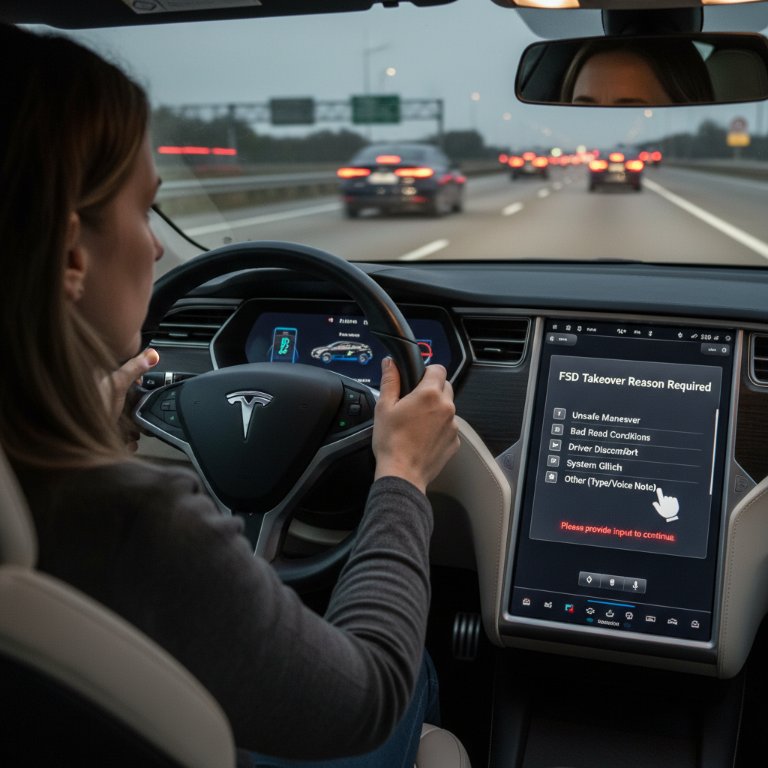
Tesla, a perennial disruptor in the automotive world, has quietly rolled out a controversial update to its Full Self-Driving (FSD) software, introducing a mandatory system that demands drivers explain every manual takeover. This change, which began affecting users in late April and is now fully active, requires drivers to tap a reason on a persistent touchscreen dialog box or record a voice note immediately after disengaging from FSD. The move, intended to gather invaluable data, has sparked a significant backlash from the FSD community, raising critical questions about driver attention and safety during the most vulnerable moments on the road.
The New Accountability Layer for FSD Users
For years, Tesla has collected vast amounts of data from FSD users, utilizing a network of cameras and sensors to understand disengagement events. However, this latest update marks a dramatic shift towards explicit driver input. Now, when a driver intervenes and takes manual control from FSD, a prominent dialog box appears on the vehicle's central touchscreen, remaining active until a response is provided. Drivers must articulate why they took over, choosing from pre-defined options or recording a verbal explanation.
- Mandatory Input: The system demands a response, pausing other screen functions until acknowledged.
- Persistent Dialog: The prompt does not disappear until the driver interacts with it.
- Data Collection Focus: Tesla's apparent aim is to gather more nuanced data on specific disengagement scenarios, moving beyond raw telemetry to direct driver feedback.
This aggressive data collection strategy aims to refine FSD's algorithms by understanding the exact circumstances of human intervention. While more data often leads to better machine learning, the implementation of this system has ignited a heated debate among the very users Tesla relies on for FSD development.
Driver Safety Concerns Clash with Data Imperatives
Unlike previous data collection methods that ran silently in the background, this new system actively requires a driver's immediate attention and interaction during a critical period. FSD disengagements often occur in complex, unpredictable, or even hazardous situations where a driver needs to focus entirely on the road and surroundings. Diverting attention to a touchscreen, even for a few seconds, could prove catastrophic.
Imagine a scenario where FSD makes an unexpected maneuver, requiring an urgent manual override. Instead of the driver dedicating 100% of their focus to correcting the vehicle's path and assessing immediate hazards, they are now presented with a persistent digital prompt demanding an explanation. This split-second cognitive load and visual distraction, immediately following a potentially stressful event, is precisely what safety advocates warn against. Critics argue that Tesla is prioritizing data acquisition over the immediate safety and undivided attention of its drivers in crucial moments.
Why This Matters:
This update is more than just a minor software tweak; it represents a significant, and potentially risky, evolution in Tesla's FSD strategy. For industry professionals and savvy EV enthusiasts, this move signals several critical implications:
- Enhanced FSD Training Data, But At What Cost? Tesla clearly believes this granular driver feedback will accelerate FSD's development. By understanding the intent behind disengagements, they can better identify edge cases and problematic behaviors. However, if this comes at the expense of driver focus during emergencies, the trade-off is deeply problematic. The question isn't if the data is useful, but how it's collected without compromising safety.
- Shifting Liability Narrative? This system could also serve a secondary purpose for Tesla: to help differentiate between FSD errors and driver interventions. By requiring a reason, Tesla might be subtly building a database to demonstrate when drivers take over unnecessarily or for reasons not directly related to FSD malfunction. This could be a proactive step in a future regulatory environment where liability for ADAS (Advanced Driver-Assistance Systems) is a major battleground. The move also contrasts sharply with the more subtle driver monitoring systems in place with competitors like GM's Super Cruise or Ford's BlueCruise, which focus on ensuring driver engagement without requiring post-takeover explanations.
- User Experience and Trust Erosion: The user backlash highlights a critical challenge: forcing compliance can alienate users. FSD beta testers are often enthusiastic and understanding of the development process. However, imposing a system perceived as an immediate safety hazard could erode trust, potentially leading to fewer FSD miles driven or even active workarounds by users, defeating the data collection purpose.
- Regulatory Scrutiny on the Horizon? Given the existing scrutiny on FSD and ADAS in general, this mandatory system, particularly with the vocal user concerns, could attract the attention of regulators like NHTSA. Agencies may question the safety implications of diverting driver attention post-disengagement, potentially leading to demands for modifications or even a recall of the feature.
Tesla's latest FSD update represents a high-stakes gamble. While the potential for richer training data is undeniable, the immediate safety implications for drivers and the potential for a regulatory showdown cast a long shadow. As Tesla pushes the boundaries of autonomous driving, the delicate balance between data imperative and driver safety must remain paramount. The industry, and particularly the discerning World Of EV audience, will be watching closely to see if this aggressive data collection strategy ultimately advances FSD or creates unforeseen liabilities and safety compromises.