Tesla's Gold Cybercab Gets Factory-Integrated Starlink: Musk Predicts Satellite-Backed Future for All Cars
Tesla has finally given the world a physical, production-intent look at its vision for the future of robotaxis. In a major milestone for its autonomou...
Editorial Team
World Of EV
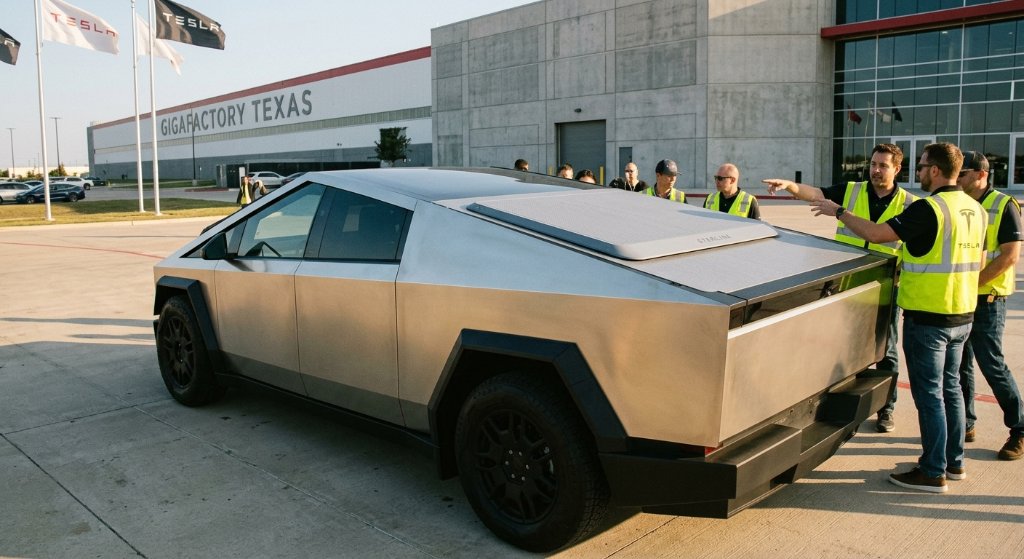
Tesla has finally given the world a physical, production-intent look at its vision for the future of robotaxis. In a major milestone for its autonomous platform, the company's official robotaxi social account shared photographs of the first completed, physical gold Cybercab parked outside Gigafactory Texas. What makes this reveal critical is not just the futuristic gold paint—a direct nod to New York’s iconic yellow cabs—but the seamless, flush-mounted Starlink V5 satellite internet antenna integrated directly into its rear roofline. This physical manifestation of a concept diagram first shared in July signals that Tesla is moving rapidly past the prototype phase and actively styling space-age connectivity into its production-ready fleet.
Following the reveal, Elon Musk took to X to double down on this hybrid tech approach, boldly claiming that "all cars will have Starlink in the future" as the only viable mechanism to route the immense, high-bandwidth data demands of autonomous AI fleets. This development bridges the gap between Tesla’s automotive division and SpaceX’s satellite network, setting a new paradigm for how self-driving fleets will operate globally.
Cutting-Edge Integration: The Hardware Under the Gold Hood
While early Cybercab prototypes were spotted on public roads earlier this year with clumsy, external Starlink dishes bolted to their test rigs, this new vehicle showcases a masterfully flush-mounted Starlink V5 dish. Featuring a custom-designed gold cover that flows seamlessly with the vehicle's bodywork, the terminal is entirely integrated to maintain both aesthetics and low aerodynamic drag.
Based on the technical layout, the Cybercab’s roof-mounted tech suite houses more than just a satellite receiver:
- Integrated Starlink V5 Antenna: A low-profile, flush-mounted receiver designed for high-speed, low-latency satellite internet.
- Dual-Layer Connectivity: Built-in backup 5G LTE antennas to guarantee seamless handoffs between ground cellular and space-based networks.
- Tesla AI4 Computer: The onboard self-driving hardware that processes navigation, vision-based FSD, and localized decision-making.
- Fleet Telemetry Hub: Built-in emergency stop hardware, internal microphones, and high-fidelity video streams.
Resolving the "Why": Why a Robotaxi Needs Space Connectivity
Critics immediately questioned the need for a satellite dish on an urban robotaxi. After all, Tesla’s Full Self-Driving (FSD) software operates entirely via localized onboard computing and doesn't require active internet to navigate. Furthermore, the primary markets where robotaxis are currently testing—like Austin, Dallas, and Miami—already feature robust 5G cellular coverage.
However, Tesla is looking far beyond today's geofenced limits. Tesla AI chief Ashok Elluswamy clarified that while Starlink is not required for safe operation, it is the ultimate safety net for navigation, customer service, remote fleet management, and video streaming. More importantly, it provides a crucial redundant channel for remote human operators to intervene, monitor live multi-camera feeds, or take control of a vehicle if it encounters an edge-case scenario in a cellular dead-zone.
Why This Matters:
- A Death Blow to Geofencing: While competitors like Alphabet's Waymo and Amazon's Zoox are restricted to hyper-localized, ultra-mapped urban grids backed by cellular networks, Tesla is building a global machine. With Starlink, a Cybercab can theoretically navigate, stream, and communicate from the middle of rural Texas or a mountain pass just as easily as it does in downtown Austin.
- SpaceX and Tesla Synergy Solidified: This integration is a massive win for SpaceX, demonstrating how Musk can leverage his outer-space monopoly to give his terrestrial automotive company an unfair advantage. It also fuels market speculation that an eventual, massive "Musk Conglomerate" merger may be inevitable.
- The Impending Cellular Squeeze: Traditional telecom giants stand to lose big. If autonomous AI vehicle traffic indeed outpaces human internet browsing as predicted, cellular carriers will miss out on lucrative machine-to-machine fleet data contracts. Tesla is building its own parallel, space-backed internet network, rendering traditional ground-based carriers obsolete for its fleet.
- A "Do-or-Die" Infrastructure Play: For Tesla, this is an infrastructure moat. No other automaker on earth has direct, proprietary access to a satellite constellation. If future autonomous vehicles genuinely demand constant, high-bandwidth data pipes to safely operate at scale, legacy OEMs will have to pay licensing fees to SpaceX just to compete with Tesla.
The Verdict on Tesla's Cosmic Fleet
The appearance of a production-intent, gold Cybercab with factory-installed Starlink V5 technology proves that Tesla is not just building a car—it is building a global, decentralized computing network. By solving the remote connectivity problem before it even becomes a bottleneck, Tesla has laid down a high-bandwidth gauntlet that legacy automakers and local ride-hail operators simply cannot match. The Cybercab may have started as a radical concept, but as it rolls off the Giga Texas line, it is rapidly materializing into the most connected vehicle ever built.