Tesla's Giga Texas Bottleneck: Why Hundreds of Cybertrucks are Stranded Despite a Federal Court Victory
Drone footage captured on Monday morning, August 10, has revealed a sobering sight at Giga Texas: sprawling clusters of completed Cybertrucks stockpil...
Editorial Team
World Of EV
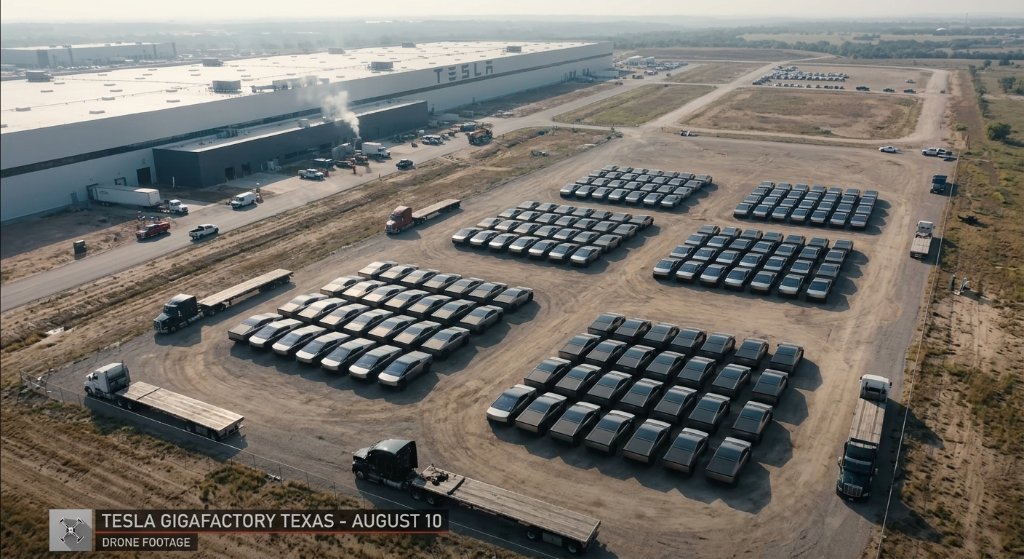
Drone footage captured on Monday morning, August 10, has revealed a sobering sight at Giga Texas: sprawling clusters of completed Cybertrucks stockpiled in temporary holding lots. While the highly anticipated electric pickup has finally crossed into volume production, this fresh bottleneck confirms that Tesla is still locked in a fierce battle to normalize its supply pipeline. The culprit? A dramatic legal showdown with supplier Angstrom Automotive Group LLC that has left thousands of custom-ordered trucks stranded just inches from the finish line.
Tesla is no stranger to what CEO Elon Musk famously dubbed "production hell"—a term coined during the agonizing Model 3 ramp-up of 2018. However, while those early struggles were largely internal, the current Cybertruck delivery freeze highlights a deeper, more systemic vulnerability: the fragility of a highly specialized, single-source supply chain. With its unique stainless-steel exoskeleton and bespoke components, any hiccup in the manufacturing of the Cybertruck can trigger a domino effect that halts the entire delivery ecosystem.
The Angstrom Standoff: Tooling Held Hostage
The root of this massive stockpile is a high-stakes legal feud. In mid-July, Michigan-based Angstrom Automotive Group LLC abruptly announced plans to shutter its facility in Troy, Texas. Crucially, this plant housed the proprietary multi-ton die-cast tooling, trim dies, and specialized inspection equipment necessary to stamp out Cybertruck parts. Rather than allowing Tesla to reclaim its equipment, Angstrom locked its doors, withheld a vital shipment of 700 finished components scheduled for July 17, and demanded a staggering $250,000 per week to keep the facility open or release the assets.
Tesla retaliated on July 23 with an emergency federal lawsuit, characterizing Angstrom's actions as a commercial "ransom" play. While a federal judge handed Tesla a victory on August 4 by granting a Temporary Restraining Order (TRO) to retrieve the equipment, the physical reality of logistics has caught up with the automaker. Moving several tons of heavy industrial machinery, recalibrating it, and reintegrating it into a new production environment is not an overnight process.
Anatomy of a Supply Chain Bottleneck
The lingering backlog at Giga Texas demonstrates that legal victories do not immediately translate to factory-floor fluidity. The key elements of this supply chain disruption include:
- Bespoke Machinery: The withheld equipment consists of multi-ton custom die-cast machinery and X-ray inspection gear that takes five to six months to manufacture from scratch.
- The Logistical Lag: Even with court-ordered access, the physical extraction, transport, and re-setup of industrial stamping tools introduces weeks of operational downtime.
- Unfinished Inventory: The stockpiled Cybertrucks visible from the air are likely waiting on the very trim pieces or structural stampings that Angstrom was contracted to produce.
Why This Matters:
This bottleneck is a stark reminder that in the automotive world, hardware is hard, and legal speed does not equal industrial speed.
Who Loses?
First and foremost, the customers. Thousands of reservation holders who have waited years—and are paying premium prices for Foundation Series models—are left watching their trucks sit in a dusty Texas lot. Additionally, Tesla’s margins take a hit; holding finished, unpaid-for inventory on a balance sheet is an expensive exercise that Wall Street deeply dislikes.
What This Signals to the Market:
The Angstrom dispute exposes a glaring flaw in Tesla's vertical integration narrative. While Tesla builds many things in-house, it remains deeply reliant on tier-1 and tier-2 suppliers for highly specialized, low-volume components. For a vehicle as structurally radical as the Cybertruck, having a single point of failure in the supply chain is a massive liability. It signals to competitors like Rivian and Ford that Tesla’s production machine, while formidable, remains highly vulnerable to external disruptions.
Conclusion
Ultimately, the drone footage over Giga Texas is a visual representation of the friction between legal resolution and physical manufacturing. Tesla has successfully wrested its multi-ton tooling back from Angstrom, but the hangover from this supply chain knife fight will linger for weeks. As the EV pioneer works to clear the backlog and finally get these trucks into customer hands, this episode serves as a cautionary tale: in the high-stakes race of EV manufacturing, your assembly line is only as strong as your most stubborn supplier.