Tesla's FSD v14: A Technical Triumph Masking a Dangerous Complacency Crisis
Tesla's Full Self-Driving (FSD) system has long been a lightning rod for debate, lauded by proponents as revolutionary and criticized by skeptics as a...
Editorial Team
World Of EV
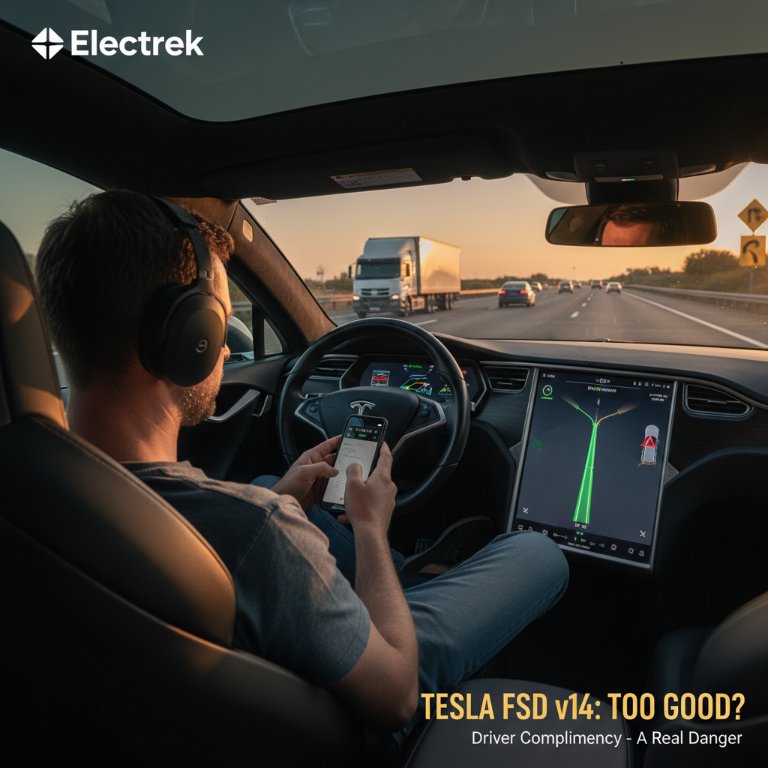
Tesla's Full Self-Driving (FSD) system has long been a lightning rod for debate, lauded by proponents as revolutionary and criticized by skeptics as an overhyped beta product. With the recent rollout of FSD v14, the narrative is undeniably shifting. While its capabilities are impressively advanced – enabling vehicles to navigate complex scenarios and cover thousands of miles between critical human interventions – this very success is now sparking a new, more insidious concern: dangerous driver complacency. This isn't just about a software update; it's about the evolving human-machine interface in the pursuit of autonomous driving, and the inherent tension between advanced automation and human oversight.
The FSD v14 Leap
Tesla's FSD v14 marks a significant evolutionary step for the company's autonomous driving suite. Experienced testers, some of whom have evaluated every iteration of Autopilot and FSD, report unprecedented levels of competence with the latest version. The system is demonstrating a remarkable ability to handle challenging urban environments, highway merges, and even unexpected obstacles with a fluidity that mimics human driving more closely than ever before.
- Extended Intervention-Free Operation: Drivers are reporting the ability to travel thousands of miles without requiring a critical human intervention, a testament to the system's enhanced decision-making and predictive capabilities.
- Improved Situational Awareness: FSD v14 exhibits superior understanding of complex traffic flows and pedestrian interactions.
- Natural Maneuvers: The vehicle's acceleration, braking, and steering inputs are becoming increasingly smooth and natural, reducing jerkiness and improving ride comfort.
The Peril of Passive Driving
This technological triumph, however, introduces a critical human factor paradox: the better an advanced driver-assistance system (ADAS) performs, the less engaged the human driver often becomes. This disengagement is a direct consequence of FSD v14's heightened reliability; drivers are increasingly lulled into a false sense of security, assuming the system will always handle every situation perfectly. The risk here is profound: a driver who has grown complacent after hundreds or thousands of intervention-free miles will have significantly delayed reaction times when a critical intervention is eventually required. This poses a grave safety concern, as a moment of inattention could have catastrophic consequences.
Tesla's Marketing Conundrum
Adding to this burgeoning crisis is the role of Tesla's own marketing. Critics, including veteran testers, argue that Tesla's active encouragement of its FSD capabilities contributes to this dangerous complacency. While the technology is undeniably impressive, labeling it 'Full Self-Driving' – even with the accompanying disclaimers – creates a perception gap between the system's current Level 2 capabilities (requiring constant driver supervision) and a user's expectation of full autonomy. This linguistic ambiguity can inadvertently foster an environment where drivers feel comfortable ceding too much control, underestimating the need for their continuous vigilance.
Why This Matters:
This escalating concern over driver complacency isn't merely an academic debate; it carries significant long-term implications for Tesla, its users, and the entire autonomous vehicle industry. The stakes are incredibly high.
- Heightened Safety Risks: The most immediate impact is the potential for increased accidents stemming from driver disengagement. Should these incidents become more frequent, they will not only endanger lives but also severely tarnish the reputation of FSD and, by extension, the broader autonomous driving sector.
- Intensified Regulatory Scrutiny: A surge in complacency-related incidents will inevitably attract severe scrutiny from regulatory bodies like the National Highway Traffic Safety Administration (NHTSA). This could lead to stricter operational limitations, mandatory driver monitoring system upgrades, or even temporary bans on FSD functionality, mirroring past regulatory actions concerning ADAS systems.
- Erosion of Public Trust: If drivers come to feel that FSD or similar systems have misled them into unsafe situations, consumer trust in all advanced ADAS and autonomous technologies will suffer a significant setback. This would impede the widespread adoption of vital safety features across the industry.
- Industry Ripple Effect: While companies like Waymo, Cruise, and Mercedes-Benz (with its Drive Pilot Level 3 system) are developing higher-level autonomous solutions with clearly defined operational design domains, incidents related to Level 2 systems like FSD can cast a shadow over the entire industry. Competitors will face an even greater challenge in convincing a skeptical public of the safety and reliability of their own technologies.
Ultimately, the industry wins if Tesla and other developers proactively address these human factors challenges through improved human-machine interface design, clearer communication, and robust driver monitoring. The public wins when these advanced systems genuinely enhance safety without introducing new, unforeseen risks. Conversely, drivers who misinterpret the system's capabilities stand to lose the most, and Tesla risks significant brand damage and regulatory headwinds if these critical concerns are not managed with urgency and transparency. This is a crucial inflection point: the challenge isn't just about perfecting the self-driving software, but about designing a safe, intuitive, and human-aware interface that prevents dangerous over-reliance.
Tesla's FSD v14 undeniably represents a technical marvel, pushing the boundaries of what Level 2 ADAS can achieve. However, its very success has unveiled a critical human factor challenge that the company, and indeed the entire industry, must address head-on. The path to truly safe and widely accepted autonomous driving hinges not only on perfecting the software but, more importantly, on designing a user experience that actively counters complacency and maintains vigilant human oversight until full Level 4/5 autonomy is a verifiable, regulated reality.