Tesla's FSD Safety Claims Crumble Under Scrutiny: A Reckoning Looms for Autonomy
A groundbreaking Reuters investigation has delivered a significant blow to Tesla's ambitious Full Self-Driving (FSD) program, exposing critical flaws ...
Editorial Team
World Of EV
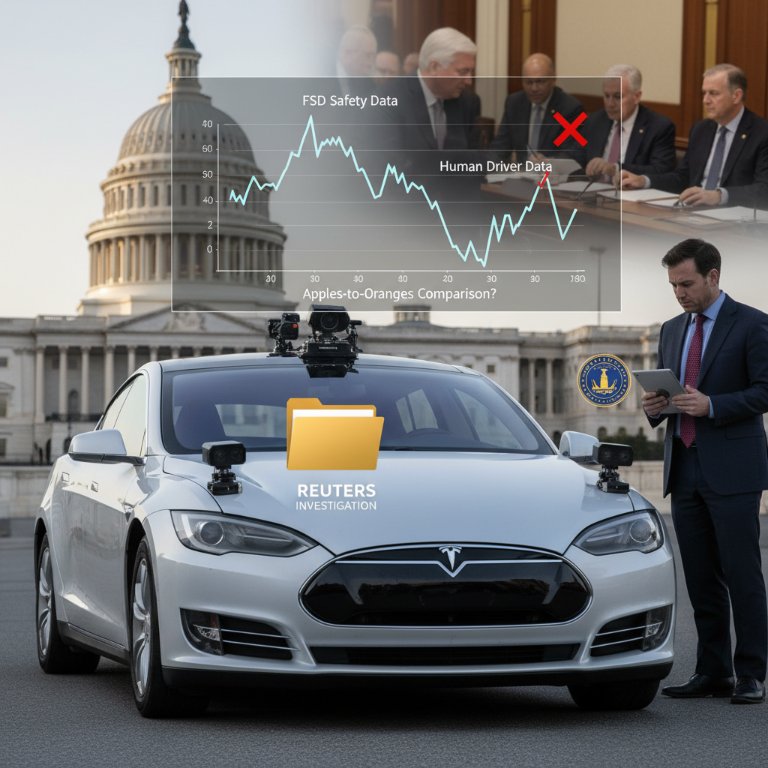
A groundbreaking Reuters investigation has delivered a significant blow to Tesla's ambitious Full Self-Driving (FSD) program, exposing critical flaws in the company's methodology for claiming FSD is significantly safer than human drivers. The revelations arrive as the Senate Commerce Committee's Subcommittee on Surface Transportation, Freight, Pipelines, and Safety intensifies its examination of autonomous vehicle safety, signaling a potential regulatory watershed for the entire industry.
Tesla has long positioned FSD as a revolutionary technology, a cornerstone of its valuation and a key differentiator in the burgeoning EV market. However, this investigative report, coupled with concerns from Tesla's own AI trainers and active federal probes, casts a long shadow over the company's aggressive pursuit of full autonomy.
The 'Apples-to-Oranges' Dilemma: Inflated Safety Claims
At the heart of the Reuters investigation lies a stark critique of Tesla's crash data comparison. The report found that Tesla dramatically inflated its safety claims by comparing crashes involving airbag deployments in its vehicles – a relatively severe incident threshold – to broader federal data that includes all tow-away crashes, a far less stringent measure of severity.
This "apples-to-oranges" methodology reportedly led to Tesla overstating FSD's safety by a factor of three, undermining the company's persistent assertion that its system is up to ten times safer than human drivers. A re-analysis by University of Michigan researcher Marco Benedetti, using comparable airbag-involved crash data, found that FSD-enabled Teslas travel only about three times farther between crashes, with even that figure having limitations due to the average newer age of Tesla's fleet compared to the national average. Despite this, Tesla reportedly continues to employ similarly flawed comparisons on its official website.
Eroding Trust: Internal Dissent and Real-World Failures
Perhaps the most damning revelation comes from within Tesla itself. The Reuters report highlighted widespread skepticism among the company's internal AI trainers – the very individuals responsible for refining and validating the FSD system. Many expressed profound distrust, stating they would not rely on FSD to drive them, with one former self-driving engineer outright dismissing Tesla's safety claims as "bullshit."
These internal experts cited numerous instances of FSD failures in real-world scenarios, including:
- Failing to recognize pedestrians in crosswalks, with some clips showing near-misses with children.
- Inadequate responses to emergency vehicles.
- Insufficient spacing from motorcycles.
- Problematically braking on freeway off-ramps and entering construction zones.
The investigation even mentioned an internal "trauma team" dedicated to reviewing near-miss incidents involving pedestrians, underscoring the severity of some of these challenges.
Regulatory Hammer Poised: Senate Committee and Federal Oversight
The Reuters investigation arrives at a pivotal moment, coinciding with heightened regulatory scrutiny. On February 4, 2026, the Senate Commerce Committee held a hearing where executives from both Tesla and Waymo testified on the future of autonomous vehicles. Senators voiced concerns about companies "beta testing on our roads with no guardrails" and emphasized the urgent need for a unified federal regulatory framework to replace the current "patchwork" of state laws.
Legislators are already proposing concrete measures. Senator Edward Markey is championing the "AV Safety Data Act," which would mandate federal data collection for autonomous vehicles, and the "Stay in Your Lane Act," aimed at requiring manufacturers to clearly define safe operating conditions for their systems. This legislative push is further fueled by the National Highway Traffic Safety Administration (NHTSA), which currently has four active investigations into FSD and Autopilot, covering issues like red-light violations and the adequacy of past recalls.
Why This Matters:
This confluence of investigative journalism, internal dissent, and escalating regulatory action marks a critical juncture for Tesla's FSD and the broader autonomous vehicle industry. It represents a credibility crisis for Tesla's FSD, directly challenging its long-held claims of superior safety and potentially impacting its market valuation, which has been heavily tied to the promise of full autonomy. The narrative of Tesla as a purely "tech company" is now under intense pressure to reconcile its bold projections with verifiable, transparent safety data.
For the entire AV industry, this serves as a crucial signal: the era of largely self-regulated safety claims is drawing to a close. There will be amplified pressure for all developers to provide rigorous, standardized, and transparent safety metrics, moving away from proprietary or misleading comparisons. Companies like Waymo, with reportedly more conservative and transparent testing methodologies, may find themselves in a stronger position.
Crucially, it signals regulatory acceleration. The Senate's active engagement and proposed legislation indicate a definitive shift towards stricter federal oversight. This could lead to a more standardized, but potentially slower, path to the widespread deployment of autonomous systems, prioritizing safety over speed.
Finally, for consumers, this news directly impacts trust and purchasing decisions. The stark reality of internal experts expressing distrust in a system aggressively marketed as "Full Self-Driving" highlights a dangerous disconnect between marketing hype and operational reality. Prospective buyers and current users of FSD will rightly question the true safety and capabilities of these advanced driver-assistance systems, reinforcing the need for continuous vigilance behind the wheel.
The winners, in the long term, are likely to be regulators and, ultimately, consumers who will benefit from better-regulated, more transparent, and demonstrably safer autonomous technologies. The losers, at least in the short term, are companies that have prioritized marketing over verifiable, transparent safety.
The Reuters investigation delivers a critical blow to Tesla's FSD safety narrative, exposing a dangerous disconnect between aggressive marketing and operational reality. The coming months, particularly the outcome of Senate deliberations and NHTSA investigations, will be pivotal in defining the future regulatory landscape for autonomous vehicles and will critically test Tesla's path to truly safe and scalable self-driving technology.