Tesla's FSD Declared 'Effectively Level 4' by Wall Street Analyst: A Robotaxi Revolution on the Horizon?
A prominent Wall Street analyst has made a bold assertion: Tesla's Full Self-Driving (FSD) system has 'effectively achieved Level 4 autonomy (at least...
Editorial Team
World Of EV
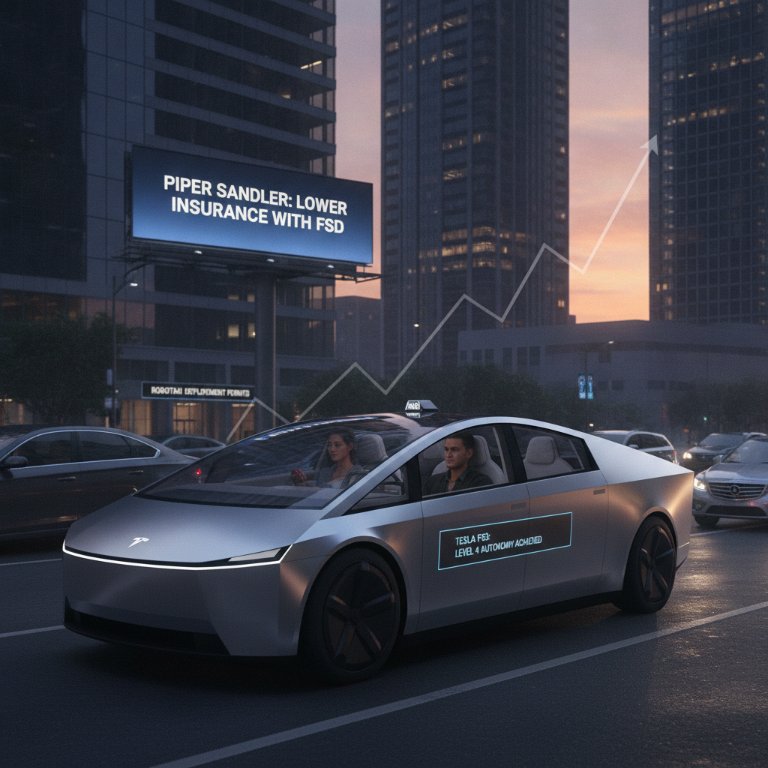
A prominent Wall Street analyst has made a bold assertion: Tesla's Full Self-Driving (FSD) system has 'effectively achieved Level 4 autonomy (at least in most conditions).' This declaration by Alexander Potter of Piper Sandler signals a potentially monumental shift for Tesla and the broader autonomous vehicle industry, moving beyond incremental updates to a new era of self-driving capabilities.
For years, Tesla's FSD has been a lightning rod for debate, with critics questioning its 'Full Self-Driving' moniker while proponents lauded its continuous improvement. The journey has been marked by ambitious timelines from CEO Elon Musk and a phased rollout of the FSD Beta program to a growing number of users, first reaching private consumer testers in October 2020. The company has steadily refined its vision-only approach, leveraging an end-to-end neural network trained on billions of miles of real-world driving data.
Analyst Declares FSD 'Effectively Level 4'
Alexander Potter's assessment isn't just a casual observation; it's a strategic conclusion based on several key indicators. According to Potter, Tesla's actions demonstrate internal confidence in FSD's maturity. He cites these compelling factors:
- Lower Insurance Premiums for FSD Users: Tesla is reportedly offering reduced insurance rates for drivers who frequently use FSD. Potter reasons, "You don't cut prices on a product that you think is going to generate claims," implying a strong belief in the software's safety and reliability.
- Volume Production of Cybercab: The Cybercab, Tesla's purpose-built robotaxi, entered volume production in April, a capital investment of potentially 'several hundred million USD (if not $1B+).' The fact that this vehicle is designed without a steering wheel or pedals underscores Tesla's commitment to fully autonomous operation.
- Securing Robotaxi Deployment Permits: Tesla is actively working to secure permits for robotaxi deployments, including a 200-space facility near Dallas. This proactive regulatory engagement, coupled with plans to expand robotaxi services to seven new cities in the first half of 2026, despite a tight timeline, indicates a clear strategic path toward widespread autonomous operation.
Defining Level 4: A Critical Milestone
To fully appreciate Potter's claim, it's essential to understand what Level 4 autonomy entails. According to the Society of Automotive Engineers (SAE) International, Level 4 is defined as 'High Driving Automation.' At this stage, the Automated Driving System (ADS) handles all driving tasks within specific operational design domains (ODDs), such as geofenced areas or particular conditions. Crucially, a human driver is no longer required to intervene and can even be absent from the driving task entirely within these domains. The vehicle must also be capable of reaching a 'minimal risk condition' safely if a system malfunction or an out-of-domain situation occurs. This is a significant leap beyond Level 2 systems, where a driver must constantly supervise the automation.
Tesla's FSD, while continuously improving, has historically been classified as a Level 2 system, requiring active driver supervision. Potter's assertion, therefore, suggests a pivotal advancement, moving Tesla into a realm previously dominated by dedicated robotaxi companies like Waymo, which operates geofenced Level 4 services.
The Robotaxi Future: More Than Just a Feature
The Cybercab's production and the pursuit of robotaxi permits are not merely extensions of FSD; they represent the monetization of Tesla's long-term autonomous vision. The Cybercab, designed without traditional driver controls, is a clear statement of intent. Tesla's strategy involves self-certifying these vehicles to comply with federal safety standards, potentially allowing for faster production ramps compared to competitors seeking exemptions. The goal is to deploy millions of Cybercabs globally, creating a vast autonomous network and fundamentally shifting how transportation is produced and consumed. While the initial rollout might be gradual, focusing on internal testing and regulatory validation, the ambition is clear: to establish Tesla as a leader in large-scale autonomous mobility.
Why This Matters:
For Tesla: Achieving 'effective Level 4' autonomy is a game-changer. It validates years of substantial investment and the controversial 'Full Self-Driving' branding. This could unlock massive new revenue streams through robotaxi services, fundamentally altering Tesla's business model from primarily selling cars to providing mobility-as-a-service. It would also likely bolster investor confidence, potentially driving a significant revaluation of the company. Tesla's valuation has historically been tied to its future growth potential, and robust FSD would be a key accelerator.
For Consumers: The promise of Level 4 autonomous ride-hailing means increased convenience, potentially lower transportation costs, and enhanced safety by eliminating human error—the cause of the vast majority of crashes. It could open up new mobility options for individuals unable to drive.
For Competitors: This development intensifies pressure on rivals in both the EV space and the autonomous driving sector. Companies like Waymo and Cruise, which have taken more cautious, geofenced approaches, will face a formidable competitor with an enormous fleet advantage. Traditional automakers investing heavily in their own autonomous platforms, often through partnerships, will need to accelerate their timelines or risk being left behind. The industry could see consolidation or increased investment in competing technologies.
For the Regulatory Landscape: A recognized Level 4 FSD in Tesla's passenger vehicles would force regulators globally to accelerate frameworks for highly automated driving. The ability to deploy a massive fleet of vehicles capable of unsupervised operation in 'most conditions' demands clear guidelines and robust oversight, pushing the entire industry forward.
Conclusion:
Alexander Potter's assertion marks a pivotal moment in the discourse surrounding Tesla's Full Self-Driving. While skepticism and regulatory hurdles remain, the convergence of FSD's advanced capabilities, Cybercab production, and aggressive robotaxi deployment plans paints a compelling picture of Tesla nearing a true autonomous breakthrough. If this 'effective Level 4' classification holds, Tesla isn't just selling cars anymore; it's on the cusp of delivering a transformative mobility platform that could redefine personal transportation for decades to come. The coming months will be crucial in observing if Tesla can convert this analyst's confidence into widespread commercial reality and truly lead the robotaxi revolution.