Tesla's FSD 14.3 Sees Explosive Early Adoption: Is Autonomy's Tipping Point Nigh?
Full Self-Driving (FSD) version 14.3 has stormed onto the scene, capturing an impressive 42.4% adoption rate among vehicles within a prominent communi...
Editorial Team
World Of EV
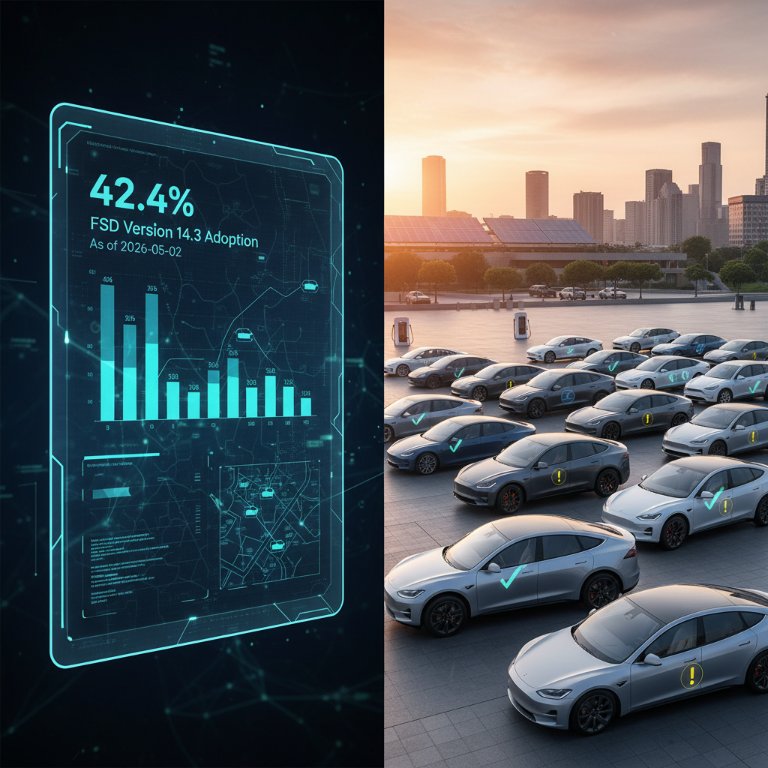
Full Self-Driving (FSD) version 14.3 has stormed onto the scene, capturing an impressive 42.4% adoption rate among vehicles within a prominent community-run FSD database as of May 2, 2026. This aggressive rollout and rapid uptake signal a significant moment in Tesla's relentless pursuit of autonomous driving, even if this initial dataset primarily represents the most enthusiastic early adopters and engaged users of the technology. For years, FSD has been a lightning rod of both fervent anticipation and intense skepticism, with each incremental update scrutinized under a microscope. This latest version's swift integration by a substantial portion of its active user base suggests a growing level of confidence in the software's capabilities and, crucially, its perceived value to those who've invested in it.
FSD 14.3's Rapid Ascent
The reported 42.4% adoption of FSD 14.3 within the FSD-active community database underscores a highly effective deployment strategy by Tesla. This figure, while not reflective of the entire FSD subscriber base, provides a critical indicator of user satisfaction and the smooth propagation of the new software iteration. Unlike some previous, more cautious rollouts, version 14.3 appears to have been pushed out with considerable speed, and users are actively engaging with it. This aggressive pace allows Tesla to rapidly gather more real-world data, accelerating its iterative development cycle—a cornerstone of the company's software-first approach to autonomy.
The Early Adopter's Verdict
It's crucial to contextualize this data: the community-run database predominantly comprises early adopters and highly engaged users. These are individuals often more forgiving of nascent technology and eager to test the boundaries of FSD. Their quick adoption of 14.3 can be interpreted in several ways:
- Perceived Improvement: Users are likely experiencing tangible enhancements that justify the immediate update, such as smoother navigation, improved decision-making in complex scenarios, or better handling of challenging intersections.
- Trust in Iteration: The long-standing FSD subscriber base has grown accustomed to continuous improvement, viewing each update as a necessary step towards the ultimate goal of full autonomy.
- Desire for the Latest Features: As with any cutting-edge software, there's a strong incentive among enthusiasts to always run the most current version to access the latest capabilities and bug fixes.
Why This Matters:
This rapid adoption of FSD 14.3 is far more than just a number; it's a profound signal resonating throughout the automotive and tech industries. For Tesla, it validates their vision-only approach and their aggressive software development methodology. High engagement means more data, which in turn fuels faster improvements, potentially accelerating the timeline for achieving truly unsupervised autonomous driving. This could solidify Tesla's leadership in a field where many competitors, after years of significant investment, are still struggling to offer comparable advanced driver-assistance systems.
FSD subscribers are the immediate beneficiaries, experiencing an improved product that reinforces their investment. A more reliable and capable FSD also incrementally enhances the value proposition of their vehicle, a point that could become increasingly important in the resale market. However, those on the fence about FSD, or those relying on competitors' less advanced ADAS, might start to feel the pressure as Tesla's solution gains perceived maturity and utility. This rapid uptake signals that the race for true autonomous driving is intensifying, and Tesla, despite its past controversies and delays, appears to be gaining significant momentum. This isn't necessarily a 'do-or-die' moment, but rather a strong indicator that Tesla is firmly on the path to making FSD a defining feature of its ecosystem, putting increasing pressure on rivals to catch up.
FSD 14.3's swift and substantial adoption within its most active user base marks a critical milestone for Tesla. While the journey to widespread, regulatory-approved Level 5 autonomy is still ongoing, this aggressive rollout and positive user engagement demonstrate a growing confidence in the software's capabilities. It's clear that for many, FSD is transitioning from a futuristic promise to a tangibly improving driving companion, setting the stage for what could be a transformative period in autonomous vehicle development.