Tesla Update 2026.38 Eliminates Supercharger Frustration and Breathes New Life Into Older Intel-Powered EVs
Tesla is rolling out its latest over-the-air (OTA) software update, version 2026.38, delivering a dual-pronged upgrade focused on charging-site naviga...
Editorial Team
World Of EV
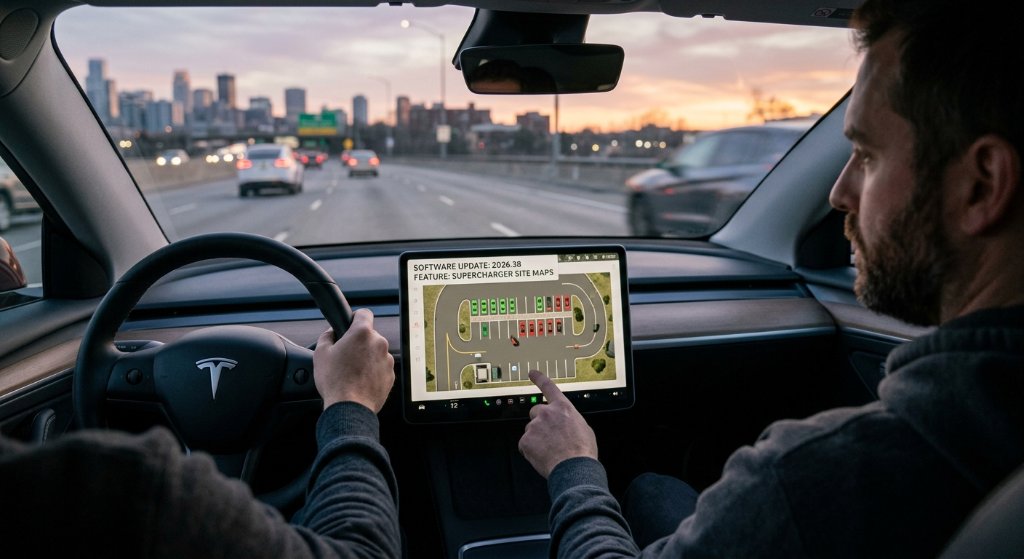
Tesla is rolling out its latest over-the-air (OTA) software update, version 2026.38, delivering a dual-pronged upgrade focused on charging-site navigation and legacy hardware longevity. At a time when the electric vehicle pioneer is scaling its next-generation platform architecture, this update proves that the Austin-based automaker is not leaving its older fleet behind. By addressing real-time charging pain points and upgrading the usability of older infotainment systems, Tesla is solving two of the most critical friction points of modern EV ownership.
Historically, Tesla has set the industry standard for OTA updates, often using software to completely change how its cars feel overnight. However, as the brand's fleet has aged, owners of older vehicles have begun to feel the sting of hardware obsolescence—particularly those with older infotainment processors. Update 2026.38 tackles this head-on, while simultaneously elevating the Supercharger experience to prepare for an increasingly crowded charging landscape.
Navigating the Supercharger Maze: Enter 'Supercharger Site Maps'
The headliner of the 2026.38 release is the brand-new "Supercharger Site Maps" feature. Rather than just guiding drivers to a general GPS pin, the update provides a granular, real-time spatial breakdown of charging stations on the in-car screen before the driver even pulls in. This is a massive functional leap for the charging experience.
Key capabilities of the new Site Maps include:
- Real-time Stall Status: High-fidelity visualization showing exactly which stalls are occupied, out of service, or fully operational.
- Physical Obstacle Mapping: Clear layout indicators highlighting curbs, pillars, tight spaces, and towing-friendly pull-through lanes to avoid awkward maneuvering.
- Optimal Approach Guidance: Directing drivers on how to approach a specific stall, reducing the back-and-forth alignment dance that frustrates drivers at busy stations.
Saving MCU2: Intel Atom UI Optimization
Another massive piece of news in this update is targeted directly at owners of older Model S, Model X, Model 3, and Model Y vehicles built roughly between 2018 and early 2022. These vehicles rely on Intel Atom processors (commonly known as MCU2), which have increasingly struggled to keep up with the visually demanding, 3D vector-rendered user interfaces designed for modern AMD Ryzen chips (MCU3). Rather than letting these older screens lag, Tesla has engineered a specialized visual interface update specifically for these legacy chips.
- Streamlined Visual Assets: UI adjustments that preserve Tesla's modern design language while drastically reducing memory usage and rendering demands on older Atom silicon.
- Slicker Screen Responsiveness: Optimization of transitions, menu navigation, and map rendering to eliminate the lag that has crept into MCU2 cars in recent years.
- Under-the-Hood Security: Critical back-end security patches that fortify older vehicle systems against emerging digital vulnerabilities.
Why This Matters:
This update is a strategic masterstroke for Tesla’s ecosystem retention and charging dominance. By launching "Supercharger Site Maps," Tesla is addressing the growing pains of having opened its Supercharger network to non-Tesla EVs. With Ford, Rivian, General Motors, and others sharing these stalls, charging stations are more congested than ever. Knowing the exact layout and physical constraints of a site before arrival turns the charging experience from a stressful guessing game into a seamless, calculated stop. It keeps the Tesla charging experience premium, even as the physical stations become democratic.
Furthermore, the Intel Atom UI optimization signals to the wider automotive market that Tesla treats its older fleet like software-defined vehicles, not disposable consumer electronics. While legacy automakers historically abandon infotainment support the moment a vehicle rolls off the lot, Tesla is actively optimizing performance for vehicles that are four to eight years old. This preserves residual values, fosters intense brand loyalty, and sets an incredibly high bar for competitors who are still struggling to deliver basic OTA stability.
Conclusion
With update 2026.38, Tesla reinforces its position as the undisputed software leader in the EV space. By solving real-world infrastructure friction and breathing new life into older hardware, the company ensures its older models remain highly usable and its charging network remains the gold standard. As the EV transition matures, these are the software-driven details that will keep drivers locked into the Tesla ecosystem for the long haul.