Tesla Unlocks Commercial EV Future with 'Semi Charging for Business' Initiative
For years, the promise of electric heavy-duty trucking has been tempered by the formidable challenge of infrastructure. While Tesla's Semi has capture...
Editorial Team
World Of EV
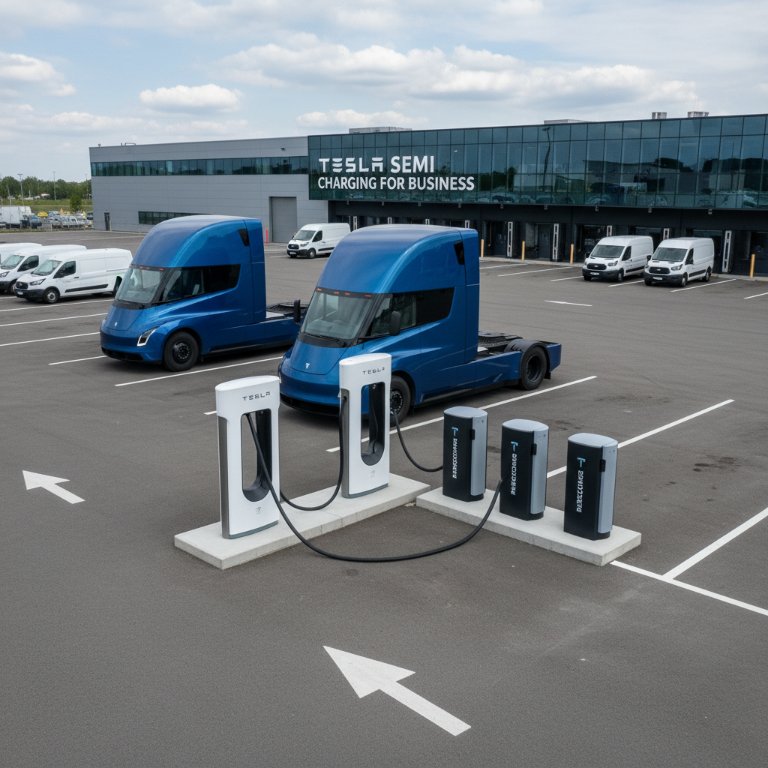
For years, the promise of electric heavy-duty trucking has been tempered by the formidable challenge of infrastructure. While Tesla's Semi has captured headlines since its unveiling in 2017, its broader adoption hinged not just on the truck's capabilities, but on a robust, dedicated charging network. Tesla is now directly addressing this critical bottleneck with the introduction of its "Semi Charging for Business" program, signaling a profound shift in how commercial electric vehicles will be powered. This isn't merely about selling trucks; it's about selling the solution, offering third-party businesses the direct path to acquire the essential DC fast-charging infrastructure needed to electrify their fleets.
A New Era for Commercial EV Charging
Tesla's new program makes its formidable charging technology directly available to fleet operators and logistics hubs. This isn't just a minor expansion; it's a strategic move to democratize access to high-power charging specifically designed for heavy-duty applications. The program offers two critical components:
- Megachargers: These are Tesla's proprietary ultra-fast DC charging stations, capable of delivering immense power levels necessary to rapidly recharge the massive battery packs of the Tesla Semi. Their availability to third parties represents a significant leap for long-haul electric trucking, addressing the range anxiety that has plagued the sector.
- Basechargers: A new, purpose-built depot charging solution, the Basecharger is primarily designed for the Tesla Semi. These are expected to facilitate overnight or during-shift charging at operational hubs, balancing speed with cost-effectiveness for routine fleet operations.
Investing in the Electric Trucking Ecosystem
The financial barrier to entry for commercial EV infrastructure has often been a deterrent. Tesla's transparent pricing strategy for the "Semi Charging for Business" program aims to streamline this investment. A base two-stall system starts at $188,000, excluding installation and taxes. This upfront cost, while substantial, represents an investment in future operational efficiency and reduced emissions for businesses committed to electrification. The inclusion of both Megachargers for fast transit charging and Basechargers for depot operations demonstrates Tesla's understanding that a multifaceted approach is required to support diverse commercial trucking needs.
Why This Matters:
This initiative is far more than a simple product offering; it's a strategic masterstroke by Tesla, designed to rapidly accelerate the adoption of electric heavy-duty vehicles. For years, the "chicken and egg" problem has plagued EV heavy trucking: truck manufacturers couldn't sell enough trucks without charging infrastructure, and charging infrastructure providers wouldn't build without trucks on the road. Tesla, by offering both, effectively solves this.
- Who Wins? Fleet operators committed to sustainability and cost-saving stand to win immensely. They gain direct access to purpose-built, high-power charging solutions, de-risking their transition to electric trucks. Tesla wins by removing a major adoption barrier for its Semi, potentially unlocking a massive market. Charging infrastructure providers who partner with Tesla or adapt to this new standard could also benefit.
- Who Loses? Competitors in the electric truck space who haven't developed robust, scalable charging solutions stand to be at a significant disadvantage. Their vehicles, however capable, will struggle to gain traction if operators can't reliably and efficiently charge them. Traditional diesel truck manufacturers face increasing pressure as the total cost of ownership equation shifts further towards EVs with accessible charging.
- Market Signal: This program signals Tesla's unwavering commitment not just to manufacturing vehicles but to building an entire energy ecosystem around its products. It forces the industry to confront the reality that for commercial EVs, the charging solution is as critical as the vehicle itself. This could catalyze further investment and innovation in heavy-duty charging across the industry.
Conclusion:
Tesla's "Semi Charging for Business" program represents a pivotal moment for the electric trucking industry. By directly enabling businesses to build out their charging infrastructure with both high-speed Megachargers and practical Basechargers, Tesla is not only paving the way for wider Semi adoption but is also setting a new standard for comprehensive OEM support in the commercial EV sector. The future of freight transport is increasingly electric, and with this initiative, Tesla is ensuring its ecosystem is ready to power that transformation.