Tesla Unleashes FSD v14.3.9 Down Under: Hardware 4 Vehicles in Australia and New Zealand Gain Game-Changing Safety Tech
### Down Under Gets a Massive Autonomy Upgrade Tesla is accelerating its global software rollout, officially deploying its highly anticipated **Full ...
Editorial Team
World Of EV
Down Under Gets a Massive Autonomy Upgrade
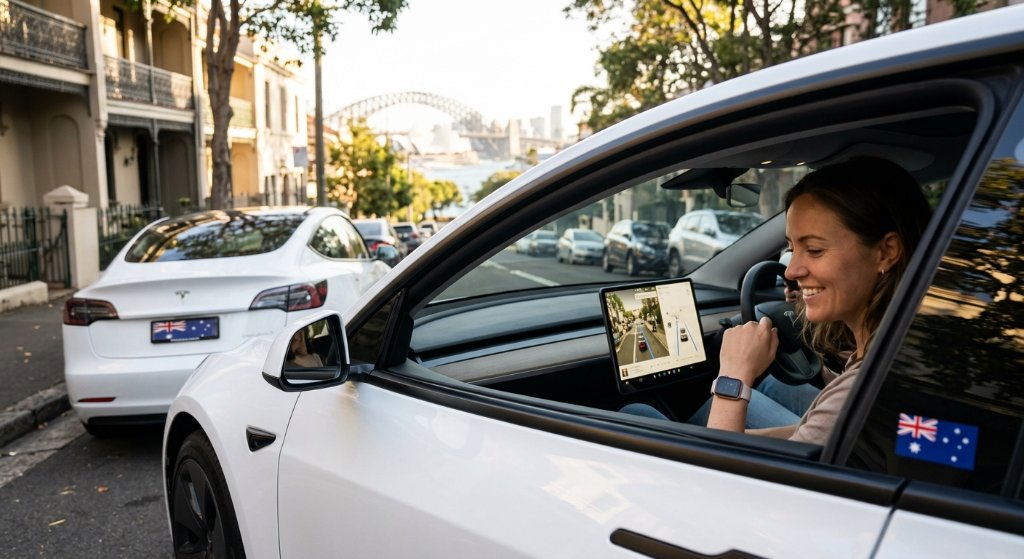
Tesla is accelerating its global software rollout, officially deploying its highly anticipated Full Self-Driving (Supervised) v14.3.9 update to Hardware 4 (AI4) vehicles in Australia and New Zealand. Arriving via firmware version 2026.28.5, this release marks a monumental step forward for Tesla’s first major right-hand-drive (RHD) markets.
Rather than a simple incremental patch, this deployment brings advanced neural network capabilities and an entirely new active safety layer to owners down under. The update lands at a pivotal moment, coinciding with the arrival of Tesla’s Cybercab showcase in local showrooms, signaling to the world that Tesla's vision-only autonomy is ready for global prime time.
The Evolution of FSD in Australia and New Zealand
To understand the weight of this release, one must look at how rapidly Tesla has advanced its software in the region. Australia and New Zealand were the world's first RHD markets to receive FSD (Supervised) back in September 2025. Since then, the software has evolved at breakneck speed:
- June 2026 (v14.3.3): The region finally transitioned from the aging v13 platform to the modern v14 neural network architecture, introducing vastly improved reinforcement learning and faster reaction times.
- March 2026: Tesla ceased outright FSD purchases in AU/NZ, transitioning entirely to a subscription-only model.
- September 2026 (v14.3.9): This latest release consolidates those neural improvements and introduces cutting-edge active safety features previously reserved for North American test fleets.
The Headline: Automatic Collision Evasion (ACE)
The standout feature of v14.3.9 is Automatic Collision Evasion (ACE), an AI-driven safety feature that operates even when you are driving the vehicle manually. Unlike traditional Automatic Emergency Braking (AEB) systems that only apply the brakes, ACE goes a step further by actively steering the vehicle to safety.
Key highlights of the v14.3.9 rollout include:
- Active Steering Evasion: If the vehicle detects an imminent frontal collision on a highway (under 85 mph) and determines that braking alone won't prevent the crash, the AI will mute the accelerator and steer the car onto the shoulder or into an open lane.
- Inattentive Driver Takeover: If the cabin camera detects severe driver inattention between 22.5 mph and 85 mph, the FSD AI can momentarily take control to stabilize the vehicle and prevent a crash.
- Smoother RHD Navigation: Upgrades to the vision encoder allow for significantly better handling of roundabouts, complex traffic lights, and unique local signage.
- Glitch Recovery: The system can now recover from temporary sensor or camera glitches seamlessly, preventing sudden, jarring disengagements on the highway.
The Great Hardware Divide: AI4 vs. Hardware 3
While the arrival of v14.3.9 is cause for celebration, it also highlights an increasingly frustrating reality for legacy Tesla owners. This update is strictly limited to vehicles equipped with Hardware 4 (AI4) autopilot computers, such as the newer Model Y and upgraded Model 3 "Highland".
For owners of legacy Hardware 3 (HW3) vehicles, v14.3.9 remains out of reach. While Tesla has deployed a downgraded "v14 Lite" branch for older hardware in other global markets, this split confirms that HW3 is approaching its computational ceiling. Local HW3 owners will have to wait for a separate, optimized software branch, highlighting the stark hardware discrepancy in Tesla's fleet.
Why This Matters:
The Winner: AI4 Owners and the Subscription Model
If you own a Hardware 4 Model Y or Model 3 in Australia or New Zealand and pay for the FSD subscription, this update is a massive win. You are no longer treated as a secondary market; you are driving one of the most advanced, safest passenger vehicles on Earth. The addition of Automatic Collision Evasion (ACE) drastically elevates the value proposition of Tesla's subscription service, transforming FSD from a novelty convenience into an essential active safety shield.
The Loser: Hardware 3 Owners and Resale Value
The hardware split is becoming impossible to ignore. As Tesla continues to reservation-gate premium features like ACE for AI4 vehicles, the secondary market for HW3-equipped Teslas is bound to take a hit. Buyers looking for true future-proof autonomy will likely bypass older models, accelerating depreciation for early adopters who were once promised their cars would have all the hardware necessary for full autonomy.
The Strategic Signal to the Industry
By deploying v14.3.9 to RHD markets, Tesla is proving that its vision-only (camera-only) architecture can quickly adapt to completely different driving orientations and infrastructure layouts. While competitors like Waymo rely heavily on expensive, localized LiDAR mapping, Tesla’s generalized AI is proving to be highly scalable. Deploying this alongside the Cybercab tour is a masterclass in marketing—showing potential buyers that the driverless future isn't a distant dream, but a software update away.
Looking Ahead to a Driverless Horizon
With v14.3.9 now live on Australasian roads, Tesla has successfully bridged one of its most difficult geographical and engineering gaps. The deployment of cutting-edge safety features like Automatic Collision Evasion proves that supervised autonomy is rapidly maturing beyond a driver convenience into a proactive safety companion. As Tesla’s local Cybercab showcase kicks off, Down Under owners with AI4 hardware are getting a first-hand taste of the driverless future today, while legacy owners are left to contemplate the limits of their hardware.