Tesla Stumbles: FSD's China Ambitions Derailed, Legal Woes Mount in Australia
Tesla's stock (TSLA) recently experienced a significant approximately 4% dip, sending ripples through the EV market. This downturn followed the conclu...
Editorial Team
World Of EV
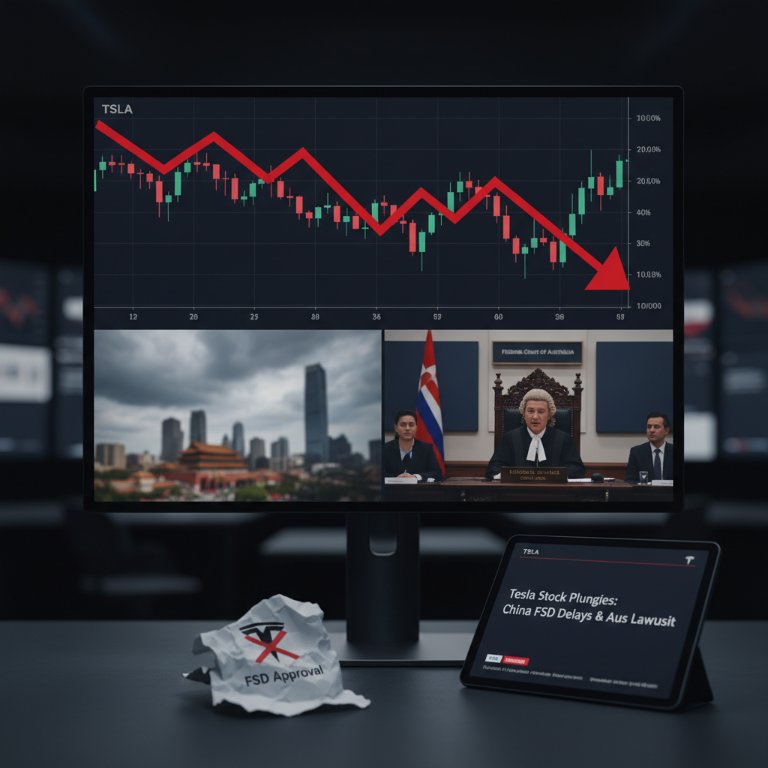
Tesla's stock (TSLA) recently experienced a significant approximately 4% dip, sending ripples through the EV market. This downturn followed the conclusion of US-China trade talks, which notably failed to yield the anticipated breakthrough for the company's Full Self-Driving (FSD) ambitions in the crucial Chinese market. Investors, accustomed to betting on Tesla's aggressive innovation, had held high hopes that CEO Elon Musk's direct involvement in the US delegation would fast-track FSD regulatory approval in the world's largest automotive market. The absence of such a green light underscores the complex regulatory hurdles Tesla faces abroad, particularly with its advanced driver-assistance systems.
Compounding Tesla's challenges, the company simultaneously faced sharp criticism in an Australian class-action lawsuit. A Federal Court Judge openly chastised Tesla for its limited cooperation in discovery proceedings. This legal scrutiny centers on serious allegations of misleading consumers regarding critical aspects of its vehicles: phantom braking incidents, exaggerated battery range claims, and the actual capabilities of its self-driving technology. These issues are not entirely new for Tesla, having been points of contention and consumer complaints in various markets for some time.
China's FSD Roadblock Remains a Strategic Setback
The failure to secure FSD approval in China represents a substantial strategic setback for Tesla. The Chinese market isn't just about vehicle sales; it's a vital proving ground and data source for autonomous driving development. For years, Tesla has been pushing its FSD system globally, promising a future of fully autonomous mobility. However, China's strict data localization laws and complex regulatory framework have posed significant obstacles. Without approval, Tesla cannot fully deploy, test, and monetize FSD in China, effectively ceding ground to aggressive local competitors like XPeng, Huawei-backed solutions, and Baidu's Apollo, which are rapidly advancing their own autonomous driving technologies tailored for the Chinese environment. The long-term implications for Tesla's global FSD leadership, especially as its competitors gain a home-field advantage in a market hungry for advanced tech, are considerable.
Legal Headwinds Down Under Expose Broader Concerns
The Australian class-action lawsuit, while geographically contained for now, highlights a growing global concern regarding Tesla's marketing practices and its handling of consumer complaints. The judge's criticism of Tesla's limited cooperation in discovery is particularly damning, suggesting a potential lack of transparency in legal proceedings. The core allegations—phantom braking, inaccurate battery range, and overstated self-driving capabilities—resonate with ongoing debates and regulatory investigations in other regions. Phantom braking, in particular, has been a persistent safety concern for Tesla owners, leading to numerous complaints and investigations in markets like the United States. This lawsuit serves as a potent reminder that regulatory bodies and legal systems worldwide are increasingly scrutinizing the claims made by autonomous vehicle developers, demanding a higher degree of accountability and data to back up their ambitious promises.
Why This Matters:
Investor Confidence Shaken: The 4% stock drop directly reflects investor unease regarding Tesla's ability to navigate complex international regulatory environments and deliver on its FSD promises globally. It signals a recognition that FSD's path to widespread profitability is neither smooth nor guaranteed.
FSD's Global Future in Question: The Chinese delay throws a wrench into Tesla's global FSD rollout strategy. China is critical for both revenue generation from FSD subscriptions and for collecting diverse real-world driving data essential for system improvement. Lingering delays could allow domestic rivals to pull ahead in a key market, potentially challenging Tesla's perceived technological superiority.
Escalating Regulatory Scrutiny: The Australian legal action underscores a hardening stance from global regulators and courts on autonomous vehicle claims. Companies, including Tesla, are facing increased pressure to substantiate their technology's capabilities and cooperate transparently in legal proceedings. This could set precedents for how ADAS and autonomous features are marketed and litigated worldwide.
Erosion of Consumer Trust: Persistent allegations of phantom braking, range inaccuracies, and misleading self-driving capabilities, especially when highlighted in court, can severely erode consumer trust. For a brand built on innovation and aspirational technology, maintaining that trust is paramount for sustained growth and adoption.
Competitive Landscape Shifts: As Tesla grapples with these challenges, competitors making more cautious, localized, or hardware-agnostic progress (like those in China with government backing) may find new opportunities to gain market share and establish their own leadership in autonomous driving solutions.
Tesla finds itself at a critical juncture, navigating the dual pressures of market expectations for its cutting-edge technology and intensifying legal and regulatory scrutiny across key global markets. The FSD delay in China and the legal challenges in Australia are not isolated incidents but rather symptomatic of broader issues that the EV giant must address head-on. How Tesla responds—through enhanced transparency, accelerated regulatory compliance, and robust technological validation—will define its trajectory in the rapidly evolving landscape of autonomous mobility.