Tesla Stock Rockets 5.5% as Nevada Approves 5,000 Robotaxis Ahead of Austin Cybercab Launch
Wall Street is buying into Elon Musk’s autonomous vision once again. On Monday, shares of Tesla (TSLA) rallied 5.51% to close at $367.95, driven by fe...
Editorial Team
World Of EV
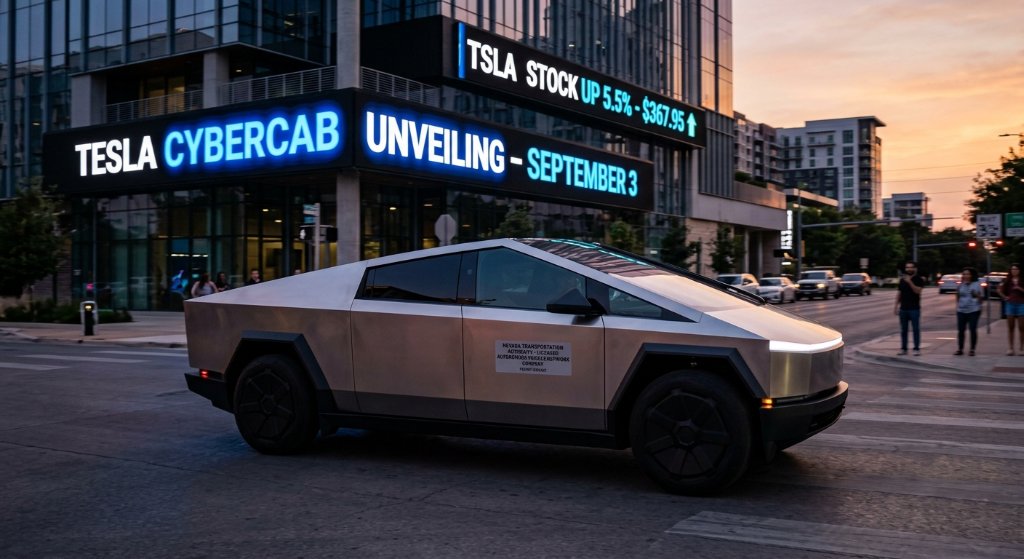
Wall Street is buying into Elon Musk’s autonomous vision once again. On Monday, shares of Tesla (TSLA) rallied 5.51% to close at $367.95, driven by feverish anticipation for the September 3 Cybercab launch event in Austin, Texas. But while Austin represents the ceremonial stage, Nevada provided the real regulatory gasoline. In a sudden reversal of fortunes, Nevada’s Transportation Authority (NTA) approved Tesla as an Autonomous Vehicle Network Company, authorizing up to 5,000 fully driverless vehicles in Clark County.
This regulatory win is a massive milestone for a company that has long struggled to turn its Full Self-Driving (FSD) promises into legally sanctioned revenue. Just weeks ago, Nevada regulators humored Tesla with a meager, highly restricted 10-car permit. Upgrading that to 5,000 vehicles completely redraws the competitive landscape in Las Vegas, transforming the Strip into a high-stakes, multi-billion-dollar autonomous battleground.
From 10 Cars to 5,000: Nevada Blinks
In late July, Tesla’s autonomous ambitions in Las Vegas looked like they were stuck in the slow lane when the NTA granted a highly restrictive permit capped at just ten vehicles. Now, regulators have fully opened the floodgates. By authorizing 5,000 driverless Teslas in Clark County, Nevada has positioned Las Vegas as the premier trial arena for autonomous ride-hailing. Tesla will go head-to-head with Alphabet's Waymo and Amazon's Zoox, both of which also hold commercial permits in the region. Key details of the new Nevada permit include:
- Statewide Scalability: Tesla can expand its geofenced operational area beyond Clark County by simply notifying the NTA, paving the way for statewide coverage.
- Airport Access: Unlike the initial restrictive permit, this approval opens up lucrative pickup routes at Harry Reid International and Henderson Executive airports.
- The 5,000 Ceiling: While Tesla’s Cybercab chief engineer Eric Early noted the company is unlikely to deploy all 5,000 vehicles in year one, the massive ceiling de-risks Tesla's financial models and establishes a clear runway for growth.
Austin Set to Unleash the Wheel-Less Cybercab
All eyes now turn to Giga Texas on September 3, where Tesla will officially integrate its custom-built Cybercab into its active robotaxi network in Austin. Unveiled nearly two years ago in October 2024, the Cybercab is a striking two-passenger vehicle designed completely without a steering wheel or pedals. While Tesla has spent months running simulated rides in Austin using safety drivers and modified Model Ys, the September 3 event marks the transition to true, unsupervised autonomy. Recent sightings on Austin streets reveal how Tesla is optimizing the user experience:
- Color-Coded Pickups: Cybercabs have been spotted using an RGB front light bar that shifts colors to match the user's app, eliminating the headache of finding the correct vehicle in a crowded downtown.
- Fleet Registry Expansion: Public transit records show Tesla has already registered several purpose-built Cybercabs in Texas's official automated vehicle database, proving these machines are ready for legal, driverless road duty.
- FSD Evolution: The launch serves as the ultimate real-world test for Tesla’s vision-only FSD stack, putting the software to work in highly complex urban environments without human intervention.
Why This Matters:
This is the moment Tesla transitions from a hardware automotive manufacturer to a high-margin AI and robotics company. Historically, Tesla’s valuation has fluctuated wildly based on quarterly vehicle deliveries. By securing a footprint for a massive robotaxi fleet, Tesla is unlocking the recurring software-as-a-service (SaaS) revenue model that bulls have pointed to for a decade. Waymo and Zoox are the immediate losers here; while Alphabet’s autonomous division has dominated San Francisco and Phoenix, Tesla’s ability to theoretically leverage its existing customer fleet alongside purpose-built Cybercabs gives it a scale advantage competitors cannot match.
However, Tesla is not completely out of the woods. While the regulatory hurdles are falling, manufacturing roadblocks remain. Tesla has quietly removed language regarding 'volume production of the Cybercab in 2026' from its latest guidance, hinting that mass-producing a brand-new vehicle platform without traditional controls is harder than anticipated. If Tesla cannot ramp up Cybercab production to meet its new 5,000-vehicle Nevada limit, it risks letting Waymo and Uber run away with the commercial ride-hailing market.
The September 3 Austin event is more than a product launch; it is Tesla’s declaration of war on the traditional transportation sector. Backed by Nevada’s blessing to deploy thousands of driverless cars, Tesla finally has the legal runway to match its technological bravado. The road ahead will be defined by how quickly Elon Musk can scale production of the wheel-less Cybercab, but for now, the vision of a driverless future is closer—and more lucrative—than ever.