Tesla Semi Hits the East Coast: Massive Megawatt Megacharger Planned for Key Florida Freight Corridor
Tesla's master plan to revolutionize long-haul trucking is finally moving beyond the West Coast. In a strategic push to establish a viable commercial ...
Editorial Team
World Of EV
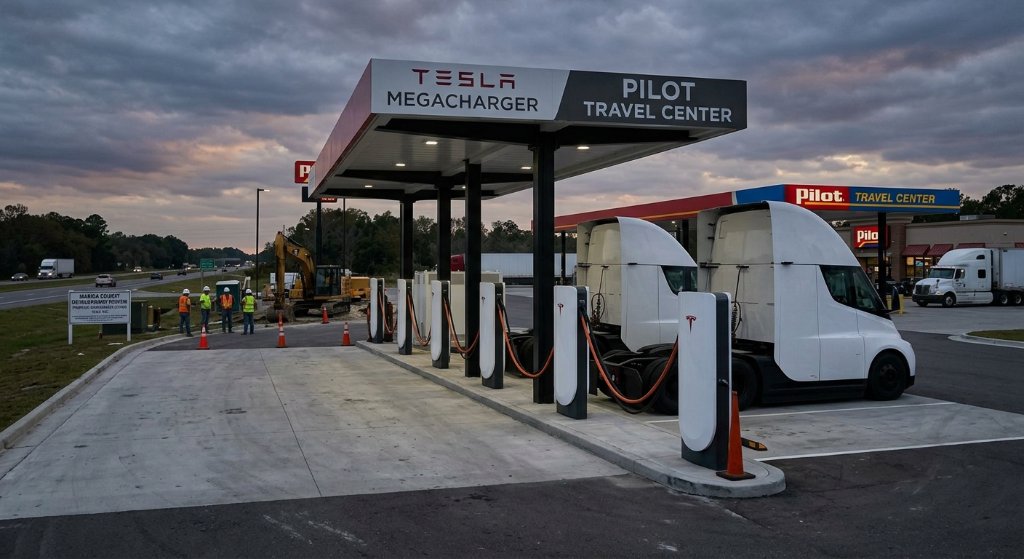
Tesla's master plan to revolutionize long-haul trucking is finally moving beyond the West Coast. In a strategic push to establish a viable commercial charging network, the EV giant has submitted a proposal to construct a high-powered, megawatt-level Megacharger station at a Pilot Travel Center near Interstate 75 in Ocala, Florida. The development represents a critical milestone in Tesla's mission to stitch together a nationwide public charging corridor for the Tesla Semi.
This move follows years of the Tesla Semi relying almost exclusively on captive, depot-based chargers at Tesla’s own facilities or highly subsidized customer hubs, such as PepsiCo's Modesto facility. Now, ahead of the massive production ramp-up targeted for late 2026 and 2027 at Gigafactory Nevada, Tesla is aggressively executing its nationwide charging partnership with Pilot Travel Centers to turn public heavy-duty electric trucking into a reality.
Inside the Ocala Megacharger Blueprint
The planned site is situated at 4255 W. Highway 326, right off Exit 358 on I-75—a highly congested, major logistics interchange in Marion County, Florida. To fast-track the project, Tesla has requested a waiver from Marion County’s Land Development Code to utilize a Building Permit Site Plan instead of undergoing a lengthy Major Site Plan revision. The Marion County Development Review Committee is scheduled to evaluate the proposal tomorrow, Monday, September 28.
According to the official site plans, the installation will seamlessly blend into the existing Pilot Travel Center's commercial flow, featuring:
- Six Megacharger posts serviced by three pre-assembled Megacharger units, next-generation V4 cabinets, utility transformers, and commercial switchboards.
- Reconfigured drive aisles and pull-through parking spaces specifically designed to accommodate Class 8 semi-trucks with trailers, preventing drivers from having to unhook their loads.
- Supporting amenities, including dedicated LED lighting, a Tesla payment kiosk, and a high-speed Wi-Fi access point to keep drivers connected during their breaks.
Unprecedented Megawatt Power
Unlike standard consumer Superchargers, which max out around 250 kW, the Megawatt Charging System (MCS) utilized by these Megachargers is an entirely different beast.
- Peak Charging Power: Up to 1.2 megawatts (1,200 kW) per stall.
- Incompatible Plug Standard: The heavy-duty MCS physical plug is physically incompatible with passenger EVs, meaning standard Teslas, and even the Cybertruck, cannot charge here.
- Charge Times: Designed to replenish roughly 70% of the Tesla Semi’s 500-mile range in just 30 minutes—aligning perfectly with federally mandated rest breaks for commercial drivers.
The Public Charging Expansion Gains Momentum
The Ocala proposal is part of a massive, rapid-fire rollout. Following an official partnership announced earlier this year between Tesla and Pilot Flying J, the companies are aiming to deploy ultra-fast Megachargers along crucial commercial corridors. Tesla’s Semi program lead, Dan Priestley, recently confirmed a target to bring over 30 public Megacharger stations online—representing more than 200 megawatt-capable posts—by the end of this year. While California and Texas boast the lion's share of the planned corridor sites, Florida is emerging as a critical southeastern anchor.
Why This Matters:
The commercial EV trucking space has long been paralyzed by a classic "chicken-and-egg" dilemma: fleet operators won't buy electric rigs without public charging, and infrastructure developers won't build chargers without trucks on the road. By leveraging its highly scalable, pre-assembled charger technology and partnering with the nation's largest truck-stop operator, Tesla is unilaterally breaking this deadlock.
The Winners:
- Early Fleet Adopters: Shipping giants and regional logistics firms can finally transition to electric heavy-duty fleets without being restricted to "return-to-base" regional routes.
- Tesla: By controlling the charging standard and physical real estate at strategic nodes like I-75, Tesla is positioning itself to be the "ExxonMobil" of the electric freight era, generating lucrative recurring revenue from third-party fleets.
- Local Infrastructure: Florida's crucial logistics corridors get an immediate, future-proof upgrade, setting a regional precedent for the Southeast.
The Losers:
- Legacy Diesel Stops: Traditional truck stops that fail to adapt risk losing a massive share of future highway fleet revenue as electrified lanes become standard.
- Rival EV Truck Manufacturers: Companies like Daimler (eActros) and Volvo (VNR Electric) are developing great trucks, but they lack a dedicated high-speed charging network. They will either have to build their own at astronomical cost or rely on Tesla’s network, handing their biggest competitor a continuous revenue stream.
This Ocala proposal is a clear signal that the transition to electric long-haul shipping is shifting out of the pilot phase and into full-throttle commercialization. If the Marion County Development Review Committee greenlights the waiver, Florida will secure a front-row seat to the next evolution of logistics. As Tesla's Megacharger network begins to span from California to Texas, and now up the East Coast, the dream of zero-emission cross-country freight is closer than ever to becoming an everyday reality.