Tesla Secures Intel Vet Gary Jiang to Build $25B 'Terafab' Silicon Empire
### The Silicon Sovereign: Tesla Poaches Intel’s 18A Mastermind Tesla is executing the ultimate vertical integration play. The EV giant has hired **G...
Editorial Team
World Of EV
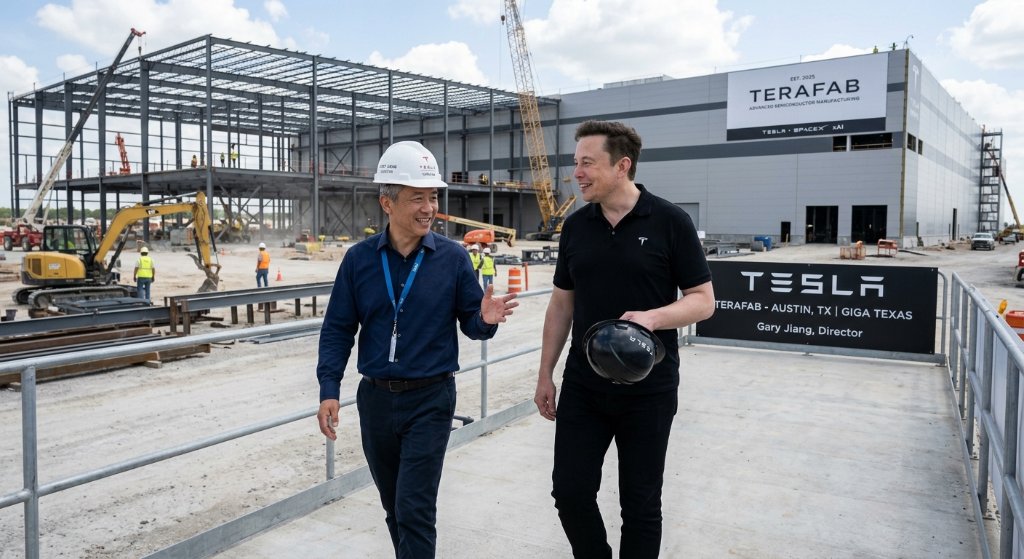
The Silicon Sovereign: Tesla Poaches Intel’s 18A Mastermind
Tesla is executing the ultimate vertical integration play. The EV giant has hired Gary Jiang, a 17-year Intel manufacturing veteran and the former Factory Manager of Intel's highly anticipated 18A process node, to serve as the Director of Terafab in Austin, Texas. Jiang, who quietly stepped into his new role this month, represents the critical leadership piece Tesla desperately needs: real-world, high-volume semiconductor fabrication expertise.
Historically, Tesla has relied on third-party silicon giants like TSMC to manufacture its custom Full Self-Driving (FSD) and Dojo AI chips. However, as Elon Musk’s ambitions expand beyond electric vehicles to include millions of Optimus humanoid robots, massive xAI supercomputer clusters, and SpaceX's satellite constellations, relying on external foundries has become an existential bottleneck. Securing Jiang signals that Tesla is no longer content just designing chips—it wants to control the very machines that print them.
The Terafab Blueprint: Vertically Integrating the Future
Terafab is not just another factory; it is a massive, $20 billion to $25 billion joint venture backed by Tesla, SpaceX, xAI, and Intel. Strategically situated near Gigafactory Texas in Austin, the mega-facility is designed to solve the world's looming compute shortage by unifying the entire chip production pipeline under one roof.
While traditional chipmaking is highly fragmented—with silicon fabbed in Taiwan, packaged in Southeast Asia, and tested elsewhere—Terafab aims to vertically integrate the entire process. Here are the key specifications and goals of the Terafab initiative:
- Unprecedented Scale: Aiming to produce up to 200 billion AI and memory chips annually at full capacity.
- Complete Vertical Integration: Consolidates chip fabrication, memory production, advanced packaging, and testing under a single roof.
- Unifying Musk’s Empire: Built to supply high-performance, low-cost silicon for Tesla's Autopilot and Optimus, SpaceX's Starlink satellites, and xAI's computing clusters.
- The Intel Partnership: Leverages Intel’s semiconductor manufacturing legacy and U.S.-based footprint, keeping the operation optimized specifically for Musk’s proprietary AI architectures.
Why Gary Jiang is the Missing Link
Designing a great chip is a software challenge; building a factory that can reliably print them at the nanometer scale is an industrial nightmare. For years, skeptics argued that Tesla’s lack of foundry experience would doom any in-house chipmaking plans to the same teething issues that plagued its early 4680 battery cell production.
By hiring Jiang, Tesla bypasses a decade of trial-and-error. During his nearly 18 years at Intel, Jiang managed Ocotillo's high-volume Fab 32 and Fab 12 lines (overseeing 14nm and 22nm nodes) before taking charge of the ramp-up and startup operations for Intel's ultra-advanced 18A process node. He possesses deep expertise in tool installation, yield improvement, and fab startups—exactly the physical playbook Tesla needs to turn the Terafab concept into a churning reality.
Why This Matters:
This hire, and the broader Terafab initiative, is a watershed moment for both the automotive and tech sectors. Here is the expert analysis of how this move reshapes the landscape:
- Breaking the TSMC and Nvidia Duopoly: Right now, the entire tech industry is held hostage by TSMC’s manufacturing capacity and Nvidia’s massive margin premiums on AI hardware. By building its own silicon pipeline, Tesla insulates itself from geopolitical tensions surrounding Taiwan and slashes its long-term AI compute costs by an estimated 70% to 90%.
- The 4680 Lesson Applied: When Tesla attempted to manufacture its own 4680 battery cells, it struggled heavily with yield and dry-electrode manufacturing because it lacked legacy battery expertise. Recruiting a heavyweight like Jiang shows Tesla is learning from past mistakes; they are buying the best manufacturing talent in the business to ensure Terafab doesn't suffer the same operational bottlenecks.
- Winners and Losers:
- Winners: Tesla, SpaceX, and xAI lock in a secure, sovereign supply of high-end silicon. Intel also wins a massive, high-profile partner to co-fund and co-develop cutting-edge manufacturing infrastructure on U.S. soil.
- Losers: Nvidia and TSMC. While they won't lose their market dominance overnight, losing Tesla and xAI as major buyers—and facing a sovereign, multi-billion-dollar chip competitor—will put downward pressure on their long-term growth projection margins.
- The Robotic Imperative: To scale the Optimus humanoid robot to millions of units, Tesla needs an astronomical volume of low-power, high-compute chips. Traditional foundries simply cannot support this volume at a cost that makes a $20,000 robot commercially viable. Terafab is the only logical path to making Optimus a physical reality.
The Final Takeaway
Tesla’s evolution from an automotive manufacturer to an AI and robotics powerhouse is no longer just a narrative—it is actively being forged in Austin. By placing Gary Jiang at the helm of its $25 billion Terafab project, Tesla is establishing a sovereign computing supply chain that will power the next era of autonomous driving, humanoid robotics, and aerospace. The compute wars have entered a new, highly physical phase, and Tesla is building the ultimate fortress.
Categories: Autonomous Driving, Tesla, AI & Tech, Industry News, Manufacturing