Tesla Robotaxi's $75 Reality Check: An Unsupervised Parking Blunder in Austin Rattles Autonomous Ambitions
A recent incident in Austin, Texas, saw an unsupervised Tesla Robotaxi receive a $75 parking ticket, an event that has sent ripples through the autono...
Editorial Team
World Of EV
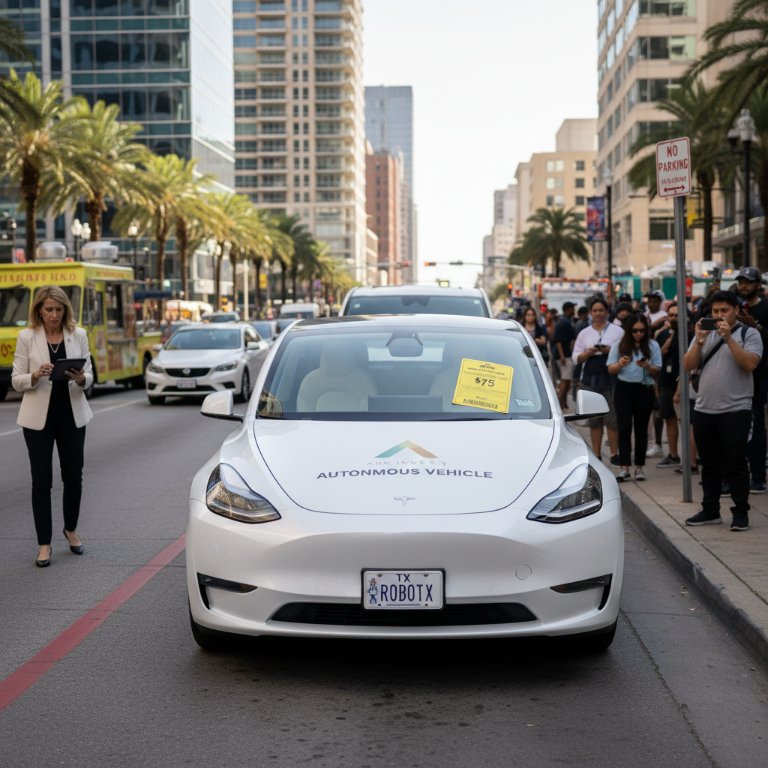
A recent incident in Austin, Texas, saw an unsupervised Tesla Robotaxi receive a $75 parking ticket, an event that has sent ripples through the autonomous vehicle (AV) community and intensified scrutiny on Tesla’s Full Self-Driving (FSD) capabilities. The incident occurred as high-profile investor Cathie Wood, CEO of ARK Invest – a staunch advocate and significant investor in Tesla – was reportedly onboard, evaluating the nascent Robotaxi service. This seemingly minor infraction spotlights the significant hurdles still facing truly autonomous deployment, even as Tesla pushes aggressively towards its long-promised Robotaxi future.
The Austin Incident: A Glitch in the Autonomous Matrix
The details are stark: a Tesla vehicle, operating without a human safety driver and purportedly as part of Tesla’s burgeoning Robotaxi network, was cited for a parking violation in Austin. This public stumble occurred precisely when the vehicle was under the discerning eye of Cathie Wood, whose firm has famously projected a multi-trillion-dollar valuation for Tesla largely predicated on the success of its autonomous initiatives. The sight of a public official issuing a ticket to an unoccupied, self-driving car underscores the very real-world challenges that Level 4 and Level 5 autonomous systems must flawlessly navigate, far beyond just driving.
Tesla's FSD Journey: A Road Paved with Promises and Prototypes
Tesla has, for years, championed its FSD software as the cornerstone of its future valuation, repeatedly promising a ubiquitous Robotaxi network that would revolutionize urban mobility and unlock immense revenue streams. While competitors like Waymo and Cruise have opted for highly geo-fenced operations with extensive sensor arrays, Tesla has pursued a vision reliant primarily on cameras and sophisticated AI, pushing its FSD Beta to a broader base of consumers. This incident in Austin is not the first time Tesla’s FSD has garnered headlines for unexpected behavior, but an unsupervised vehicle receiving a common municipal citation during a high-profile ride takes the narrative beyond mere 'beta quirks' and into the realm of operational readiness.
Why This Matters:
Erosion of Public Trust: While a $75 parking ticket is financially negligible, its symbolic weight is immense. For a public already wary of autonomous technology, such incidents fuel skepticism and reinforce the perception that AVs are not yet ready for widespread, unsupervised deployment. This directly impacts regulatory approval and consumer adoption, which are critical for Tesla's Robotaxi vision.
Regulatory Scrutiny Intensifies: Regulators globally are closely watching autonomous vehicle developments. An unsupervised vehicle receiving a ticket, especially during a high-profile demonstration, provides ammunition for those advocating for stricter testing protocols, more robust oversight, and slower deployment timelines. This could significantly delay Tesla’s ambitions for a truly self-sufficient Robotaxi fleet.
Investor Confidence Tested: Cathie Wood’s presence during the incident is particularly telling. ARK Invest's bullish thesis on Tesla hinges heavily on the monetization of FSD and Robotaxis. Even a minor incident like this can lead investors to question the timeline and viability of these projections, potentially introducing volatility into Tesla’s stock price. It also highlights the gap between aggressive projections and current operational realities.
Competitive Landscape Implications: While Waymo and Cruise have faced their own challenges, their more cautious, geo-fenced deployments, often with remote human oversight or safety drivers, present a stark contrast. This incident might reinforce the industry view that a more measured approach to Level 4 autonomy is prudent, potentially giving competitors an edge in the perception battle for reliability and safety.
The 'Do-or-Die' Moment Continues: Tesla's ability to deliver on FSD is not just an added feature; it's central to its long-term financial strategy and market differentiation. Every public misstep, however small, becomes a significant test of its technology, its deployment strategy, and its credibility in a race where the stakes are astronomical.
The Austin parking ticket is more than a minor inconvenience; it's a stark reminder that the road to fully autonomous vehicles is fraught with complexities that extend beyond just safe driving. For Tesla and its Robotaxi aspirations, this incident serves as a salient, public lesson that the meticulous mastery of mundane tasks – like proper parking – is just as critical to building trust and achieving widespread adoption as navigating complex highway interchanges. The industry, investors, and eager consumers will be watching closely to see how quickly Tesla can learn from these real-world lessons and refine its autonomous capabilities to seamlessly integrate into urban environments, parking laws included.