Tesla Rewrites the EV Playbook: First Cybertruck Built with In-House Refined Texas Lithium Rolls Off the Line
For more than a decade, the global automotive industry has functioned on a precarious assumption: carmakers design and build vehicles, while an incred...
Editorial Team
World Of EV
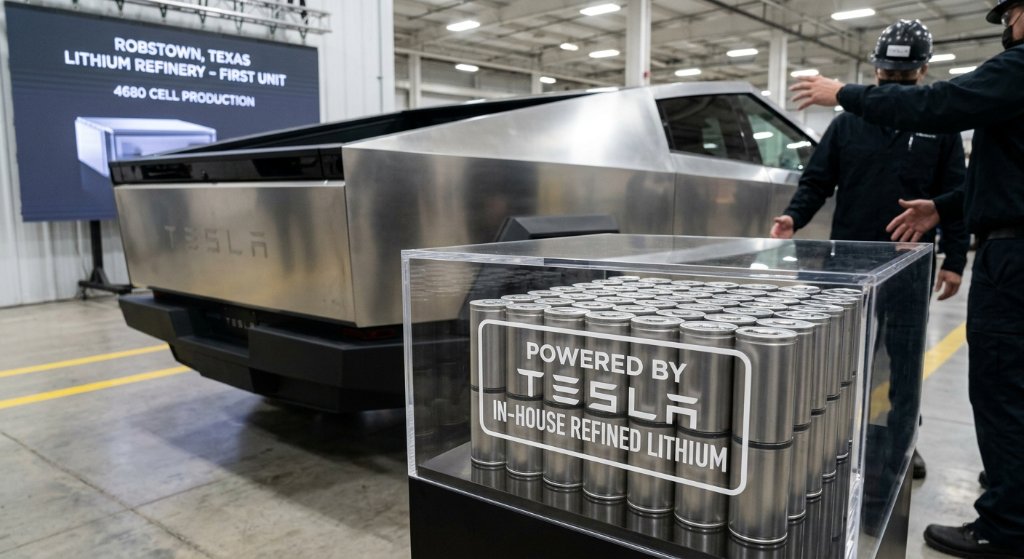
For more than a decade, the global automotive industry has functioned on a precarious assumption: carmakers design and build vehicles, while an incredibly complex, geopolitically vulnerable web of global suppliers handles the dirty work of chemical refining. Today, Tesla shattered that paradigm. On September 22, 2026, the first Cybertruck equipped with 4680 battery cells utilizing lithium refined entirely at Tesla's own Gulf Coast refinery in Robstown, Texas, rolled off the assembly line at Gigafactory Texas.
This milestone is not merely a symbolic victory; it marks the first time in automotive history that an OEM has taken direct control of the ultra-sensitive lithium refining process. In an industry where legacy players like Ford and GM are still grappling with multi-tier supplier bottlenecks and trying to secure raw materials through third-party off-take agreements, Tesla has built a localized, closed-loop supply chain that runs from raw spodumene ore to finished electric truck—all within the borders of Texas.
Behind the Robstown Refinery’s Green Innovation
The Robstown facility, located on a massive 1,200-acre site near Corpus Christi, broke ground in May 2023, commenced operations in January 2026, and achieved full ramp-up by July of this year. Unlike traditional Chinese refiners that rely on heavy chemical profiles, Tesla’s refinery is a showcase of next-generation chemical engineering.
Key technical and operational highlights of this domestic refining operation include:
- Acid-Free Alkaline Leaching: Tesla bypassed the industry-standard sulfuric acid method in favor of an alkaline leaching process. This innovation cuts chemical reagent costs by 60% and slashes CO2 emissions by roughly 30%.
- Zero-Waste Output: Instead of producing hazardous acidic tailings, the refinery's primary byproduct is anhydrite—a non-hazardous mineral that Tesla can sell directly to the construction industry.
- Massive Scale: The facility is targeted to reach an annual capacity of 30 GWh, feeding battery-grade lithium hydroxide directly to Giga Texas’s 4680 cell lines.
- Unprecedented Local Integration: With cumulative Cybertruck production having already surpassed the 100,000-unit milestone in August 2026, this domestic supply chain matches peak manufacturing throughput at the Austin plant.
Insulating Against Global Commodity Chaos
To appreciate why this matters, one only has to look at the historical volatility of the lithium market. Battery-grade lithium hydroxide is the most volatile component on an EV battery's bill of materials. Contract prices famously skyrocketed from $10 per kilogram in 2020 to an eye-watering peak of over $80 per kilogram in 2022, only to plunge below $15 per kilogram in 2024.
For legacy automakers buying refined lithium on spot markets or through rigid contracts, these pricing swings make long-term financial planning nearly impossible and wreak havoc on gross margins. By shifting the refining process in-house, Tesla essentially builds a physical hedge. The company can now absorb raw ore price swings while keeping the highly technical (and costly) refining margins entirely under its own roof, insulating itself from geopolitical disruptions and cartel-like pricing structures.
Why This Matters:
The Expert Take: Tesla’s successful integration of in-house refined lithium is a watershed moment that shifts the competitive landscape of the EV transition.
- Who Wins: Tesla and its consumer base. By cutting out midstream processing markups and transportation costs, Tesla secures a cheaper, more stable cost-per-kilowatt-hour for its 4680 cells. For the consumer, this guarantees highly competitive pricing and ensures that Tesla’s vehicles easily meet the strict domestic sourcing requirements needed to qualify for federal EV tax credits.
- Who Loses: Traditional midstream lithium refiners and legacy OEMs. Refining companies lose their pricing power and their largest prospective customer. Meanwhile, legacy carmakers are left exposed. While they are busy signing "memorandums of understanding" for future mineral rights, Tesla is already running a fully integrated domestic pipeline.
- The Market Signal: This is a clear warning to the rest of the auto industry: assembling batteries is no longer enough. To survive the impending margin squeeze of the late 2020s, automakers must become chemical processing companies. Tesla has proved that vertical integration is not just a strategic choice—it is a survival mechanism.
Looking Ahead
As Giga Texas scales up to its targeted annual capacity, the impact of the Robstown refinery will expand beyond the Cybertruck to power Tesla's next-generation platforms. By mastering the hardest part of the battery puzzle—the chemical transition from raw earth to battery-grade material—Tesla has fortified its moat, leaving legacy rivals once again scrambling to catch up.