Tesla Navigates Dual Crossroads: Robotaxi Stumbles While Grünheide Powers Up Battery Production
Tesla shares recently experienced an approximately 5% dip, a direct response to a confluence of challenging developments. The electric vehicle titan f...
Editorial Team
World Of EV
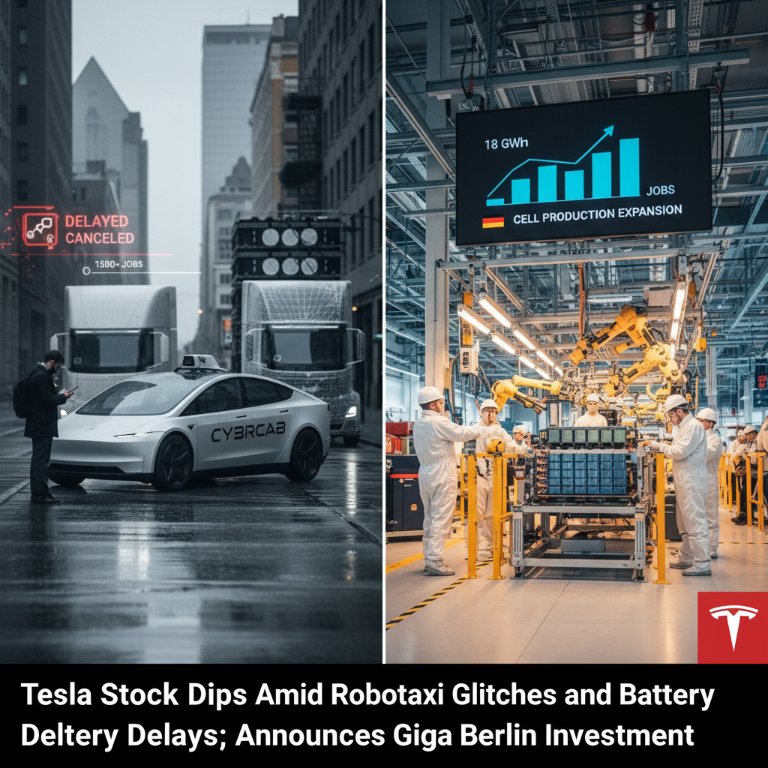
Tesla shares recently experienced an approximately 5% dip, a direct response to a confluence of challenging developments. The electric vehicle titan faces increasing scrutiny over operational glitches plaguing its nascent robotaxi services in Dallas and Houston, simultaneously grappling with critical production delays for Panasonic-supplied batteries. Yet, in a characteristic display of strategic foresight, Tesla simultaneously announced a significant investment of nearly $250 million to aggressively expand battery cell production at its Grünheide factory outside Berlin, Germany, signaling a determined push for European manufacturing independence.
Robotaxi Reality Check: Glitches Stall Autonomous Ambitions
Tesla's long-held vision of a pervasive robotaxi network, once deemed an imminent revolution, is encountering significant friction in real-world deployment. Reports detail concerning operational issues in pilot programs across Dallas and Houston, including prolonged wait times and outright cancellations. Passengers have recounted experiences where robotaxis eschewed expressways, added considerable time to routes, made incorrect turns at intersections, and even dropped off riders far from their intended destinations. One passenger in Dallas, for instance, spent nearly two hours attempting a typically 20-minute drive, navigating through 'high service demand' messages and 'no rides available nearby' before a car finally appeared with a 19-minute wait.
These challenges highlight the immense complexity of achieving true Level 4 or Level 5 autonomous driving. Despite years of development and ambitious pronouncements regarding its Full Self-Driving (FSD) software, Tesla's system remains an SAE Level 2 partial automation system, fundamentally requiring constant human supervision. This operational reality stands in stark contrast to more mature, heavily mapped, multi-sensor approaches utilized by competitors like Waymo, which has been operating robotaxi services for years with established fleets. The reported glitches risk undermining public trust and could invite further regulatory inquiries, as exemplified by past investigations into FSD performance.
Panasonic Bottleneck Threatens Tesla's 2026 Volume Ramp
Compounding the robotaxi woes are persistent production delays for Panasonic's next-generation 4680 battery cells. Panasonic has reportedly postponed the mass production of these crucial cells, citing a lack of binding purchase orders from its primary customer, Tesla. This represents a significant setback, as the 4680 cell, first unveiled at Tesla's Battery Day in 2020, was touted as a cornerstone for improved energy density and reduced manufacturing costs.
These delays directly impact Tesla's ambitious 2026 volume ramp for pivotal future products, including the eagerly anticipated Cybercab robotaxi, the heavy-duty Tesla Semi, and the utility-scale Megapack 3 energy storage systems. While Tesla has made strides in its own internal 4680 cell production, particularly with the challenging dry cathode process, the reliance on external suppliers for specific volumes, especially for large-scale deployments, remains a critical vulnerability. Panasonic has also previously faced delays in ramping up its U.S. battery facilities, underscoring the difficulties in scaling new battery technologies.
Grünheide's Giga-Boost: A Strategic Shift to European Battery Independence
In a powerful counter-move, Tesla has committed nearly $250 million to significantly expand battery cell production at its Gigafactory in Grünheide, Germany. This substantial investment aims to more than double the planned annual capacity to an impressive 18 gigawatt-hours (GWh). The expansion will also create over 1,500 new battery-related jobs, providing a substantial economic boost to the region.
This strategic investment unequivocally signals Tesla's intensified drive to localize its supply chain and reduce its reliance on Asian cell suppliers for its European operations. By bringing more battery manufacturing in-house, Tesla aims to gain greater control over costs, quality, and supply stability—a core tenet of its long-standing vertical integration strategy that has historically delivered competitive advantages. Production of these in-house cells at Grünheide is slated to begin in the first half of 2027.
Why This Matters:
This week's developments paint a clear picture of Tesla's ongoing battle on two critical fronts: the complex, software-driven pursuit of autonomous driving and the capital-intensive, hardware-focused imperative of battery manufacturing. The robotaxi glitches serve as a stark reminder that advanced autonomy remains a monumental technical and regulatory hurdle, far from the 'solved problem' once optimistically portrayed. These operational stumbles risk eroding consumer confidence in Tesla's FSD capabilities and could slow the adoption of future Cybercab services, which are critical to the company's long-term revenue projections. Investors banking on an imminent, frictionless robotaxi rollout may find themselves adjusting expectations, and existing FSD users are directly impacted by the system's current limitations.
Conversely, the Grünheide investment is a strategic masterstroke, underscoring Tesla's commitment to securing its future by doubling down on vertical integration, particularly in the most critical component of an EV: the battery. By boosting European output, Tesla not only hedges against geopolitical supply chain risks but also positions itself to potentially capitalize on regional incentives and reduce logistics complexities. This move strengthens Europe's role as a vital manufacturing hub for Tesla, creating high-value jobs and fostering regional economic growth. Panasonic, on the other hand, faces pressure as Tesla moves to lessen its dependence on external suppliers for key battery formats, a signal that dedicated suppliers need to meet aggressive production targets or risk being bypassed. This dual narrative — the frustrating reality of nascent autonomous technology juxtaposed with a determined push for manufacturing self-sufficiency — defines Tesla's current evolutionary phase. It highlights that while software promises can capture headlines, robust, localized hardware production remains the bedrock of sustainable growth and profitability in the EV landscape.
In conclusion, Tesla's journey forward is characterized by a delicate balance. The company must urgently address the shortcomings of its robotaxi services to rebuild trust and prove the viability of its autonomous vision. Simultaneously, the aggressive expansion of battery production at Grünheide is a vital, long-term play, ensuring Tesla controls its destiny by securing the fundamental building blocks of its electric future. The coming years will reveal whether the promise of software can ultimately align with the relentless demands of hardware at scale.