Tesla FSD v14.3.9 Redefines Active Safety: Your Car Will Now Take the Wheel to Evade Crashes
For years, active vehicle safety has been a binary choice: either you let the driver-assistant system take total control, or you drive manually and re...
Editorial Team
World Of EV
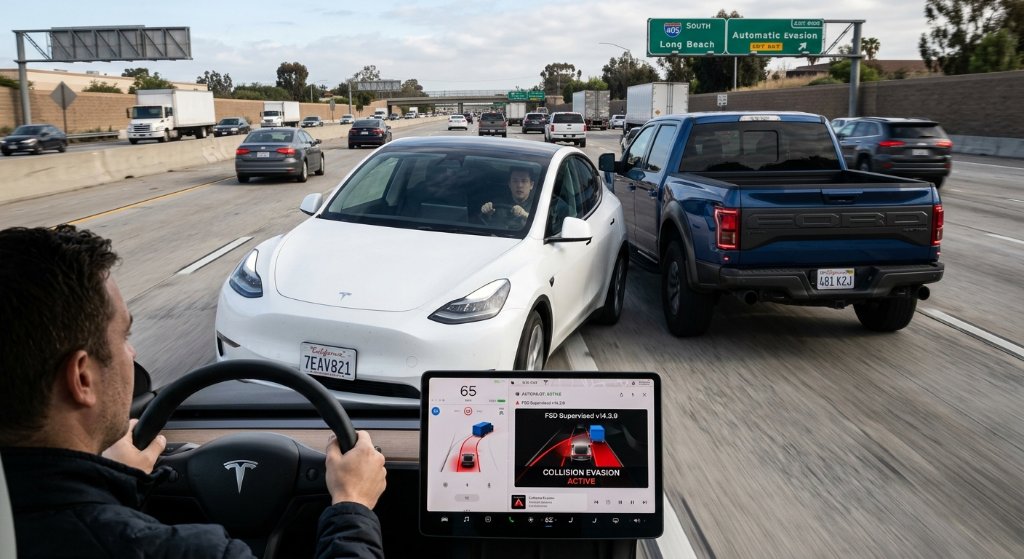
For years, active vehicle safety has been a binary choice: either you let the driver-assistant system take total control, or you drive manually and rely on basic haptic warnings and Automatic Emergency Braking (AEB) to slam the brakes right before impact. But as Tesla continues to push toward its promise of unsupervised autonomy, the EV pioneer is shifting tactics by deploying its cutting-edge AI stack as a permanent, silent guardian.
Tesla's AI team has officially commenced the rollout of Full Self-Driving (FSD) Supervised v14.3.9. The headline advancement is a paradigm shift in active safety: 'Automatic Collision Evasion'. This update allows the FSD computer to run continuously in the background during manual drives, stepping in to take directional steering control if an imminent crash is detected and traditional braking alone is insufficient.
A Silent Co-Pilot in the Background
Traditionally, FSD has operated as an 'all-or-nothing' feature. You engage it, and the car drives; you touch the steering wheel or brake, and you are back on your own. Version 14.3.9 shatters this barrier by running a slice of the v14 neural network stack as a passive safety shield. If you are driving manually and a threat materializes, the car can now seamlessly intervene.
Key triggers for this background intervention include:
- Imminent Frontal Collisions: When traditional AEB is insufficient and straight-line braking cannot prevent an impact, the system can steer into a clear adjacent lane or shoulder.
- Heavy Driver Distraction: If the cabin camera detects the driver is heavily distracted or completely checked out during a high-risk situation, the FSD system can automatically activate.
- Accidental Disengagements: If a driver accidentally turns off FSD—such as bumping the stalk during a sharp turn—the system can instantly re-engage to prevent a sudden loss of control.
The Technical Limits of Evasive Steering
While this sounds like science fiction, Tesla has put specific boundaries on this first iteration of Automatic Collision Evasion. The software is designed for extreme, highway-speed edge cases rather than everyday obstacle avoidance.
- Hardware and Speed Limits: The initial rollout of v14.3.9 is targeted primarily at AI4-equipped vehicles, requiring dry road conditions and normal steering operation at speeds under approximately 85 mph.
- Clear Path Verification: The system will only execute an evasive swerve if it detects a completely clear escape route. It is programmed not to intervene if pedestrians, cyclists, or other vulnerable road users are detected in the swerving path.
- Dynamic Maneuvering: Unlike traditional AEB, which only modulates the brakes, FSD-driven emergency evasion can simultaneously apply steering, braking, and even rapid acceleration to safely clear an obstacle.
Why This Matters:
This update is a monumental shift that completely redefines active safety standards. For years, legacy automakers have boasted about five-star safety ratings based on basic, reactive lane-keeping and emergency braking systems. Tesla is proving that AI-driven vision networks are no longer just for cruising convenience—they are the new baseline for passenger protection.
However, this is a double-edged sword that introduces a massive liability pivot. If Tesla's AI-steered vehicle swerves to avoid an obstacle but clips a guardrail or another vehicle, who is legally responsible? By allowing FSD to automatically seize control without the driver’s explicit, real-time consent, Tesla is entering uncharted legal territory. If the software suffers a 'false positive' steer—a lingering worry given Tesla's historical struggles with phantom braking and unexpected swerves—it could inadvertently cause a crash rather than prevent one.
Ultimately, the everyday driver wins with a highly sophisticated safety net that could drastically lower accident rates and insurance premiums. Conversely, traditional Tier-1 ADAS suppliers relying on legacy, non-neural-network sensors will find themselves falling even further behind in the technology race.
Guarding the Road Ahead
FSD v14.3.9 proves that the value of Tesla's massive AI investment extends far beyond the eventual promise of a robotaxi fleet. By weaving its self-driving stack into the background of manual drives, Tesla is offering a glimpse of a future where cars simply refuse to let their drivers crash. Whether the public and regulators will comfortably embrace a silent, invisible hand on the steering wheel remains the next great automotive question.