Tesla FSD v14.3.4 Unleashes AI Overhaul: Faster Reactions, Sharper Vision Accelerate Robotaxi Drive
Tesla has just rolled out software version 2026.14.6.11, a pivotal update for its Full Self-Driving (Supervised) system, bringing FSD to v14.3.4. This...
Editorial Team
World Of EV
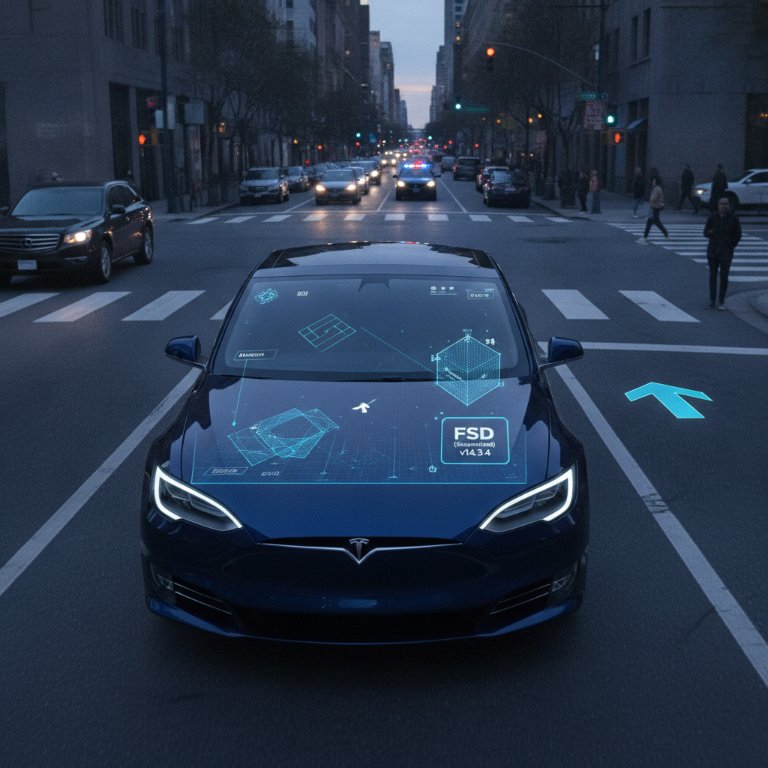
Tesla has just rolled out software version 2026.14.6.11, a pivotal update for its Full Self-Driving (Supervised) system, bringing FSD to v14.3.4. This isn't merely an incremental patch; it represents a profound architectural enhancement to Tesla’s core AI, setting the stage for significantly improved performance and a clearer pathway toward its ambitious autonomous driving goals. For years, Tesla has been at the forefront of the autonomous driving debate, often promising a future of ubiquitous self-driving cars while meticulously iterating through its 'Supervised' FSD beta program. This latest update underscores a decisive shift, doubling down on fundamental AI advancements to push the boundaries of what its vision-only system can achieve.
Neural Network Overhaul Drives Smarter Decisions
At the heart of FSD v14.3.4 lies a substantial upgrade to Tesla's neural network architecture. The company has implemented an upgraded Reinforcement Learning (RL) stage for FSD neural network training. This advancement allows the system to learn more effectively from real-world scenarios, continuously refining its decision-making processes in complex environments. Complementing this is an enhanced neural network vision encoder, designed to provide the system with a superior understanding in challenging scenarios and to construct more accurate 3D geometry of the vehicle’s surroundings. This isn't just about 'seeing' more; it's about interpreting, understanding, and predicting with greater fidelity, directly addressing long-standing challenges in perception and spatial awareness that are critical for truly autonomous operation.
MLIR Rewrite Delivers 20% Faster Reaction Times
Perhaps one of the most significant, yet technically nuanced, improvements comes from a complete rewrite of the AI compiler and runtime using MLIR (Multi-Level Intermediate Representation). This foundational engineering feat has directly resulted in a 20% faster reaction time for the FSD system. In the world of autonomous driving, milliseconds can mean the difference between smooth navigation and an intervention. This speed increase not only enhances safety and responsiveness but also facilitates quicker model iteration. For developers, a more efficient compiler and runtime means faster cycles from hypothesis to testing, dramatically accelerating the pace at which Tesla can refine and deploy new FSD capabilities. This is a testament to Tesla's commitment to optimizing its AI stack from the ground up, not just at the application layer.
Polishing the Driving Experience and Unifying the Vision
Beyond these core architectural changes, v14.3.4 addresses several user-reported issues and unifies the underlying AI model across different functionalities, showcasing Tesla's methodical approach to refinement:
- Addresses unnecessary lane biasing: Drivers often reported the system favoring one side of a lane; this update aims to center the vehicle more appropriately.
- Minor tailgating corrected: Improvements in maintaining a safer and more comfortable following distance.
- Increased decisiveness in parking: Enhanced confidence and efficiency when maneuvering into parking spaces.
- Enhanced response to emergency vehicles and rare objects: Critical for safety, this update sharpens the system's ability to identify and appropriately react to less common but high-stakes scenarios.
- Unification of the model across 'Actually Smart Summon,' FSD, and Robotaxi functionalities: This is a crucial strategic move. By unifying the underlying AI model, Tesla is building a single, robust intelligence capable of handling various driving tasks, from close-quarters summoning to full autonomous navigation, and crucially, laying the groundwork for a scalable Robotaxi service.
Why This Matters:
This FSD v14.3.4 update is far more than a routine software release; it signals a maturation of Tesla's AI stack and a significant stride in its autonomous driving journey. The investment in upgraded Reinforcement Learning and an enhanced vision encoder indicates Tesla is moving beyond reactive adjustments to foundational improvements in how its vehicles perceive and understand the world. The MLIR rewrite, delivering a 20% faster reaction time, isn't just a number; it's a game-changer for safety, confidence, and the sheer velocity of future development. This efficiency gain allows Tesla to out-iterate competitors, potentially widening the gap in autonomous capabilities.
Who Wins? Tesla owners with FSD subscriptions will likely experience a tangible improvement in the system's fluidity, reliability, and human-like driving characteristics, increasing the perceived value of their investment. Tesla, as a company, significantly benefits from a more robust and faster-iterating AI platform, accelerating its path to revenue-generating Robotaxi services. This update reinforces Tesla's position as an AI company first and foremost, leveraging its massive data advantage.
Who Loses? Competitors in the autonomous driving space, particularly traditional OEMs attempting to build or acquire similar capabilities, face increased pressure. Tesla’s integrated, vision-first, and now significantly optimized AI approach sets a high bar, making it harder for those relying on disparate sensor suites or less mature AI architectures to catch up in terms of development speed and real-world performance.
This update is a clear market signal: Tesla is not wavering from its vision-centric, AI-driven strategy. It’s a statement that their bet on neural networks and end-to-end learning is paying dividends, and they are executing on the fundamental engineering required to bring full autonomy to fruition. While not a 'do-or-die' moment, it's a powerful accelerant, affirming that Tesla’s competitive edge extends far beyond battery technology to its sophisticated and rapidly evolving software and artificial intelligence capabilities.
Conclusion:
FSD v14.3.4 represents a substantial leap forward for Tesla's autonomous driving ambitions, driven by core AI advancements in perception, processing speed, and model unification. While 'Supervised' remains the operative term, these foundational improvements bring the long-promised Robotaxi vision closer into focus, potentially setting new benchmarks for the entire automotive industry. The race for true autonomy is far from over, but with this update, Tesla has significantly boosted its lead, demonstrating a potent combination of cutting-edge AI research and rapid engineering execution.