Tesla FSD Supervised Logs 20 Million Kilometers in Europe: A New Era of Autonomous Adoption
Tesla's Full Self-Driving (FSD) Supervised system has achieved a significant milestone, accumulating over 20 million kilometers (approximately 12.4 mi...
Editorial Team
World Of EV
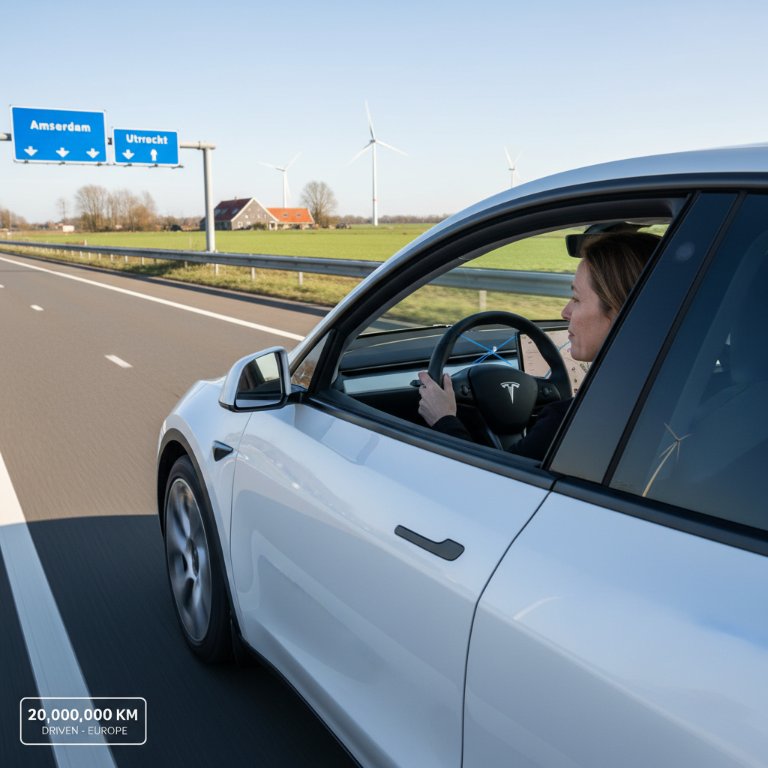
Tesla's Full Self-Driving (FSD) Supervised system has achieved a significant milestone, accumulating over 20 million kilometers (approximately 12.4 million miles) driven by owners in the Netherlands and Lithuania as of May 23, 2026. This rapid accumulation of real-world data underscores a pivotal moment for Tesla's advanced driver-assistance system, particularly as it gains traction in new European markets.
Historically, Tesla's FSD journey has been characterized by ambitious promises and incremental rollouts, primarily in North America. The system, while continually evolving, has faced scrutiny and required active driver supervision at all times. The recent regulatory approvals in the Netherlands on April 10, 2026, and in Lithuania on May 20, 2026, have unlocked a substantial new frontier for FSD Supervised, demonstrating a clear acceleration in its deployment and usage across the continent.
Rapid European Expansion Fuels Data Avalanche
The pace of adoption in these newly approved regions is nothing short of remarkable. The FSD Supervised system achieved its second 10 million kilometers in an astonishing 18 days, averaging approximately 555,555 kilometers (around 345,000 miles) daily. This surge highlights a pent-up demand and keen interest among European EV enthusiasts and prospective buyers who have eagerly awaited the system's arrival.
- Netherlands Approval: April 10, 2026
- Lithuania Approval: May 20, 2026
- Total Mileage: Over 20 million km (12.4 million miles) as of May 23, 2026
- Recent Accumulation Rate: Second 10 million km in 18 days, averaging ~555,555 km/day
This extensive real-world usage in diverse European driving conditions provides an invaluable dataset for Tesla's artificial intelligence models. Such a massive influx of driving scenarios, traffic patterns, and environmental variables is crucial for refining the system's capabilities, enhancing its safety features, and pushing towards greater levels of autonomy.
Why This Matters:
This achievement is far more than just a numerical milestone; it signals a fundamental shift in the landscape of autonomous driving, particularly within Europe. For Tesla, it validates their strategy of a data-centric development approach, proving that with regulatory green lights, their system can scale rapidly and collect critical real-world information at an unprecedented rate. This data advantage is paramount, allowing Tesla to iterate and improve FSD Supervised faster than many competitors who might rely on more simulation-heavy or geographically limited testing.
Who Wins? Clearly, Tesla is a primary winner, solidifying its position as a leader in advanced driver-assistance systems. The company gains immense data, potential new revenue streams from FSD subscriptions in Europe, and a powerful marketing tool. Early adopters in the Netherlands and Lithuania also win, gaining access to a highly advanced system that promises convenience and, eventually, a path to greater autonomy. The broader EV industry stands to gain from the precedent set, potentially accelerating regulatory pathways for other manufacturers' advanced systems.
Who Loses? Competitors who have been slower to develop or deploy their own advanced ADAS solutions, especially those with more conservative regulatory strategies, face increased pressure. Furthermore, regulatory bodies across other European nations may find themselves compelled to accelerate their review processes as neighboring countries embrace the technology, potentially losing ground if they remain overly cautious.
This rapid adoption and accumulation of mileage signal to the market that Europe is increasingly open to advanced driver-assist technologies. It underscores that with appropriate regulatory frameworks, real-world deployment can scale quickly, providing valuable insights and accelerating the entire industry's progress towards safer and more automated vehicles. This isn't just a Tesla moment; it's a bellwether for the future of mobility on the continent.
As FSD Supervised continues its expansion, the continuous feedback loop of real-world driving data will be critical. This milestone is not an endpoint but rather a powerful indicator of the accelerating trajectory of Tesla's autonomous ambitions and the broader evolution of self-driving technology in Europe. The coming months will undoubtedly reveal further advancements and regulatory discussions as this technological wave continues to build across the continent.