Tesla Ends a Nine-Year Wait: Roadster 'Go For Launch' Scheduled for October 1 in Waco, Texas
Nine years after Elon Musk famously rolled a red prototype out of the back of a Semi cabin and promised a revolution in electric performance, Tesla is...
Editorial Team
World Of EV
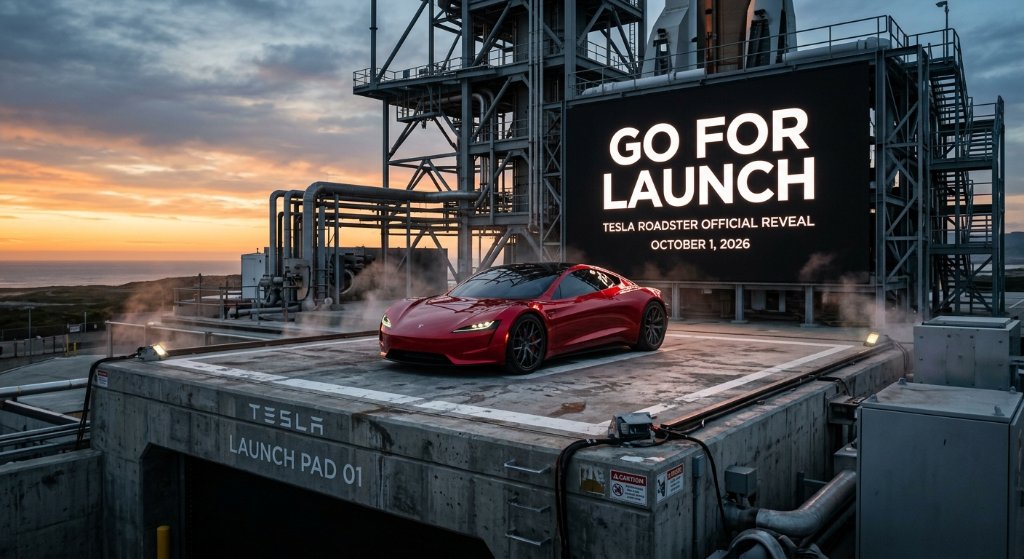
Nine years after Elon Musk famously rolled a red prototype out of the back of a Semi cabin and promised a revolution in electric performance, Tesla is finally preparing to show its hand. On September 12, 2026, the automaker dropped a bombshell promotional campaign featuring the second-generation Roadster bathed in rocket-launch style lighting on a simulated launchpad. Captioned simply "Go for launch" and stamped with the date "10.01", a concurrent countdown clock on Tesla's website confirms that October 1, 2026, is indeed the day the world will finally see what this legendary EV can do.
To further cement that this isn't just another vaporware tease, Tesla has already sent out formal invitations to reservation holders for an exclusive event in Waco, Texas—conveniently situated just down the road from SpaceX’s McGregor engine test facility. For early adopters who laid down massive $50,000 to $250,000 deposits nearly a decade ago, this announcement represents a mix of immense relief and intense curiosity.
Shattering the Laws of Physics with SpaceX Thrusters
The focal point of the upcoming October demonstration is undoubtedly the vehicle's long-rumored, highly-debated "SpaceX Package." Rather than relying solely on traditional rubber-to-asphalt traction, the Roadster is expected to leverage technology borrowed directly from aerospace engineering.
- Cold-Gas Thrusters: Using ultra-high compressed air pumped up to 10,000 psi, the system will utilize multiple thrusters integrated seamlessly into the body of the car.
- Sub-One-Second 0-60 MPH: Musk has recently claimed that the thruster-boosted Roadster will conquer the 0-60 mph sprint in under 1.0 second, a figure that defies modern tire physics.
- The "Hover" Demonstration: Reports suggest Tesla plans to demonstrate a brief "flying" or hovering capability. Because of the sheer force and noise of the cold-gas thrusters, this demo will reportedly be operated remotely without a human driver inside.
- Ground-Effects Tech: In addition to thrusters, Tesla’s patented adaptive aerodynamics could use high-powered fans to create a vacuum seal under the chassis, keeping the vehicle glued to the road like the record-breaking McMurtry Spéirling.
Overcoming a Decade of Broken Promises
For Tesla, the road to the second-generation Roadster has been littered with missed deadlines and shifting corporate priorities. Initially slated for a 2020 production start, the Roadster was repeatedly sidelined as Tesla pivoted its resources toward high-volume manufacturing (Model 3 and Model Y), the Cybertruck, and more recently, autonomous robotaxis and AI.
Indeed, this single year has seen multiple shifted dates, from an April Fool’s joke "demo" that never materialized, to late April, to August, and now finally to October 1. Critics and high-profile reservation holders, including tech reviewer Marques Brownlee and OpenAI's Sam Altman, have previously expressed frustration, with some canceling their orders entirely. By placing the reveal in Waco near McGregor, Tesla is putting its engineering credibility on the line to prove the wait was worth it.
Why This Matters:
This is much more than the release of another fast electric car; it is a critical defining moment for Tesla’s identity and its engineering legacy. Lars Moravy, Tesla’s VP of Vehicle Engineering, has described the next-gen Roadster as the "swan song" of human-driven cars—the ultimate driver’s machine before the industry transitions fully to autonomous robotaxis.
- The Winners: Tesla's brand prestige and the patient reservation holders who didn't pull their deposits. Successfully executing a thruster-assisted launch and hover demo instantly re-establishes Tesla as the undisputed leader in EV performance innovation, leaving premium traditional competitors like Porsche, Rimac, and Ferrari scrambling to keep pace.
- The Losers: Skeptics who dismissed the SpaceX package as science fiction, and high-performance rivals like Rimac (whose Nevera recently claimed acceleration records) who are about to see their physics-defying benchmarks eclipsed by rocket tech.
- The Strategic Signal: This event is Tesla’s way of saying it has not lost its magic. In a market increasingly crowded with highly capable, low-cost Chinese EVs and premium European electric sports cars, the Roadster serves as the ultimate "halo car." It shifts the narrative from incremental manufacturing improvements back to jaw-dropping, boundary-pushing technology. If Tesla can pull off a successful demo on October 1, it proves that the company still possesses the unmatched audacity that built its empire.
Conclusion
If the October 1 launch delivers on its promise of cold-gas thrusters, gravity-defying acceleration, and actual hover capabilities, Tesla will have successfully rewritten the automotive playbook. But in the high-stakes world of electric hypercars, a demo is only half the battle. The true test will be whether Tesla can transition this highly complex, aerospace-adjacent vehicle from a spectacular Texas showpiece to a street-legal production reality.