Tesla and Sunrun Unleash Record-Breaking 580-Megawatt Virtual Power Plant to Save California’s Grid
On the evening of September 9, 2026, California’s electricity grid faced a severe heat wave that threatened to trigger rolling blackouts. Rather than ...
Editorial Team
World Of EV
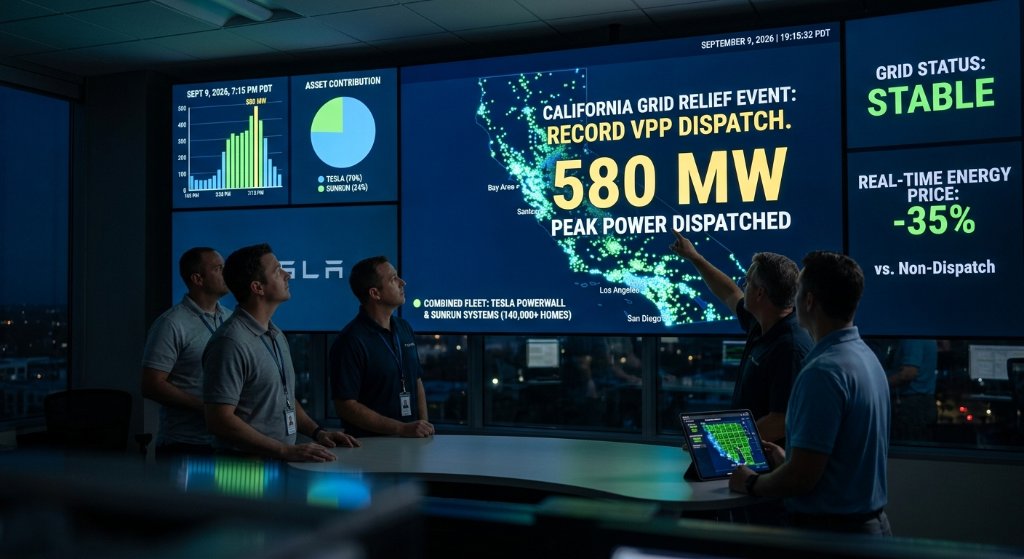
On the evening of September 9, 2026, California’s electricity grid faced a severe heat wave that threatened to trigger rolling blackouts. Rather than firing up dirty, expensive fossil-fuel "peaker" plants, the state relied on a massive, invisible network of residential clean energy: a historic virtual power plant (VPP) coordinated by Tesla and Sunrun. The two companies pooled the resources of over 140,000 home batteries to dispatch a record-breaking 580 megawatts (MW) of peak power directly into the grid.
This monumental dispatch represents the largest residential VPP event in history, proving that distributed energy resources are no longer just a niche backup solution for tech-savvy homeowners. For years, critics of solar and storage argued that home batteries couldn’t operate at a scale large enough to impact utility-level operations. On September 9, Tesla and Sunrun quieted those skeptics, proving that an ecosystem of distributed batteries can out-perform traditional peaker plants while lowering real-time wholesale energy prices for everyone.
Unpacking the 580-Megawatt Power Drop
The logistics behind this historic event showcase the sheer scale that Tesla and Sunrun have achieved in the residential energy market:
- The Fleet Size: More than 140,000 home batteries participated in the three-hour evening dispatch window.
- The Powerwall Dominance: Roughly 110,000 Tesla Powerwalls accounted for the vast majority of the output, delivering 517 MW.
- Sunrun's Key Role: Sunrun owned or operated 55% of those participating Powerwalls, while also dispatching over 30,000 additional home batteries from other manufacturers to kick in another 63 MW.
- Real-World Impact: The 580 MW output matches the peak power needs of every single household in Sacramento County.
The defense of the grid didn't stop there. On the following evening, September 10, Southern California Edison requested another three-hour dispatch. Tesla and Sunrun responded by delivering an additional 140 MW of peak power. According to the companies, if both nights’ dispatch fleets had been called on simultaneously, they would have sent a staggering 720 MW to the grid.
The Mechanics of a State-Level VPP
To understand the significance of this event, we must look at how it differs from previous efforts. In July 2025, Pacific Gas and Electric (PG&E) conducted what was then the largest VPP test, drawing an average of 535 MW from 100,000 batteries over a two-hour window. The September 9, 2026 event was not a scheduled test; it was an emergency, real-world deployment prompted by soaring energy demand and extreme heat. It utilized 40% more batteries and operated over a longer, three-hour window.
The event was triggered automatically when the California Independent System Operator's (CAISO) day-ahead locational marginal price surged past $200 per megawatt-hour. The dispatch was coordinated through two crucial California programs:
- Demand Side Grid Support (DSGS): A California Energy Commission program designed to incentivize voluntary load reduction and clean energy dispatch during grid stress.
- Emergency Load Reduction Program (ELRP): A CPUC program that pays battery owners to feed stored energy back into the grid when demand spikes.
Why This Matters:
This record-breaking event signals a profound shift in how the modern electrical grid will operate. Here is our expert take on what this means for consumers, automakers, and the broader energy market:
- The Impending Death of the 'Peaker' Plant: Historically, utilities had to maintain expensive, highly polluting natural gas "peaker" plants that only turn on during the hottest days of the year. This VPP event proved that a network of clean home batteries can step in and do the same job instantly—without the emissions. For utilities, VPPs represent a massive cost-saving tool that mitigates the need to build new gas infrastructure.
- A New Revenue Stream for EV and Clean Tech Owners: For consumers, a battery is no longer just insurance against blackouts; it is an active asset. Under programs like ELRP and DSGS, homeowners receive direct financial compensation for the power they share. This changes the return-on-investment (ROI) calculation for solar-and-storage setups. According to a report by the Brattle Group, expanding VPP programs could save California utility customers up to $206 million annually in net system costs by 2028.
- Tesla’s Evolution Beyond Automobiles: While most of the public views Tesla as a car manufacturer, this event underscores Elon Musk's long-standing vision of Tesla as a decentralized energy utility. The company's energy storage division is scaling rapidly, and the Powerwall is the undisputed backbone of this transition. By coupling solar panels, stationary batteries, and eventually Vehicle-to-Grid (V2G) EV technology, Tesla is building an ecosystem moat that traditional automakers—who are lagging severely in the energy storage space—cannot easily replicate.
- The Blueprint for the Future of EVs: The massive success of this 580 MW dispatch is only a preview of what is to come. If 140,000 stationary home batteries can stabilize California’s grid, imagine the potential when millions of electric vehicles with bidirectional charging capabilities are plugged in. The EV in your garage will transition from an energy drain into a dynamic grid stabilizer, unlocking a multi-gigawatt virtual power plant nationwide.
Conclusion
The September 9, 2026 dispatch is a watershed moment for clean energy. It has proved beyond a doubt that distributed residential batteries can safeguard a massive electrical grid during a climate-induced crisis. As extreme weather events become more frequent, the partnership between homeowners, software, and utilities will define the next generation of energy infrastructure. The age of the central, fossil-fueled power plant is winding down—and the era of the decentralized, consumer-powered grid has officially arrived.