Tesla Accelerates Global FSD Push with Unified European Software and Imminent Australian Launch
Tesla is making significant strides in its global Full Self-Driving (FSD) ambitions, marked by a critical software unification in Europe and a strong ...
Editorial Team
World Of EV
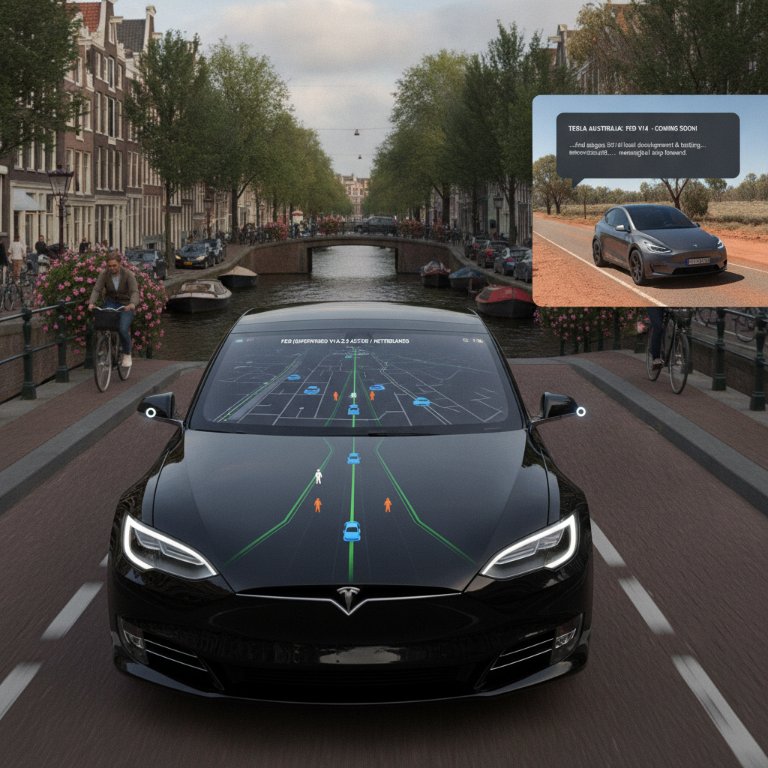
Tesla is making significant strides in its global Full Self-Driving (FSD) ambitions, marked by a critical software unification in Europe and a strong hint of an imminent Hardware 4 FSD launch in Australia. These developments signal a maturing of Tesla's autonomous driving technology and a concerted effort to broaden its availability beyond North America, addressing long-standing market demands and regulatory complexities.
On June 6, 2026, Tesla initiated the rollout of FSD (Supervised) version 14.2.2.6 to vehicles in the Netherlands, integrated within the 2026.17.5 software update. This is not merely a regional expansion; it represents a pivotal strategic move for the European market. Simultaneously, Australian customers received tantalizing email communications suggesting that FSD Supervised version 14 for Hardware 4 vehicles is on the cusp of release, promising a 'meaningful step forward in performance and capability' for the region. This dual-front progress underscores Tesla's commitment to refining and expanding its sophisticated driver-assistance system globally, a journey that has seen its share of technological hurdles and regulatory scrutiny.
A Unified Software Approach for Europe
The most impactful aspect of the European rollout is the merging of Tesla’s FSD and Spring Update branches into a single installation for FSD subscribers across the continent. Historically, FSD subscribers in Europe have often found themselves on a separate software branch, leading to potential delays in receiving general vehicle improvements and a sometimes-fragmented user experience. This unification promises several key benefits:
- Streamlined Development: Consolidating software branches simplifies Tesla's internal development and testing processes, potentially leading to faster and more consistent updates across the entire vehicle fleet.
- Enhanced User Experience: European FSD subscribers can now expect to receive general vehicle improvements and FSD updates in a more cohesive package, eliminating the staggered releases that have sometimes characterized the European FSD experience.
- Improved Stability: A unified codebase often leads to better stability and fewer potential conflicts between different software features, as the entire system is developed and tested as a single entity.
Australia Gears Up for Hardware 4 FSD
While Europe enjoys a refined software delivery, Australian Tesla owners, particularly those with newer Hardware 4 vehicles, are on the brink of a significant FSD upgrade. The email hints suggest that FSD Supervised version 14 is in its final stages of local development and testing. This is particularly exciting given the capabilities of Hardware 4, Tesla’s latest generation of autonomous driving computer, which boasts:
- Enhanced Processing Power: Hardware 4 offers substantially greater computational power, crucial for handling the complex real-time data processing required for advanced FSD features.
- Improved Camera Suite: With upgraded camera sensors, Hardware 4 vehicles can theoretically perceive their surroundings with greater clarity and range, leading to more robust and reliable decision-making by the FSD system.
- Future-Proofing: Launching FSD on Hardware 4 in Australia positions these vehicles at the forefront of Tesla's autonomous technology, likely enabling them to receive future advancements more readily.
Why This Matters:
This latest wave of FSD news isn't just about regional availability; it signals a critical inflection point for Tesla's long-term autonomous driving strategy. The unification of software branches in Europe is a pragmatic move that simplifies Tesla's engineering efforts and directly addresses previous frustrations from its European customer base regarding update consistency. This move should accelerate FSD feature parity and stability across the continent, directly impacting user satisfaction and potentially boosting subscription rates. Tesla wins by streamlining its operations and improving customer perception in a vital market. The customer wins with a more integrated and reliable software experience.
The impending Australian Hardware 4 FSD launch is equally significant. Australia presents unique driving conditions and regulatory environments, and a successful deployment there would demonstrate the adaptability and scalability of Tesla's FSD system to diverse global contexts. For industry professionals, this indicates Tesla's increasing confidence in FSD's underlying architecture, particularly how it leverages the superior processing capabilities of Hardware 4 to tackle more complex driving scenarios. It also puts pressure on competitors in the ADAS space, especially those still grappling with Level 2+ system deployments, as Tesla continues to push the boundaries of what's available to consumers, albeit under 'supervised' conditions. This is a crucial step towards validating Tesla’s technology for broader international adoption, moving past the primarily North American focus that has defined much of its FSD journey.
These strategic rollouts highlight Tesla's continued, albeit cautious, expansion of FSD (Supervised) globally. The unification in Europe addresses past software fragmentation, while the Australian Hardware 4 push leverages the company's latest technological advancements. As Tesla continues to navigate regulatory landscapes and refine its AI, these steps are crucial in cementing its position as a leader in automotive autonomy and moving closer to the fully autonomous future it envisions.