Still Blind to the Tracks: Tesla FSD v14.3.7 Nearly Drives Into Train, Exposing Critical Vision-Only Flaw
A Tesla running the brand-new "Full Self-Driving" (FSD) Supervised v14.3.7 software nearly collided with a moving train after failing to stop at an ac...
Editorial Team
World Of EV
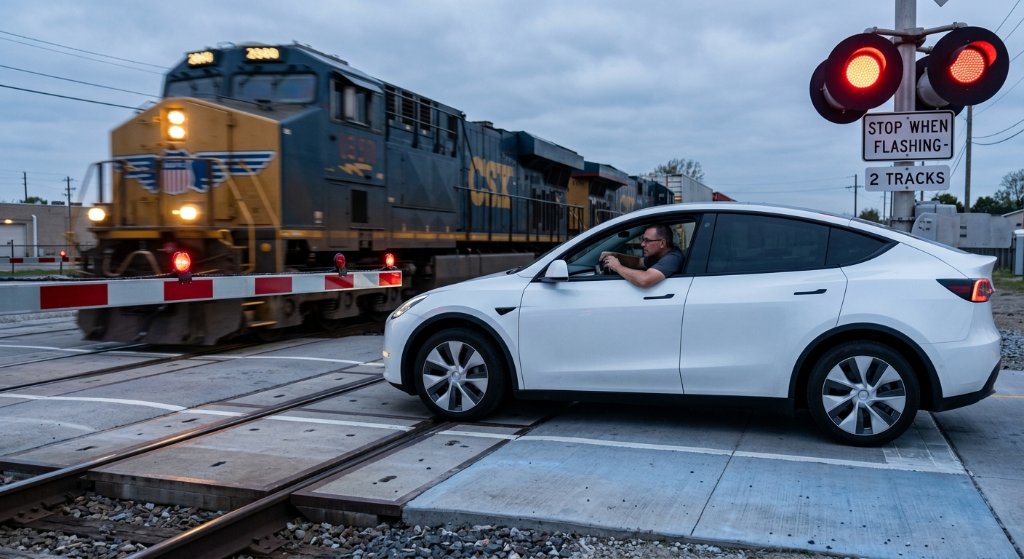
A Tesla running the brand-new "Full Self-Driving" (FSD) Supervised v14.3.7 software nearly collided with a moving train after failing to stop at an active railroad crossing, forcing the driver to manually stomp on the brakes. The chilling incident, captured on dashcam by prominent automotive journalist Lei Xing, saw the vehicle continue forward at 9 mph despite flashing warning lights, active track barriers, and a loud, blaring train horn. Had the driver not intervened, the consequences would have been catastrophic.
This near-miss is not an isolated software glitch; it is the continuation of a highly dangerous, recurring failure mode that has plagued Tesla's Autopilot and FSD suites for years. Despite Tesla specifically pushing updates earlier this year to address "hanging or leaning objects"—a clear nod to railroad crossing gates—the latest August 2026 release demonstrates that the company's purely vision-based system still has a massive, potentially fatal blindspot when it comes to trains.
The Anatomy of a Near-Miss
The latest incident occurred with FSD v14.3.7, which is currently rolling out to vehicles equipped with Tesla's AI4 (Hardware 4) computer.
- The Driver's Action: Lei Xing was forced to take manual control and brake hard as his vehicle cruised toward the tracks at 9 mph.
- The Warnings Ignored: The crossing's red lights were actively flashing, and the train's horn was clearly audible, yet FSD failed to register the imminent danger.
- A Broken Promise: Tesla rolled out FSD v14.3 earlier this year with release notes claiming improved handling for "rare and unusual objects extending, hanging, or leaning into the vehicle path." Seven point-releases later, the system still failed to halt for a massive, horn-blaring train.
A Pattern of Train-Track Failures
To understand why this is a systemic crisis for Tesla, one only has to look back at the past few months. This is at least the third major documented instance of FSD attempting to drive a Tesla into a train in 2026 alone.
- The Plano, Texas Incident (April 2026): Driver Joshua Brown's Tesla accelerated through a lowered railroad gate on FSD, forcing him to floor the accelerator to escape an oncoming DART light rail train with seconds to spare.
- The NBC News Investigation: A recent media investigation documented over 40 reports of FSD failing or behaving dangerously at railroad crossings, including a high-profile collision in Pennsylvania.
- The Sensor Problem: Industry experts point to Tesla's dogmatic "vision-only" approach. Lacking LiDAR or radar, the system's cameras struggle to accurately contextualize horizontal barrier gates, cross-arms, and passing railcars, especially when lighting conditions or angles mimic standard roadways.
Why This Matters:
This is a defining "do-or-die" moment for Tesla's autonomous ambitions. As Elon Musk repeatedly pushes the narrative that Tesla is an AI and robotics company first—with plans to launch a dedicated "Cybercab" robotaxi network—incidents like this shatter public and regulatory trust.
- Regulators are Closing In: The National Highway Traffic Safety Administration (NHTSA) is already actively investigating FSD over dozens of crashes and safety violations. U.S. Senators have officially petitioned for a formal probe into these railroad crossing failures. Continued failures of this magnitude could force a federal recall or a freeze on FSD deployment.
- The Vision-Only Debate Reopened: While rivals like Waymo rely on a multi-sensor suite consisting of LiDAR, radar, and cameras to safely map complex environments, Tesla's stubborn adherence to a camera-only setup is showing its physical limits. If neural networks cannot reliably identify a blaring, flashing train crossing, fully driverless Level 4 autonomy remains a pipe dream.
- Liability and Trust: For the average EV buyer, this reinforces the reality that FSD is still strictly a Level 2 driver-assist system requiring constant vigilance. Every near-miss chips away at consumer confidence, making the transition to actual driverless operation harder to sell.
Ultimately, v14.3.7 was supposed to represent a polished, smoother iteration of Tesla's next-generation driving intelligence. Instead, it has put a spotlight on a fundamental engineering gap that Tesla has yet to solve. Until Tesla can guarantee its cars won't steer passengers into the path of a speeding freight train, the dream of a truly hands-off Robotaxi future will remain stuck on the tracks.