Software Over Battery Size: HERE-SBD Index Reveals Why the Next Wave of EV Buyers Will Be Won on Data, Not Range
The global electric vehicle transition is entering its most critical phase, moving past tech-forward early adopters to target skeptical, pragmatic mai...
Editorial Team
World Of EV
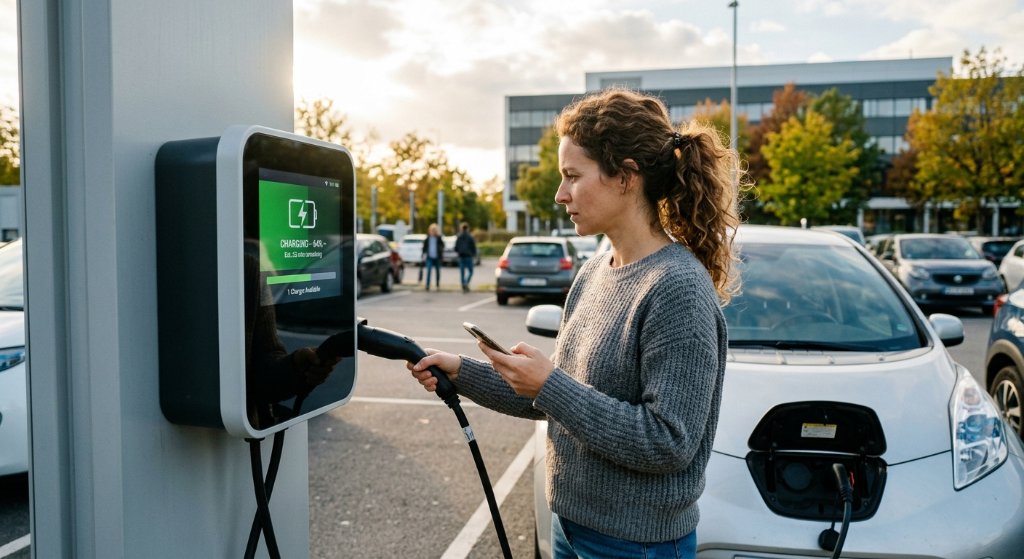
The global electric vehicle transition is entering its most critical phase, moving past tech-forward early adopters to target skeptical, pragmatic mainstream buyers. According to the newly released HERE-SBD EV Index 2026—which surveyed over 4,000 drivers worldwide—the industry is sitting on a massive opportunity: 27% of internal combustion engine (ICE) owners are increasingly open to going electric. However, actually converting this group depends entirely on conquering the "final frontier" of EV adoption: the charging experience.
For years, automakers operated under the assumption that cramming larger, heavier batteries into vehicles was the ultimate antidote to range anxiety. But as the market matures, the definition of anxiety has evolved. It is no longer just about how far an EV can drive on paper; it is about the utter unpredictability of what happens when the state of charge drops. The 2026 Index shows that winning over ICE drivers and retaining current owners requires a fundamental pivot from hardware to real-time software.
Precision Over Projection: The Demand for Accurate Range Math
Current EV owners surveyed in the index made it clear that their daily satisfaction is heavily tied to the vehicle's brain. Specifically, they demand highly accurate range calculations to eliminate on-road anxiety. For too long, legacy automakers have relied on crude estimation algorithms—colloquially dubbed "guess-o-meters"—that fail to account for real-time factors like elevation changes, headwind, cabin climate control, or battery degradation. When Volkswagen launched its ID.4 and Ford introduced the Mustang Mach-E, early software iterations left drivers guessing about their true range during highway stints. To bridge this gap and win over the remaining 27% of ICE holdouts, the next generation of EVs must offer:
- Dynamic Range Modeling: Cloud-based algorithms that integrate external environmental variables (such as ambient temperature, wind speed, and topography) in real-time.
- Battery Preconditioning Integration: Software that automatically warms or cools the battery packs (similar to Tesla’s highly optimized thermal management or BYD’s Blade battery system) ahead of a charging stop to ensure maximum charging speeds upon arrival.
- Adaptive Driving Style Tracking: Vehicle software that learns individual driver behaviors, such as aggressive highway acceleration, to constantly refine and personalize range predictions.
Ending Charger Roulette with Real-Time Data
The second non-negotiable demand from drivers is access to reliable, real-time charger availability data. It is a frustratingly common scenario: an EV driver arrives at a high-speed charger only to find a queue three cars deep, a broken screen, or an "ICE'd" spot occupied by a gasoline vehicle. According to the HERE-SBD survey, solving this relies heavily on rich, up-to-the-minute data pipelines.
To combat this "charger roulette," automakers and charging networks must collaborate on several key fronts:
- Live Occupancy Tracking: Seamless API integrations between charging operators (like Electrify America, ChargePoint, and EVgo) and in-car navigation systems to show exactly how many stalls are currently occupied.
- Functional Status Verification: Instant, automated reporting of broken plugs, software glitches, or reduced charging power directly to the driver’s screen before they route to the station.
- Seamless Reservation Capabilities: Future software integrations that allow drivers to temporarily reserve a charging stall as they approach, ensuring zero wait times.
Why This Matters:
This shifting dynamic signals a massive paradigm shift in the EV race. For the last decade, Tesla dominated the industry largely because it treated the vehicle as a connected computer on wheels and built a vertically integrated, proprietary Supercharger network. While legacy giants like Ford and GM are desperately trying to match this by adopting Tesla's NACS connector and outsourcing software via Google Built-in, the HERE-SBD Index proves that a physical plug standard is only half the battle.
The real winners of this next era will be the automakers who successfully master software-defined vehicles (SDVs). Companies that treat software as an afterthought will suffer catastrophic losses. If an OEM relies on lagging, third-party navigation systems that cannot communicate with the battery or the charger, their customers will quickly retreat to the safety of hybrid or ICE platforms. This is a do-or-die moment for legacy auto; they must either rapidly develop robust software ecosystems or risk permanently alienating the very 27% of gas car buyers who are currently sitting on the fence.
Ultimately, the HERE-SBD EV Index 2026 proves that the path to mass EV adoption is paved with data, not just asphalt and copper. As charging infrastructure slowly expands, the vehicle's ability to intelligently navigate that infrastructure will define the ownership experience. Automakers who can turn raw data into peace of mind will capture the mainstream market; those who cannot will watch their electric ambitions stall out.