Software-Defined Survival: PwC Forecasts BEVs Will Claim 30% of Global Production as AI Takes the Wheel
The automotive landscape is undergoing its most radical transformation in a century. PwC’s inaugural Global Automotive Outlook—which surveyed 720 auto...
Editorial Team
World Of EV
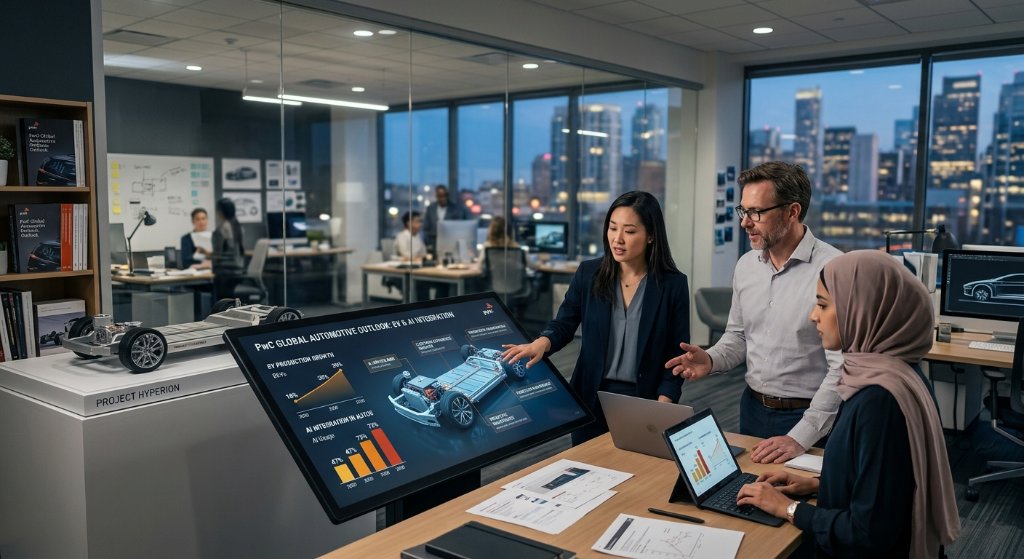
The automotive landscape is undergoing its most radical transformation in a century. PwC’s inaugural Global Automotive Outlook—which surveyed 720 automotive executives across 33 countries—has drawn a line in the sand. The report reveals a stark truth: the future of transportation isn’t just electric; it is software-defined and heavily automated.
For years, legacy giants like Toyota and Volkswagen treated software as an afterthought, outsourcing code while focusing on stamping metal. This allowed Tesla and rapid Chinese disruptors like BYD and Xiaomi to capture the high-tech high ground. Now, facing an aggressive transition, the global auto industry is scrambling to rewrite its playbook to avoid being left behind.
The Electric Surge: BEVs Set to Claim 30% of Global Production
Despite recent mainstream media narratives of a cooling electric vehicle market, the PwC report paints a highly bullish picture for the medium term. Over the next five years, battery electric vehicles (BEVs) are projected to grow from 18% to 30% of global vehicle production volume. This massive shift is driven by three key factors:
- Production Volume Expansion: A near-doubling of BEV production share as gigafactories scale worldwide.
- Regulatory Mandates: Stringent emission rules in Europe and regional US regulations forcing OEMs to convert assembly lines.
- Falling Battery Costs: Rapid advancements in Lithium Iron Phosphate (LFP) and upcoming solid-state chemistries making EVs price-competitive with internal combustion engine (ICE) vehicles.
The AI Revolution: From 47% to 72% Adoption by 2030
Building an electric powertrain is only half the battle. To cope with rising competition and shifting mobility expectations, automotive companies are aggressively prioritizing digital software and AI. Executive usage of these advanced technologies is projected to skyrocket from 47% today to 72% by 2030.
This digital pivot is manifest in several key operational areas:
- Accelerated R&D: Utilizing generative AI to slash vehicle development cycles from the traditional five years down to less than 24 months.
- Software-Defined Vehicles (SDVs): Migrating from hundreds of isolated microcontrollers to centralized computer architectures that allow for robust over-the-air (OTA) updates.
- New Revenue Streams: Transitioning from one-time transactional sales to recurring monthly subscriptions for advanced driving assistance systems (ADAS) and digital cabin features.
Why This Matters:
This report signals the definitive end of the ‘wait-and-see’ era for legacy automakers. The transition is no longer a slow-burning evolution; it is a fast-paced software race.
Who Wins: Agile, tech-first manufacturers like Tesla, Rivian, and Chinese powerhouses (BYD, Li Auto, Xiaomi). These companies possess centralized electronic architectures and software-native engineering teams, allowing them to iterate instantly.
Who Loses: Legacy OEMs that fail to reform their organizational silos. We’ve already seen the devastating impact of software struggles, such as Volkswagen’s CARIAD division delaying critical Porsche and Audi EV rollouts. Companies that continue to rely on bloated tier-one supplier software integrations will find themselves with uncompetitive, obsolete vehicles.
The Market Signal: For consumers, this shift means vehicles will get smarter, safer, and more integrated into their digital lives. For the industry, it is a do-or-die moment. Automakers must transform into tech companies that happen to build hardware, or they will be reduced to low-margin contract manufacturers.
Looking Ahead
PwC's inaugural outlook underscores that the automotive industry is crossing a point of no return. By 2031, nearly one in three vehicles rolling off global production lines will be fully electric, powered by highly sophisticated AI brains. The question is no longer whether the electric, software-defined vehicle will dominate, but which of today's automotive titans will survive to see it happen.