Slowing to a Crawl: How Tesla’s Drastic FSD Scaling Retreat Signals an Investor Crisis of Faith
For nearly a decade, Tesla CEO Elon Musk has pitched a near-future where millions of privately owned Teslas would double as income-generating robotaxi...
Editorial Team
World Of EV
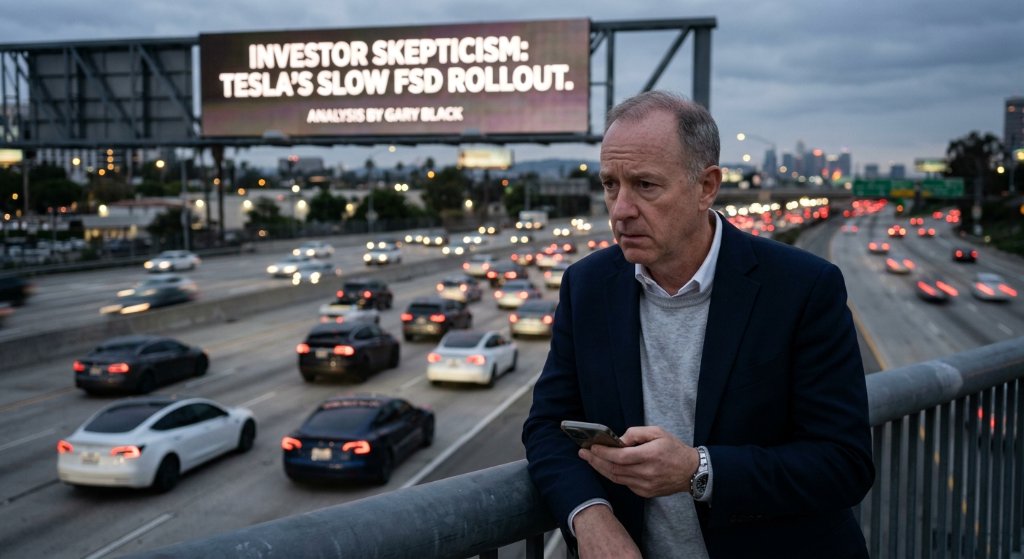
For nearly a decade, Tesla CEO Elon Musk has pitched a near-future where millions of privately owned Teslas would double as income-generating robotaxis while their owners slept. It was a vision of absolute disruption that justified Tesla's nosebleed-inducing market valuation. But as 2026 rolls on, that grand vision is colliding with a cold, hard operational reality.
Prominent investor and Future Fund partner Gary Black recently sounded the alarm, highlighting that Tesla is quietly but drastically scaling back its unsupervised Full Self-Driving (FSD) and Robotaxi rollouts. Far from the exponential expansion promised to Wall Street, the company’s autonomous dreams are facing a sharp bottleneck—sparking a quiet crisis of confidence among even its most ardent institutional backers.
The Math of a Slowdown: Shifting Timelines and Missed Targets
The retreat is most clearly visible in how Tesla has iteratively revised its deployment velocity. What was once heralded as a rapid, nationwide takeover has been systematically downgraded to a cautious trickle:
- The Original Late-2025 Target: Tesla initially set an ambitious goal to have its unsupervised FSD and Robotaxi services accessible to half of the U.S. population by the end of 2025.
- The Fallback Plan: When that deadline slipped, the guidance pivoted to a target of "doubling the active fleet size month-over-month".
- The Current Reality: According to Tesla's AI Chief, Ashok Elluswamy, the current target has crawled down to a mere 10% weekly growth rate of the unsupervised fleet.
This drastic deceleration reveals the sheer difficulty Tesla is experiencing in moving from "supervised" FSD (which still requires an alert human driver to intervene) to truly "unsupervised" autonomy, where the car operates entirely on its own.
A Goliath Fleet vs. David's Test Batch: The Scale Disparity
While Tesla champions its massive fleet of millions of consumer vehicles gathering driving data, its actual pool of unsupervised, driverless validation vehicles is shockingly small. This stands in stark contrast to the market leader, Alphabet's Waymo:
- Tesla’s Unsupervised Fleet: Tesla currently operates a minuscule fleet of only 90 to 100 driverless test vehicles operating without safety drivers in limited test markets like Austin.
- Waymo's Active Fleet: In contrast, Waymo has over 4,000 active, safety-driverless robotaxis deployed on public roads across major metro areas, completing upwards of 500,000 paid passenger trips per week.
- The Validation Bottleneck: By relying on so few driverless assets, Tesla struggles to actively validate the safety of its vision-only neural networks in the real world. Investors are increasingly skeptical that a 100-car fleet can collect enough high-quality data to solve the final, treacherous "0.001%" of driving edge cases.
Why This Matters:
This is a defining crossroads for Tesla, shifting the narrative from a hardware-and-software juggernaut to a company caught in a self-inflicted validation bottleneck.
Who Wins? Alphabet’s Waymo is the undisputed beneficiary. Waymo’s multi-sensor approach—utilizing highly calibrated Lidar, radar, and cameras—was once mocked by Musk as an expensive crutch. Today, Waymo is aggressively capitalizing on its lead, prepping the mass deployment of its cheaper, 6th-generation "Ojai" platform built by Zeekr. Legacy ride-hailing networks like Uber are also winning by cementing partnerships with established AV players, leaving Tesla locked out of the immediate commercial loop.
Who Loses? Tesla and its premium retail investors. The company’s trillion-dollar-plus valuation is fundamentally predicated on solving autonomy. If Tesla cannot scale unsupervised FSD, it is valued as an automotive manufacturer facing slowing global EV demand, rather than a high-margin AI software powerhouse.
Furthermore, the legal and public relations risks are paralyzing. As Gary Black rightly pointed out, even a single high-profile accident involving a driverless Tesla would generate devastating headlines, risking regulatory crackdowns that could freeze the program entirely. Tesla's conservative 10% weekly ramp suggests that management is privately terrified of the liability of their vision-only system, choosing slow-walked validation over aggressive market penetration.
Conclusion:
Tesla’s pivot to a highly conservative, slow-growth model for its unsupervised FSD program is a sobering reality check for the EV industry. While Elon Musk continues to champion the absolute dominance of "pure vision" neural nets, the massive execution gap between Tesla’s 100 test vehicles and Waymo’s 4,000 active robotaxis is becoming impossible for Wall Street to ignore. If Tesla cannot find a way to safely break through its validation bottleneck and scale, it risks permanently losing the autonomous race to rivals who prioritized rigorous engineering over viral promises.