Show Us the Pedals: NHTSA Challenges Tesla’s Bold Cybercab ‘Self-Certification’ with Looming Sworn Deadline
Tesla (TSLA) shares slipped over 3% today, closing in on a high-stakes federal showdown. The National Highway Traffic Safety Administration (NHTSA) ha...
Editorial Team
World Of EV
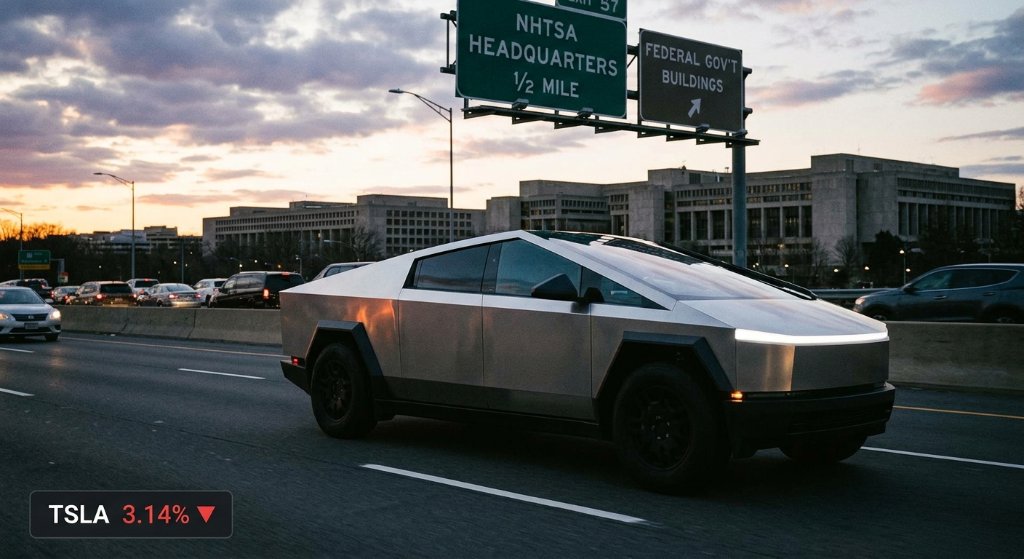
Tesla (TSLA) shares slipped over 3% today, closing in on a high-stakes federal showdown. The National Highway Traffic Safety Administration (NHTSA) has backed the electric vehicle giant into a corner, issuing a formal Special Order demanding that Tesla prove, under oath, how its newly deployed, control-free Cybercab robotaxi complies with current safety regulations. With a hard deadline of September 30, the agency is taking direct aim at Tesla’s controversial decision to "self-certify" a vehicle built entirely without a steering wheel, pedals, or mirrors.
This federal pressure comes just weeks after Tesla began commercial Cybercab operations in Austin, Texas on September 3, immediately triggering a government audit. Historically, autonomous vehicle developers like Amazon’s Zoox have meticulously petitioned for regulatory exemptions under Part 555—which permits testing and deploying driverless vehicles but strictly caps fleet sizes at 2,500 units per year. Bypassing this conservative route entirely, Tesla chose to self-certify the Cybercab as fully street-legal right out of the gate, attempting to unlock unlimited manufacturing scale. Now, that aggressive regulatory gamble has hit a massive federal wall.
The FMVSS Paradox: Safety Rules Written for Humans
The core conflict lies in the rigid nature of the Federal Motor Vehicle Safety Standards (FMVSS). Established decades ago, these federal mandates were explicitly written under the assumption that a human driver is at the controls. By deploying a vehicle built entirely without physical driver interfaces, Tesla has run headfirst into regulatory language it simply cannot self-interpret away:
- The Foot-Brake Mandate: FMVSS 135 explicitly dictates that a vehicle’s service brakes must be activated "by means of a foot control". The Cybercab, by design, features no pedals.
- The Mirror Requirement: FMVSS 111 mandates physical driver-side and interior rearview mirrors. Because the Cybercab relies solely on Tesla’s camera-based Autonomous Driving System (ADS), it lacks these physical mirrors.
- The "Inoperative" Threat: Regulators are actively questioning whether Tesla temporarily attached physical steering wheels and pedals during safety testing to pass standard compliance, only to remove them before public deployment—a move that could violate federal laws prohibiting automakers from making mandatory safety features "inoperative".
The Price of Silence: Demands, Deadlines, and Sworn Affidavits
What started on September 3 as a routine Audit Query (AQ26002) has rapidly escalated. The NHTSA's Special Order, signed by Chief Counsel Peter Simshauser, represents a powerful legal weapon that forces Tesla's legal team to verify its responses under a sworn affidavit.
- The September 30 Deadline: Tesla has only days left to answer 21 detailed technical questions defending its self-certification strategy.
- $139 Million in Jeopardy: Failing to provide fully truthful, comprehensive answers by the deadline exposes Tesla to crushing civil penalties of up to $139 million, alongside potential criminal liabilities for filing false statements under oath.
- Operations on the Line: If the NHTSA deems Tesla’s self-certification invalid, the federal agency has the authority to halt Cybercab operations in Austin and order a full recall of the vehicles.
Why This Matters:
This is a critical, make-or-break regulatory moment for Tesla's entire autonomy narrative. By opting to self-certify instead of seeking a Part 555 Exemption, Tesla attempted an audacious regulatory shortcut. The company's goal was clear: bypass the 2,500-vehicle annual limit that shackles competitors like Zoox, allowing Tesla to immediately scale its driverless fleet to millions of units. But the NHTSA has effectively called Elon Musk’s bluff, reminding the industry that self-certification is not a blank check to ignore the letter of the law.
The Winners and Losers:
- The Losers: Tesla’s near-term scaling ambitions and TSLA shareholders. If Tesla is forced to back down and apply for standard Part 555 exemptions, the Cybercab's rollout will be severely throttled, delaying the "unlimited robotaxi" profit model that Wall Street has already baked into the stock's premium valuation.
- The Winners: Legacy AV operators like Alphabet's Waymo and Amazon's Zoox. By playing strictly by the regulatory book, these companies have built a legally sound, if slower-scaling, foundation. Tesla's regulatory scramble validates their patient, compliant approach to public road testing.
This federal clash signals to the broader EV and AV markets that the regulatory "Wild West" era of autonomous driving is officially over. Even as the federal government works on rewriting safety standards to accommodate driverless tech, the existing, human-centric rules remain the law of the land. Tesla’s attempt to force the feds' hand has backfired into a legal crucible that will determine whether the Cybercab can legally drive on public roads—or remains an expensive science project restricted to private test tracks.
Tesla's looming September 30 deadline is far more than a routine compliance check; it is a defining test of the company's aggressive, boundary-pushing corporate ethos. How Tesla answers the NHTSA's 21 questions will determine the financial and operational trajectory of the Cybercab. If Tesla cannot defend its self-certification under oath, the dream of a rapid, steering-wheel-free robotaxi revolution may be put on ice, forcing the automaker to redesign its platform or accept crippling fleet caps.