Rivian’s Next-Gen LiDAR R2 Arrives in Late 2026—But Only If You’re on the Payroll
When Rivian first unveiled its next-generation Gen 3 autonomy platform, it sent shockwaves through the electric vehicle landscape. By ditching off-the...
Editorial Team
World Of EV
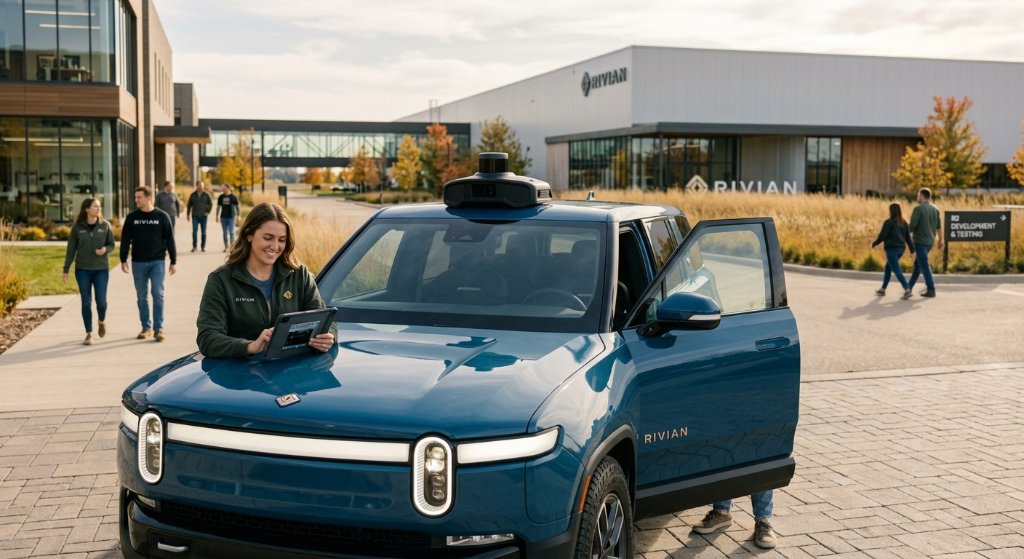
When Rivian first unveiled its next-generation Gen 3 autonomy platform, it sent shockwaves through the electric vehicle landscape. By ditching off-the-shelf Nvidia chips in favor of its custom-built RAP1 (Rivian Autonomy Processor 1) silicon and adding an ultra-precise, low-cost LiDAR sensor, the California-based EV maker drew a sharp line in the sand. This was not just a minor software upgrade; it was a multi-modal, hardware-backed assault on Tesla’s vision-only Full Self-Driving (FSD) approach.
But for eager reservation holders waiting to get their hands on the LiDAR-equipped R2 SUV, the latest update comes with a bitter-sweet twist. Rivian has confirmed that while the highly anticipated RAP1 and LiDAR-equipped R2 models will start shipping in late 2026, those early builds are going exclusively to Rivian employees. Public reservation holders and regular retail customers will have to wait until 2027 to receive these upgraded models. Meanwhile, current Gen 2 owners can look forward to a massive point-to-point autonomous driving software rollout scheduled to remain on track for late 2026.
The Power of RAP1: Silicon Made for 'Physical AI'
At the heart of this upcoming rollout is Rivian’s custom-designed RAP1 chip, a 5nm processor built in partnership with Arm. It powers the Gen 3 Autonomy Compute Module (ACM3) and represents a massive leap over the dual NVIDIA Drive Orin processors (which put out roughly 250 TOPS) found in current Gen 2 R1 vehicles.
Here is what makes the new hardware platform a game-changer:
- Insane Compute Muscle: The dual-chip setup delivers an astonishing 1,600 sparse INT8 TOPS of AI compute, designed to handle billions of pixels per second.
- Sensor Fusion with LiDAR: Unlike Tesla’s camera-only strategy, Rivian integrates a sleek, forward-facing LiDAR sensor seamlessly into the R2’s roofline.
- Drastically Lower Costs: Rivian has brought down the cost of this LiDAR sensor to 'a few hundred dollars,' down from thousands of dollars just a few years ago, protecting vehicle margins.
- Vertical Integration Margin Boost: Designing the RAP1 chip in-house means Rivian keeps the margins rather than paying third-party chipmakers like Nvidia.
The Employee Fleet Strategy: A Smarter Beta Test?
The decision to restrict initial RAP1-equipped R2 deliveries to employees is a classic, albeit frustrating, automotive strategy. By using its own workforce as a closed-loop testing fleet, Rivian can iron out manufacturing quirks, stress-test the custom silicon, and gather real-world data in a controlled manner before shipping to paying customers in 2027.
For reservation holders who might feel sidelined, there is a silver lining. Current Gen 2 owners of R1 and early R2 platforms won't be left behind in the software department. Rivian’s point-to-point autonomous software rollout remains strictly on track for late 2026, utilizing the existing vision-and-radar setup to deliver Level 2+ hands-free capabilities.
Why This Matters:
This is a calculated, high-stakes gamble for CEO RJ Scaringe’s team. On one hand, delaying retail deliveries of the LiDAR-equipped R2 until 2027 is a setback. It risks frustrating early reservation holders who are cross-shopping the R2 with the refreshed Tesla Model Y or other upcoming mid-size EV crossovers. However, as legacy OEMs have learned the hard way with half-baked EV launches, releasing unfinished autonomy hardware to the public is a brand-killer.
The real story here is the technology war. By pairing 1,600 TOPS of custom silicon with a low-cost LiDAR, Rivian is positioning itself as the ultimate anti-Tesla. While Elon Musk insists that cameras alone are enough, Rivian is building a 'ground-truth' multi-modal safety net. Using an internal employee fleet to perfect this system before the 2027 public launch ensures that when the retail R2 with LiDAR drops, it will be robust, safe, and ready to challenge the status quo. If they pull this off, Rivian secures its place at the vanguard of the software-defined vehicle era. If they stumble, the delay gives competitors a massive head start.
Ultimately, Rivian’s employee-first strategy for its flagship RAP1 autonomy computer and LiDAR-equipped R2 is a mature, safety-focused decision. While retail reservation holders will have to exercise patience until 2027, the dual-track strategy—keeping Gen 2 point-to-point software on schedule for late 2026 while rigorous internal testing refines the next-gen hardware—is exactly the kind of disciplined engineering that defines a long-term industry leader.