Rivian’s $5 Billion Georgia Mega-Plant Charges Ahead: How a 300,000-Vehicle Capacity Boost Redefines Its EV Survival Strategy
Ground is officially breaking in Social Circle, Georgia, as Rivian's $5 billion, 16-million-square-foot manufacturing campus moves into vertical const...
Editorial Team
World Of EV
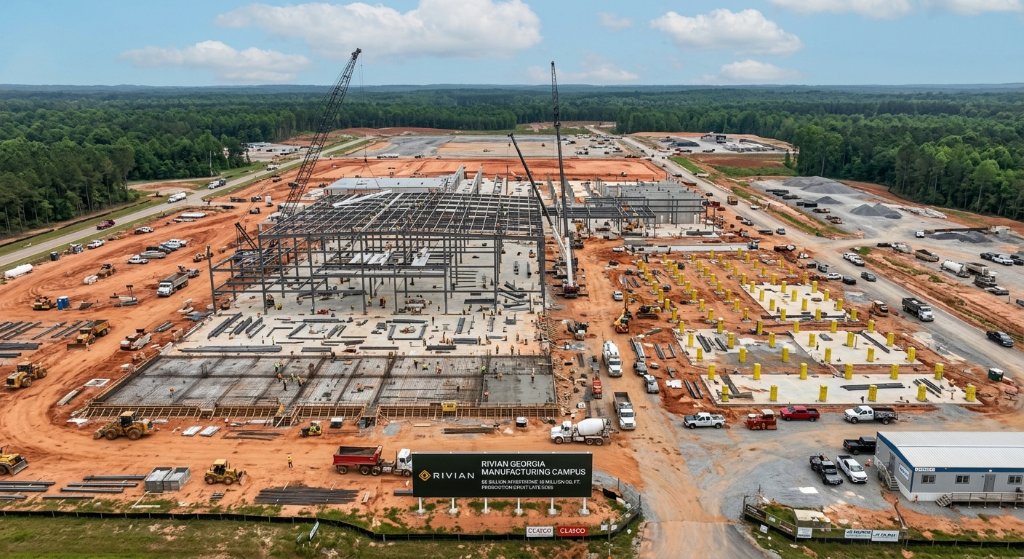
Ground is officially breaking in Social Circle, Georgia, as Rivian's $5 billion, 16-million-square-foot manufacturing campus moves into vertical construction. Lead contractors Clayco and JE Dunn are currently pouring foundations and erecting steel, marking a dramatic resurrection for a project that once looked like a casualty of the EV market correction.
This progress represents a masterclass in strategic pivots. In early 2024, Rivian shocked the industry by pausing the Georgia plant to conserve precious cash, electing instead to launch its high-stakes, more affordable R2 SUV at its existing facility in Normal, Illinois. Now, armed with a restructured plan and a modified federal loan, the Georgia mega-factory is charging ahead toward a late 2028 production start with a massive capacity upgrade.
Inside the 300,000-Vehicle Mega-Factory
Rather than scaling up slowly, Rivian has consolidated its build plan into a single, highly efficient first phase. The facility will now debut with an annual production capacity of 300,000 vehicles—a 50% increase from the originally planned 200,000 units. By compressing the factory’s footprint and accelerating capacity up front, Rivian intends to drastically lower the per-unit cost of its next-generation vehicles.
Key details of the Georgia facility include:
- Massive Footprint: A 16-million-square-foot campus spread across 2,000 acres in Stanton Springs North, Georgia.
- Aggressive Timeline: Vertical construction is underway, with buildings slated to rise through 2027, clearing the way for equipment installation and a late 2028 production start.
- Next-Gen Platforms: The facility will serve as the primary hub for Rivian's midsize platform, including the upcoming R2 SUV, the R3 crossover, and the highly anticipated R3X performance variant.
- Robotaxi Ambitions: Under a newly minted partnership with Uber, the plant is also expected to produce purpose-built robotaxis to scale ride-hailing fleet operations.
Smarter Debt and Subterranean Milestones
The physical progress on-site is matched by a restructured financial foundation. Rivian successfully renegotiated its U.S. Department of Energy (DOE) loan down to $4.5 billion, from the conditional $6.6 billion announced in late 2024. By optimizing the plant's design into a single-phase build, Rivian reduced its ultimate debt load while pulling its first loan draw forward to early 2027—a year ahead of schedule.
Currently, heavy machinery is excavating the subterranean foundations for two massive metal stamping presses. This area is the most capital-intensive and technically challenging component of the campus. Once the stamping presses are anchored, the remaining manufacturing structures will rise simultaneously, transforming the Georgia red clay into a state-of-the-art EV hub.
Why This Matters:
This is a defining "do-or-die" moment for Rivian. By boosting initial capacity to 300,000 vehicles in Georgia, Rivian is targeting a combined corporate capacity of 515,000 units (when added to the 215,000-unit capacity in Normal, Illinois). This is the exact critical mass Rivian needs to achieve positive free cash flow and graduate from a promising startup into a self-sustaining automotive powerhouse.
The Winners:
- Prospective EV Buyers: A massive production footprint guarantees shorter wait times and lower MSRPs for the highly anticipated, affordable R2 and R3 models.
- The Georgia Economy: The project secures 7,500 direct jobs by 2030, injecting billions into the regional economy and cementing the state's status as a premier EV manufacturing hub.
The Losers:
- Legacy Automakers: Legacy brands struggling to transition to dedicated EV platforms now face a highly focused, high-volume competitor operating with optimized margins.
- Tesla: While the Model Y remains the king of the midsize EV segment, a scaled-up, lower-cost Rivian R2 built in a state-of-the-art Southern plant presents the most credible threat to Tesla's market dominance yet.
The Market Signal:
This isn't just a construction update; it's a declaration of solvency and ambition. Wall Street has long worried about Rivian's capital burn. By shrinking its DOE debt, pulling funding forward, and scaling phase-one capacity, CEO RJ Scaringe has shown that Rivian can play defensively with cash while building an incredibly aggressive offensive capability.
As vertical construction progresses in Georgia, Rivian is laying the physical and financial foundations for its next decade. If the company can successfully navigate the complexities of this massive build-out, the late-2028 launch of the Georgia campus will represent the precise moment Rivian matures into a true mass-market player, permanently reshaping the American electric vehicle landscape.