Rivian Unleashes Production Power: Georgia Plant Capacity Soars to 300,000, R2 SUV Poised for Mass Market Domination
Rivian, the ambitious American EV manufacturer, is significantly escalating its production capabilities, announcing a monumental 50% increase in the i...
Editorial Team
World Of EV
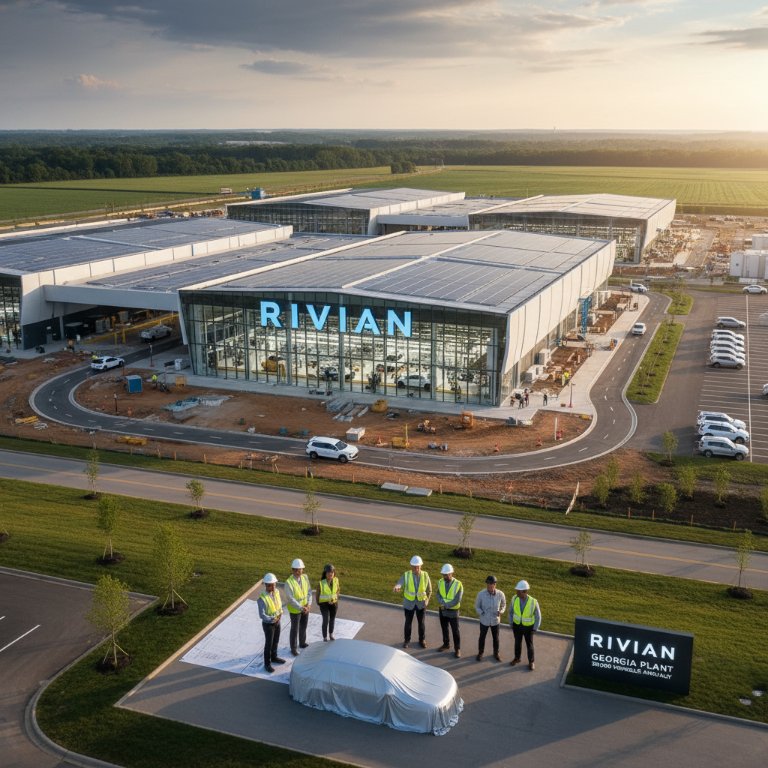
Rivian, the ambitious American EV manufacturer, is significantly escalating its production capabilities, announcing a monumental 50% increase in the initial annual capacity for its new Georgia manufacturing facility. This strategic move, boosting the target from 200,000 to an impressive 300,000 vehicles, signals Rivian's aggressive pivot toward mainstream market dominance with its upcoming R2 SUV. The expansion, backed by an updated loan of up to US$4.5 billion from the U.S. Department of Energy, aims to unlock critical cost efficiencies and pave the way for substantial future growth.
Since its inception, Rivian has captivated the market with its premium R1T pickup and R1S SUV, carving out a niche in the adventure lifestyle segment. However, scaling production and achieving profitability in the competitive EV landscape have presented ongoing challenges. This latest announcement positions the R2 as the linchpin in Rivian's strategy to move beyond its luxury offerings and truly compete in the high-volume mid-size SUV category, a crucial step for the company's long-term viability.
Georgia Plant: A New Hub for High-Volume EV Production
Rivian's Stanton Springs North, Georgia, facility is rapidly transforming into a cornerstone of its manufacturing strategy. The substantial increase in planned initial production capacity underscores the company's commitment to large-scale output.
- Initial planned capacity: 200,000 units annually.
- New initial target capacity: 300,000 units annually – a 50% increase.
- Location: Stanton Springs North, Georgia.
- Vehicle to be produced: The highly anticipated R2 SUV.
- Production slated to begin: Late 2028.
This optimized, single-phase build-out is designed to immediately lower per-unit costs, strengthening operating leverage and providing a robust foundation for subsequent expansion.
Federal Backing Fuels Rivian's Scalability and Cost Strategy
The U.S. Department of Energy (DOE) is playing a pivotal role in de-risking Rivian's ambitious expansion. The updated loan agreement, while revised from an initial $6.6 billion, provides significant capital to propel the Georgia plant's development.
- Partnership with the U.S. Department of Energy.
- Updated loan facility of up to US$4.5 billion.
- Primary goals: Enhance cost efficiency and provide substantial room for future growth.
This federal backing highlights a shared vision for strengthening American manufacturing competitiveness and solidifying the nation's leadership in the rapidly evolving EV industry.
The R2: Rivian's Pivot to the Mainstream (and Beyond)
The R2 SUV is not just another model; it represents Rivian's critical entry into a broader, more accessible market segment. CEO RJ Scaringe has tantalizingly hinted at unannounced variants of the R2, suggesting a broader product family built on this mid-size platform.
- Primary production vehicle: The R2 SUV, designed to be price-competitive with gas-powered equivalents.
- R2 production at the Georgia plant to commence in late 2028.
- CEO RJ Scaringe has alluded to future, unannounced variants of the R2 platform, potentially including a pickup truck and an R2X performance model.
This strategy mirrors Rivian's successful R1 platform, which spawned both the R1T pickup and R1S SUV, indicating a clear path to leveraging the R2 architecture for diverse offerings.
Why This Matters:
This announcement is far more than a simple production adjustment; it's a profound strategic recalibration for Rivian. For years, Rivian has navigated the complexities of launching a new automotive brand, establishing a premium identity with the R1 series. While critically acclaimed, the R1s are high-priced, and scaling their production has proven capital-intensive and challenging for profitability. The R2 changes that equation entirely.
- Who Wins? Rivian is the clear winner here, charting a credible course toward profitability and market relevance beyond its niche. EV enthusiasts and prospective buyers will also benefit from a potentially more affordable and widely available Rivian product. The U.S. manufacturing sector also gains, with significant job creation and strengthened domestic EV production capabilities.
- Who Loses? Established players in the mid-size EV SUV segment, such as the Tesla Model Y, Ford Mustang Mach-E, and offerings from Hyundai and Kia, will face an intensified competitive landscape. Legacy automakers struggling with their own EV transitions will find themselves further pressured by Rivian's aggressive scaling.
- What Does This Signal? This move unequivocally signals Rivian's commitment to volume production and, crucially, to achieving cost efficiency. The DOE loan, even with its revised figure, demonstrates significant governmental confidence in Rivian's long-term vision and its contribution to American clean energy goals. It also highlights the R2's pivotal role as Rivian's 'Model 3 moment' – a mass-market vehicle designed to unlock scale and sustainable growth.
- Is This a Do-or-Die Moment? Absolutely. The R2's success is paramount. The R1 platform proved Rivian could build desirable EVs, but the R2 must prove it can build them profitably and at scale. This expanded Georgia facility, combined with the significant federal loan, is a massive bet on the R2's ability to drive Rivian into the black and establish it as a formidable force in the broader EV market.
Conclusion:
Rivian's dramatic increase in Georgia plant capacity marks a decisive turning point in its journey. By supercharging its R2 production goals and leveraging substantial federal backing, the company is making an unequivocal statement: it intends to be a major force in the global EV transition. As the late 2028 production start draws closer, all eyes will be on Rivian to execute this ambitious plan, potentially reshaping the competitive landscape of the mid-size electric SUV market and solidifying its place as a key player in the future of mobility.